

India-China economic ties don't reflect their might

Core Issue:
India and China are major global growth engines, together accounting for nearly 40% of global GDP and almost half of the world’s population, yet their economic relationship is marked by trade asymmetry, investment stagnation, supply-chain dependence and security concerns.
1. Trade Imbalance
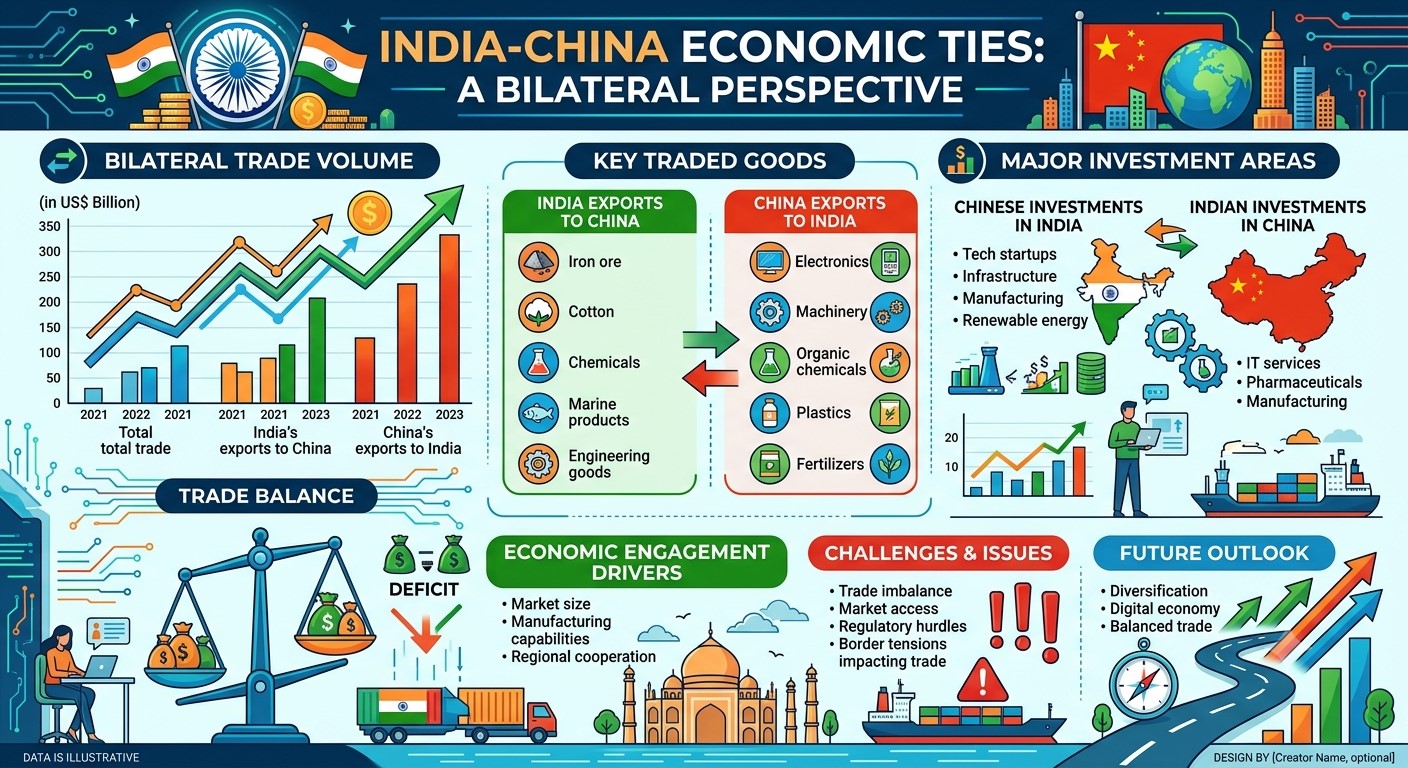
- 2025–26 bilateral trade: $151.1 billion, with China re-emerging as India’s largest trading partner.
- India’s exports: $19.47 billion
- Imports from China: $131.63 billion
- Trade deficit: $112.16 billion, a historic high.
- India mainly exports iron ore, marine products, cotton and other relatively lower-value goods, while importing telecom equipment, electronics components, machinery and organic chemicals.
- Thus, the relationship reflects high trade volume but unequal trade value and limits India’s movement up the value chain.
2. Investment Gap
- Chinese FDI in India remains limited, reportedly around $2.51 billion (0.32% of total inflows, 2000–2026).
- India remains cautious about Chinese capital because of national-security concerns, particularly in sensitive sectors.
- March 2026: India reportedly amended Press Note 3 (2020) to permit investments involving up to 10% Chinese beneficial ownership through the automatic route, aimed at easing supply-chain bottlenecks.
- However, strategic sectors such as power grids, AI and EV infrastructure continue to face greater scrutiny.
3. Security–Trade Nexus
The 2020 Galwan clash created a major trust deficit and strengthened India’s “security-first” approach.
- Restrictions/bans on 200+ Chinese apps, including TikTok and WeChat, demonstrated that India is willing to prioritise security over economic convenience.
- Chinese investments are scrutinised more closely in sensitive sectors.
- Therefore, unlike a purely market-driven relationship, geopolitics directly shapes India-China economic ties.
Supply-Chain Paradox
China remains deeply embedded in Indian manufacturing.
- China accounts for a significant share of Indian imports of electronics, machinery and organic chemicals.
- Chinese intermediate inputs are important for electronics, pharmaceuticals, renewable energy and other manufacturing sectors.
- Hence, Make in India creates a paradox: India needs Chinese components in the short term to build manufacturing capacity that can reduce dependence in the long term.
Economic Survey 2023–24: Rather than complete decoupling, India could integrate selectively with Chinese supply chains and use them to strengthen domestic manufacturing and exports.
Strategic Comparison
|
India |
China |
|
Large domestic market + services |
Global manufacturing hub |
|
Manufacturing transition |
Export-oriented manufacturing |
|
PLI and selective protection |
Subsidy-supported exports |
|
Major importer from China |
Major supplier to India |
|
Cautious Chinese investment |
Aggressive global investment/BRI |
Way Forward
- De-risk, not completely decouple from China.
- Diversify through the China+1 strategy.
- Develop domestic components, technology and R&D, not merely final assembly.
- Improve Indian export access to China.
- Attract FDI from Japan, South Korea, Taiwan, Europe and other partners.
- Protect critical technologies and infrastructure.
- Institutionalise border stability to build economic confidence.
Conclusion
India-China economic relations represent “Armed Peace and Managed Dependency”—high economic interdependence coexisting with strategic mistrust. The relationship can reflect the true economic potential of both countries only through greater market access, balanced trade, resilient supply chains and sustained border stability.
