

India Electric Mobility Index (IEMI) 2025

Source: The Hindu
India Electric Mobility Index: Purpose and Framework
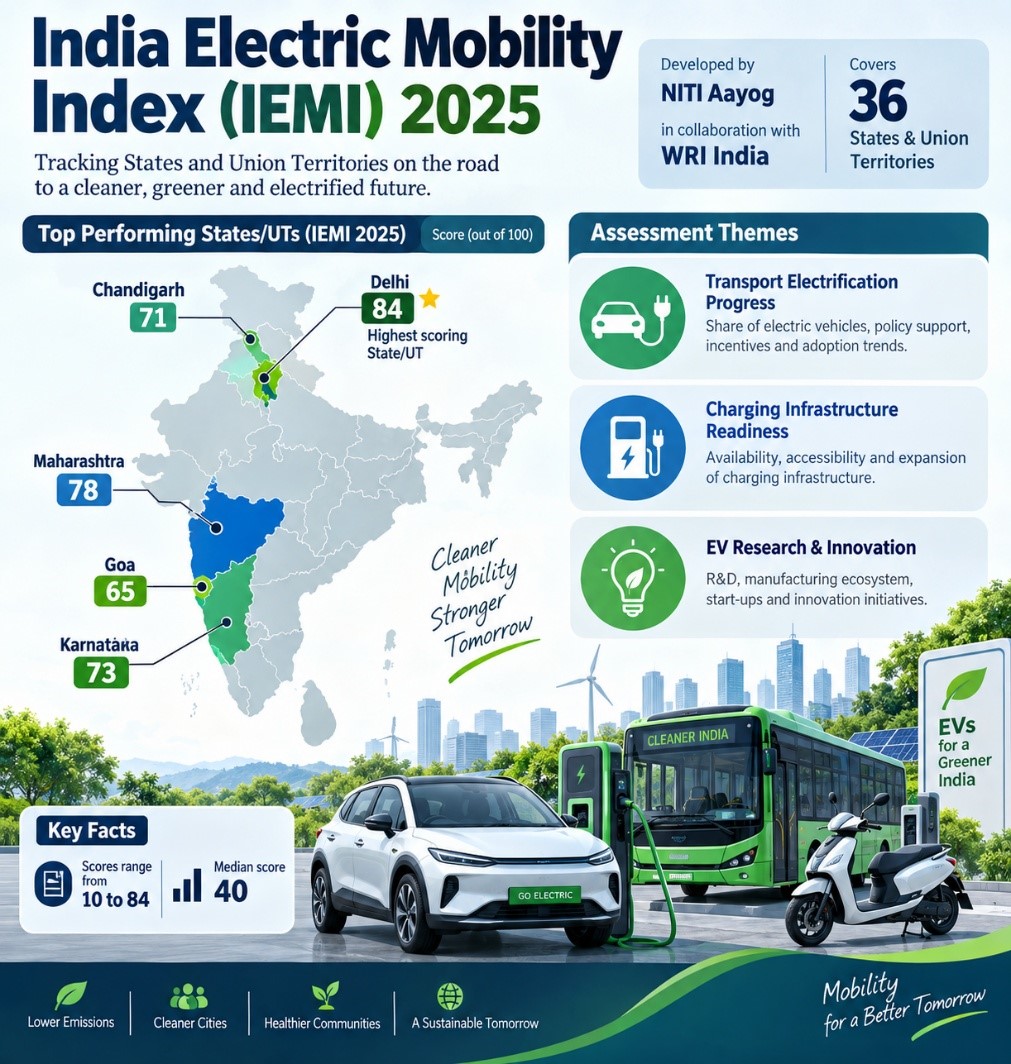
- NITI Aayog, in collaboration with WRI India, released the second edition of the India Electric Mobility Index (IEMI) 2025.
- It evaluates all 36 States and Union Territories on a 100-point scale based on both EV policy frameworks and implementation outcomes.
- Objectives:
- Support state-level decision-making.
- Encourage healthy competition and peer learning.
- Identify best practices and implementation gaps.
- The index uses 16 indicators under three themes:
|
Theme |
Weightage |
Key Parameters |
|
Transport Electrification Progress |
50% |
EV adoption, market absorption, consumer acceptance and demand-side momentum |
|
Charging Infrastructure Readiness |
30% |
Charger-to-vehicle ratio, charging subsidies, building bye-laws and power availability |
|
EV Research & Innovation |
20% |
EV startups, R&D initiatives and patents |
Key Findings and State-wise Performance
- Composite scores range from 10 to 84, with a median score of 40.
- Top performers: Delhi (84), Maharashtra (78), Karnataka (73), Chandigarh (71) and Goa (65).
- Delhi and Maharashtra retained the top two positions from 2024; Karnataka moved to third, overtaking Chandigarh.
- Goa climbed 10 positions to fifth, while Madhya Pradesh recorded the most notable improvement, rising from 23rd to 7th.
- The highest score increased from 77 in 2024 to 84 in 2025, indicating continued improvement among leading states.
- Among 17 large states, Maharashtra and Karnataka were the only ones among the top performers.
- Large-state categories:
- Frontrunners (50–64): Tamil Nadu, Madhya Pradesh, Odisha, Andhra Pradesh, Telangana, Haryana, Rajasthan and Uttar Pradesh.
- Emerging performers (35–49): Chhattisgarh, West Bengal, Bihar, Kerala, Jharkhand, Punjab and Gujarat.
Theme-wise Performance and Major Gaps
- Transport Electrification Progress:
- Carries the highest weightage of 50% but records the weakest overall performance.
- Only Delhi, Chandigarh and Maharashtra qualified as top performers.
- Most States/UTs therefore have their largest opportunity for improving EV adoption.
- Charging Infrastructure:
- Karnataka recorded the highest score (97), followed by Goa (92) and Maharashtra (91).
- Some states are expanding charging infrastructure faster than EV adoption, creating an infrastructure–adoption mismatch.
- Research and Innovation:
- Delhi scored the highest (94), reflecting its relatively strong EV startup, R&D and patent ecosystem.
- Major barriers:
- Inadequate charging infrastructure.
- Dispersed settlements that increase the cost and complexity of charger deployment.
- Limited innovation ecosystems outside leading states.
- With EV policies now established across most States/UTs, the key challenge is shifting from policy formulation to implementation, including charger deployment, subsidy delivery, building-code enforcement and grid readiness.
India’s EV Transition: Significance and Way Forward
- Road transport contributes around 12% of India’s energy-related CO₂ emissions, making electrification important for climate mitigation.
- EV adoption can reduce dependence on imported crude oil, strengthening energy security and reducing pressure on the current account.
- EV penetration increased from 0.5% in 2018 to 8.25% of total registered vehicles in 2025–26.
- More than 8.7 million EVs were operating on Indian roads in 2025–26.
- Nearly 2.5 million EVs were registered during 2025–26, around 25% higher than the previous year.
- India’s transition differs from several developed markets, with two- and three-wheelers playing a particularly important role rather than passenger cars.
- Globally, electric cars accounted for roughly one-tenth of new car sales in the US, more than one-quarter in the EU and over half in China in 2025.
- The IEMI provides a mechanism to:
- Compare state-level performance.
- Identify whether gaps lie in adoption, infrastructure or innovation.
- Shift policy attention from announcing EV policies towards effective implementation.
- Sustained progress requires coordinated action on charging networks, grid capacity, consumer adoption, innovation, subsidies and state-level execution to support India’s Viksit Bharat 2047 objectives.
