

India emerging as global business hub due to its policy reforms
The Statesman
Key Arguments of the Article
Policy Reforms and Ease of Doing Business
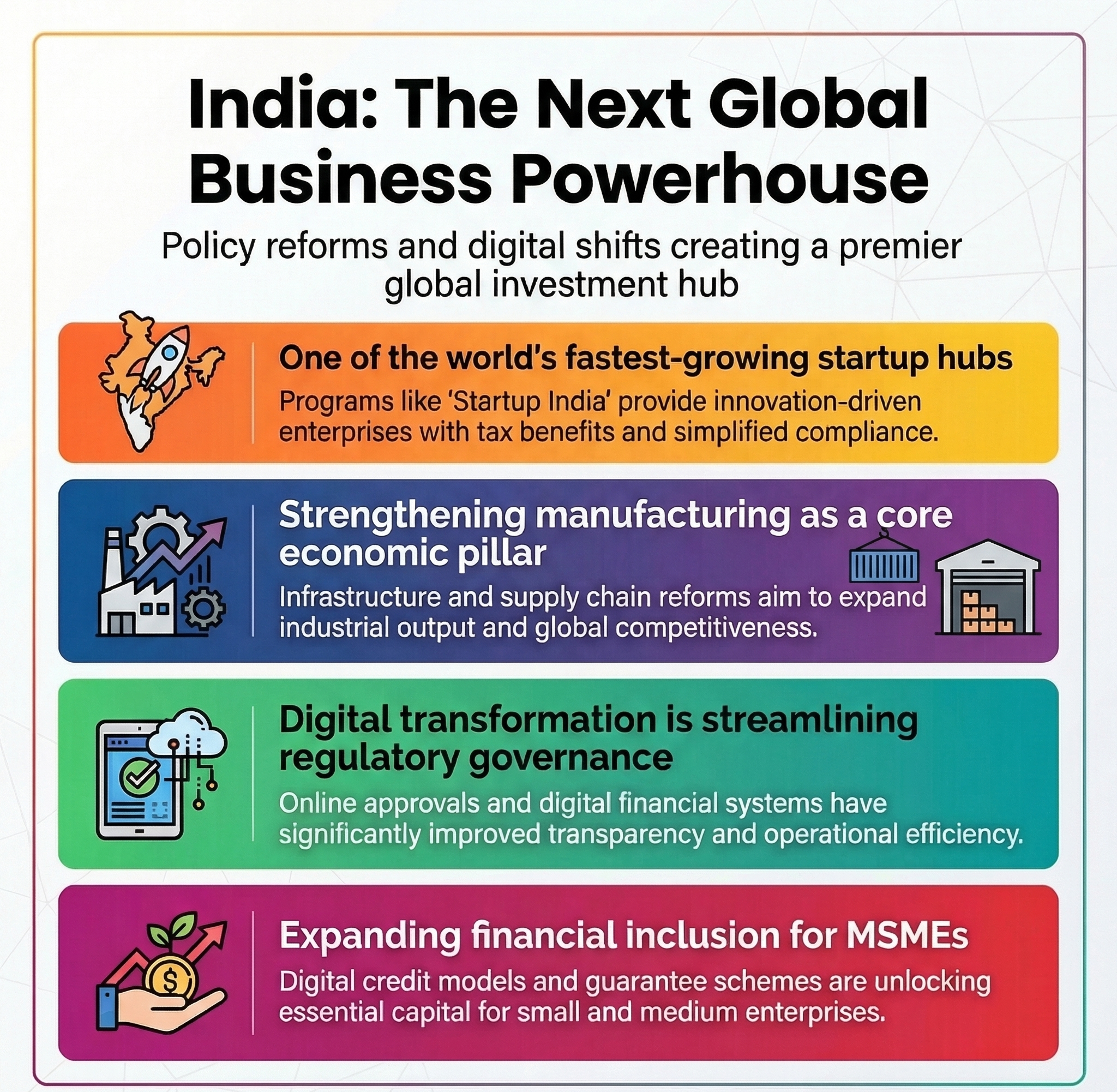
The article highlights that government reforms have focused on simplifying regulatory frameworks and reducing bureaucratic hurdles. Initiatives aimed at improving the ease of doing business have encouraged both domestic and foreign enterprises to expand operations in India.
These reforms are presented as central to creating a more competitive business environment.
Growth of Startup Ecosystem
India’s startup ecosystem is portrayed as one of the fastest-growing in the world. Programmes such as Startup India and related incentives have helped increase the number of registered startups and encouraged innovation-driven entrepreneurship.
Recognition from the Department for Promotion of Industry and Internal Trade provides startups access to tax benefits, simplified compliance, and intellectual property support.
Strengthening the Manufacturing Sector
The article emphasises that manufacturing remains a key pillar of India’s economic growth, contributing significantly to GDP and employment generation. Policy reforms are intended to expand industrial output and improve global competitiveness.
The development of industrial infrastructure and supply chain integration is considered essential for scaling manufacturing activities.
Financial Inclusion for MSMEs
The article notes that financial reforms such as credit guarantee schemes and digital credit assessment models are helping improve access to finance for micro, small, and medium enterprises.
Fintech platforms and digital financial systems are enabling greater financial inclusion and expanding credit availability.
Digital Transformation and Governance
Digitalisation of regulatory processes—such as online approvals, simplified compliance procedures, and digital financial systems—has improved transparency and efficiency.
These changes are portrayed as making India’s business environment more technology-driven and investor-friendly.
Author’s Stance
The author adopts a positive and reform-oriented perspective toward India’s economic policies. The article emphasises the progress achieved through regulatory reforms and portrays India as an emerging investment destination.
The tone reflects optimism regarding India’s economic trajectory and its potential role in the global business landscape.
Possible Biases
Reform Optimism
The article emphasises policy achievements and may underplay challenges such as regulatory inconsistencies, infrastructure gaps, or bureaucratic delays.
Government-Centric Narrative
The narrative focuses primarily on government initiatives while giving less attention to private sector challenges or market constraints.
Limited Global Comparison
The article highlights India’s progress but does not extensively compare its performance with other competing economies.
Advantages of the Reform Agenda
Increased Investment
Improved business regulations can attract foreign direct investment and stimulate domestic entrepreneurship.
Job Creation
Expansion of manufacturing and startups can generate employment opportunities.
Innovation and Technology Development
Startup ecosystems encourage technological innovation and new business models.
Formalisation of Economy
Digitalisation and regulatory reforms can improve compliance and reduce informal economic activity.
Challenges and Limitations
Infrastructure Deficits
Logistics, transport, and energy infrastructure still require significant improvement.
Regulatory Complexity
Despite reforms, some sectors continue to face procedural challenges and overlapping regulations.
Skill Gap
Industrial expansion requires skilled labour, and gaps in workforce skills may affect productivity.
Global Economic Uncertainty
External factors such as global trade tensions and economic slowdowns can affect investment flows.
Policy Implications
Continued Regulatory Reforms
Sustained simplification of business regulations is essential for maintaining investor confidence.
Strengthening Infrastructure
Investment in logistics, industrial corridors, and digital infrastructure will support industrial expansion.
Skill Development
Education and training programmes should align with industry needs.
Support for MSMEs
Policies should focus on improving credit access, market integration, and technology adoption for small businesses.
Integration with Global Supply Chains
India must leverage trade agreements and industrial policies to position itself within global production networks.
Real-World Impact
If reforms are effectively implemented:
• Increased domestic and foreign investment
• Growth in manufacturing and services sectors
• Expansion of startup ecosystem
• Improved employment opportunities
If challenges persist:
• Slower industrial growth
• Limited competitiveness in global markets
• Uneven regional economic development
Alignment with UPSC GS Papers
GS Paper III
Economic growth, industrial policy, ease of doing business, MSME development, startup ecosystem, and investment climate.
GS Paper II
Government policies and reforms related to economic development and regulatory governance.
GS Paper I
Urbanisation and economic geography related to industrial clusters.
GS Paper IV
Ethical governance, transparency in regulatory processes, and accountability in economic policymaking.
Balanced Assessment
The article highlights the significant role of policy reforms in improving India’s business environment. Government initiatives have contributed to expanding entrepreneurship, strengthening industrial sectors, and enhancing digital governance.
However, sustained progress requires addressing infrastructure gaps, regulatory inconsistencies, and workforce skill shortages.
Future Perspective
India’s aspiration to become a global business hub will depend on the continuity of reforms, strengthening of institutions, and integration with global markets. As global supply chains diversify, India has an opportunity to position itself as a key manufacturing and innovation destination.
For policymakers and civil services aspirants, the challenge lies in ensuring that economic reforms translate into inclusive growth, technological advancement, and long-term economic resilience.
