

India not growing enough pulses to meet nutritional needs of population: Study
Business Standard
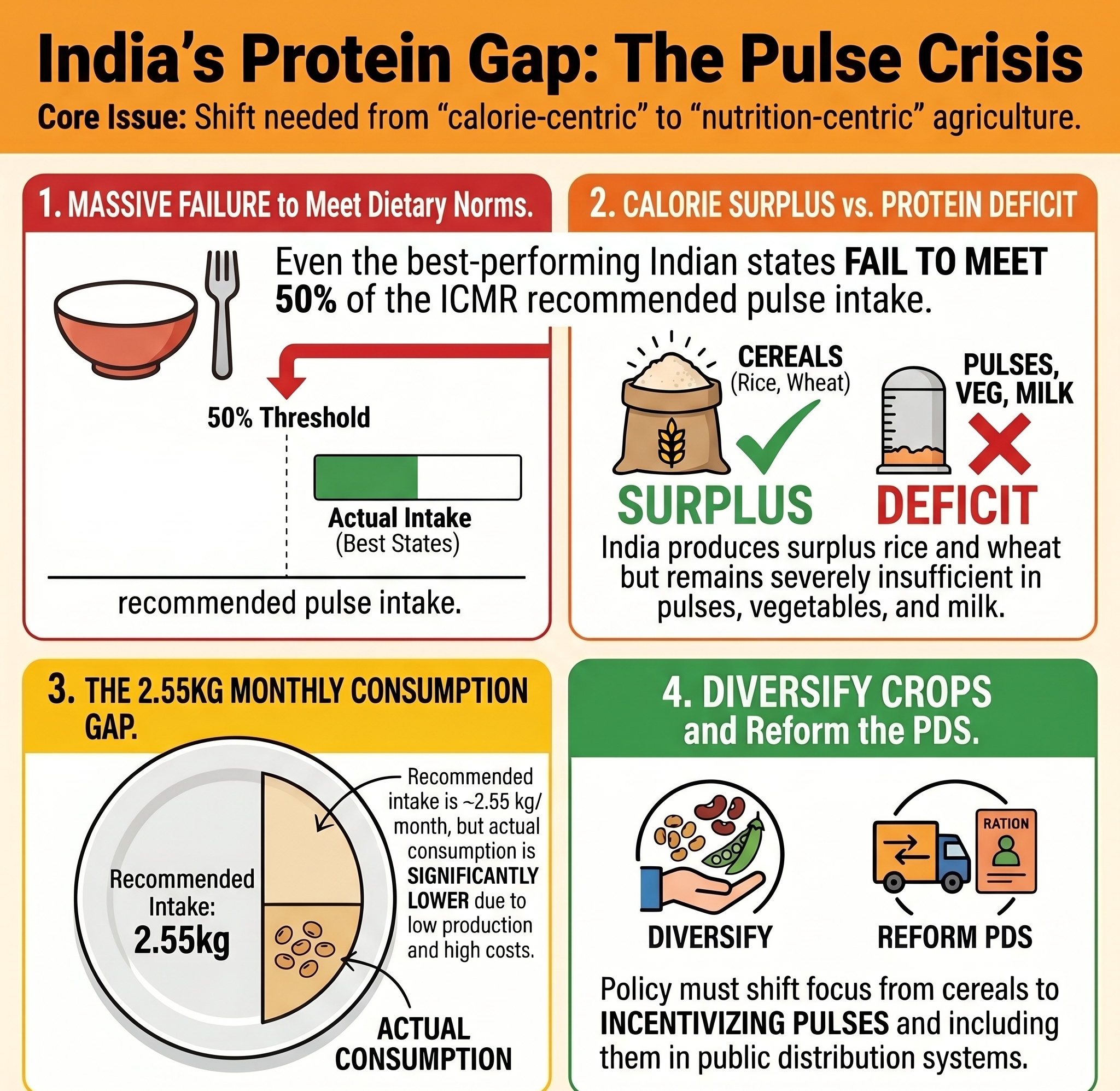
1. Core Theme
The article highlights a structural mismatch between food production and nutritional requirements in India, focusing on:
- Inadequate pulses and protein-rich food production
- Gap between ICMR dietary norms and actual consumption
- Persistent nutritional insecurity despite food surplus
2. Key Arguments
(1) Production–Nutrition Mismatch
- India produces:
- surplus cereals (rice, wheat)
- But insufficient:
- pulses, dry fruits, vegetables, milk (in many regions)
Core issue:
Food security ≠ Nutritional security
(2) Pulses Deficit is Severe
- Recommended intake: ~2.55 kg/month
- Actual consumption:
- significantly lower across all states
- Even better-performing states fail to meet 50% of norms
(3) Consumption Gap Across States
- States like:
- Manipur, Rajasthan → extremely low consumption
- Regional disparities:
- uneven access and affordability
(4) Supply-Side Constraints
- Domestic production:
- insufficient to meet even current consumption
- Would fall further short if:
- people followed recommended dietary norms
(5) Demand-Side Issues
- Low consumption due to:
- affordability constraints
- lack of awareness
- dietary habits
(6) Dairy Paradox
- India produces:
- surplus milk
- Yet consumption:
- uneven across regions
(7) Excess Dependence on Cereals
- Cereals dominate diets due to:
- PDS focus
- Leads to:
- protein deficiency
(8) Policy Gap
- Agricultural policies:
- biased towards cereals
- Nutrition policies:
- not fully aligned with production patterns
(9) Role of ICMR Guidelines
- Provide:
- scientific benchmarks for nutrition
- But:
- poor translation into policy and practice
(10) Need for Awareness
- Behavioural change required:
- dietary diversification
3. Author’s Stance
- Evidence-based and analytical
- Highlights:
- systemic policy failure
- Advocates:
- shift from calorie-centric to nutrition-centric approach
4. Biases in the Article
(1) Supply-Side Emphasis
- Focuses heavily on:
- production deficits
- Underplays:
- cultural dietary preferences
(2) Normative Assumption
- Assumes:
- ICMR norms are universally achievable
- Ignores:
- economic diversity
(3) Limited Focus on Market Mechanisms
- Does not deeply analyse:
- pricing, MSP distortions
- global trade role
5. Pros and Cons
Pros
Data-driven analysis
- Based on NSS/NSO consumption surveys
Highlights real issue
- Moves debate beyond food security
Policy relevance
- Direct implications for agriculture and nutrition
Cons
Limited policy roadmap
- Lacks concrete implementation strategy
Ignores behavioural inertia
- Dietary habits slow to change
6. Policy Implications
(1) Crop Diversification
- Incentivise:
- pulses
- oilseeds
- horticulture
(2) Reform PDS
- Include:
- pulses
- protein-rich foods
(3) Nutritional Targeting
- Align schemes like:
- ICDS
- Mid-Day Meal
- Poshan Abhiyaan
(4) Price and MSP Policy
- Expand MSP support for:
- pulses
- Ensure procurement efficiency
(5) Behavioural Change Campaigns
- Promote:
- balanced diets
- awareness of ICMR norms
(6) Regional Strategy
- State-specific nutrition planning
7. Real-World Impact
Current Scenario
- High levels of:
- protein deficiency
- hidden hunger
If Unaddressed
- Impact on:
- human capital
- productivity
- health outcomes
If Addressed
- Improved:
- public health
- economic productivity
8. UPSC GS Linkages
GS Paper II
- Welfare schemes
- Health and nutrition
GS Paper III
- Agriculture
- Food security vs nutritional security
GS Paper I
- Poverty and hunger
Essay Topics
- “From food security to nutritional security”
- “Agriculture policy and human development”
9. Critical Insight
India’s food system reflects a paradox: calorie sufficiency alongside protein deficiency, indicating deeper structural issues in policy alignment.
10. Balanced Conclusion
The article rightly underscores:
- mismatch between production and nutrition
- regional inequalities in food consumption
However:
- solutions require:
- integrated policy approach
- long-term behavioural change
11. Way Forward
- Shift to nutrition-sensitive agriculture
- Integrate:
- agriculture, health, and welfare policies
- Strengthen:
- awareness and affordability
Final Editorial Takeaway
India must transition from a cereal-centric food system to a nutrition-centric ecosystem—where agricultural policy, public distribution, and dietary behaviour converge to ensure true food security.
