

India targets 47% emission cut and 60% power capacity from non-fossils by 2035
Indian Express
1. Key Arguments
A. Enhanced Climate Commitments
India has upgraded its Nationally Determined Contributions (NDCs).
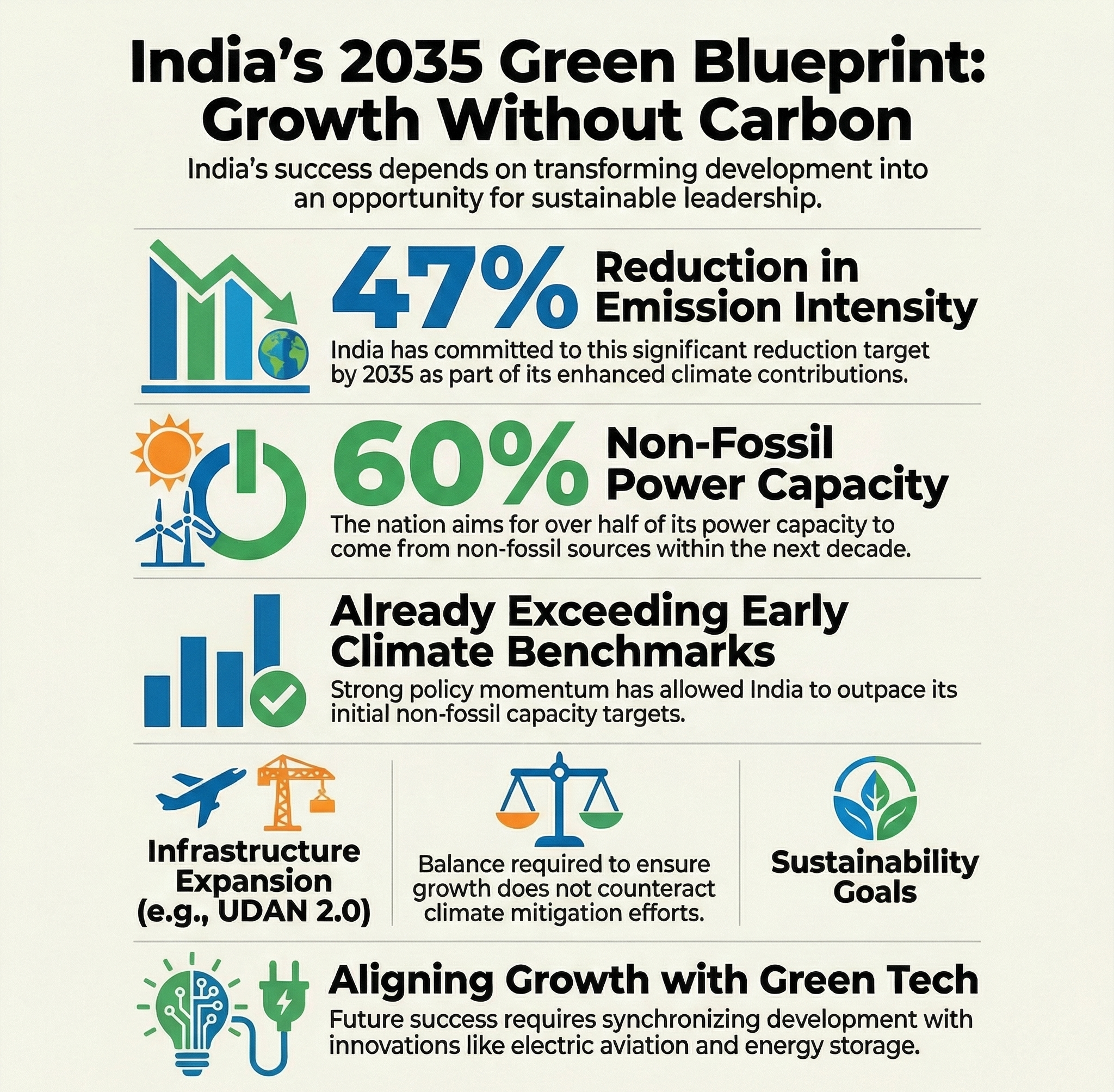
Targets include 47% reduction in emission intensity and 60% non-fossil power capacity by 2035.
B. Progress and Early Achievements
India is ahead on certain targets.
Non-fossil capacity already exceeds earlier benchmarks, indicating policy momentum.
C. Need for Greater Ambition
Targets may still fall short of global climate goals.
Criticism suggests that ambition levels are moderate relative to climate urgency.
D. Climate Action Beyond Targets
Focus on resilience, finance, and sustainable lifestyles.
Non-quantifiable measures are equally important but harder to track.
E. UDAN 2.0: Expanding Regional Connectivity
Government pushes infrastructure development.
Regional air connectivity aims to boost economic integration and accessibility.
F. Development vs Sustainability Trade-off
Infrastructure expansion may increase emissions.
Aviation growth under UDAN could counteract climate mitigation efforts.

2. Author’s Stance
Balanced with cautious optimism
Acknowledges progress in climate action
Recognises India’s proactive approach.
Highlights gaps in ambition and coherence
Suggests need for stronger alignment between growth and sustainability.
3. Biases and Limitations
Climate-centric critique bias
Focus on emissions may underplay developmental needs.
Limited economic analysis of UDAN
Benefits of connectivity are not deeply quantified.
Global comparison underdeveloped
India’s relative performance vis-à-vis other countries is not fully explored.
4. Strengths (Pros)
Comprehensive coverage of policy landscape
Combines climate commitments with infrastructure initiatives.
Data-backed analysis
Provides measurable targets and progress indicators.
Relevance to global climate discourse
Links national policy with international obligations.

5. Weaknesses (Cons)
Limited integration between themes
Climate and infrastructure discussed somewhat separately.
Insufficient focus on implementation challenges
Financial, technological, and institutional barriers need more attention.
Underexplored sectoral impacts
Energy, transport, and industry transitions not deeply analysed.
6. Policy Implications
A. Strengthening Climate Ambition
Revisiting targets periodically
Aligning with global net-zero pathways.
B. Green Infrastructure Development
Integrating sustainability in projects like UDAN
Promoting green aviation technologies.
C. Climate Finance Mobilisation
Domestic and international funding mechanisms
Supporting large-scale transition.
D. Energy Transition Acceleration
Scaling renewables and storage solutions
Reducing fossil fuel dependence.
E. Policy Coherence
Aligning development and climate goals
Ensuring infrastructure expansion does not undermine commitments.
7. Real-World Impact
Environmental Impact
Reduction in emission intensity
Improved climate performance.
Economic Growth
Enhanced connectivity boosts regional development
Tourism, trade, and employment.
Energy Sector Transformation
Shift towards renewable energy
Investment and innovation opportunities.
Challenges
Balancing growth with sustainability
Risk of policy contradictions.
8. UPSC GS Paper Linkages
GS Paper III (Environment & Economy)
- Climate change
- Energy transition
- Infrastructure development
GS Paper II (Governance & IR)
- International climate commitments
- Policy implementation
GS Paper I (Geography)
- Resource distribution
- Infrastructure and regional development
9. Balanced Conclusion
India’s climate targets and infrastructure expansion reflect both ambition and contradiction.
While progress in renewable energy is commendable, aligning growth initiatives like aviation with sustainability goals remains a critical challenge.
10. Future Perspective
Towards integrated policy frameworks
Synchronising climate and development strategies.
Technological innovation in green sectors
Electric aviation, energy storage, and efficiency.
Strengthening global leadership
India as a model for balanced development.
Long-term sustainability focus
Ensuring growth does not compromise environmental goals.
Final Insight
India’s success will depend on its ability to grow without carbon—transforming development from a challenge into an opportunity for sustainable leadership.
