

India to count castes for first time in a century
Morning Standard
1. Core Thesis of the Article
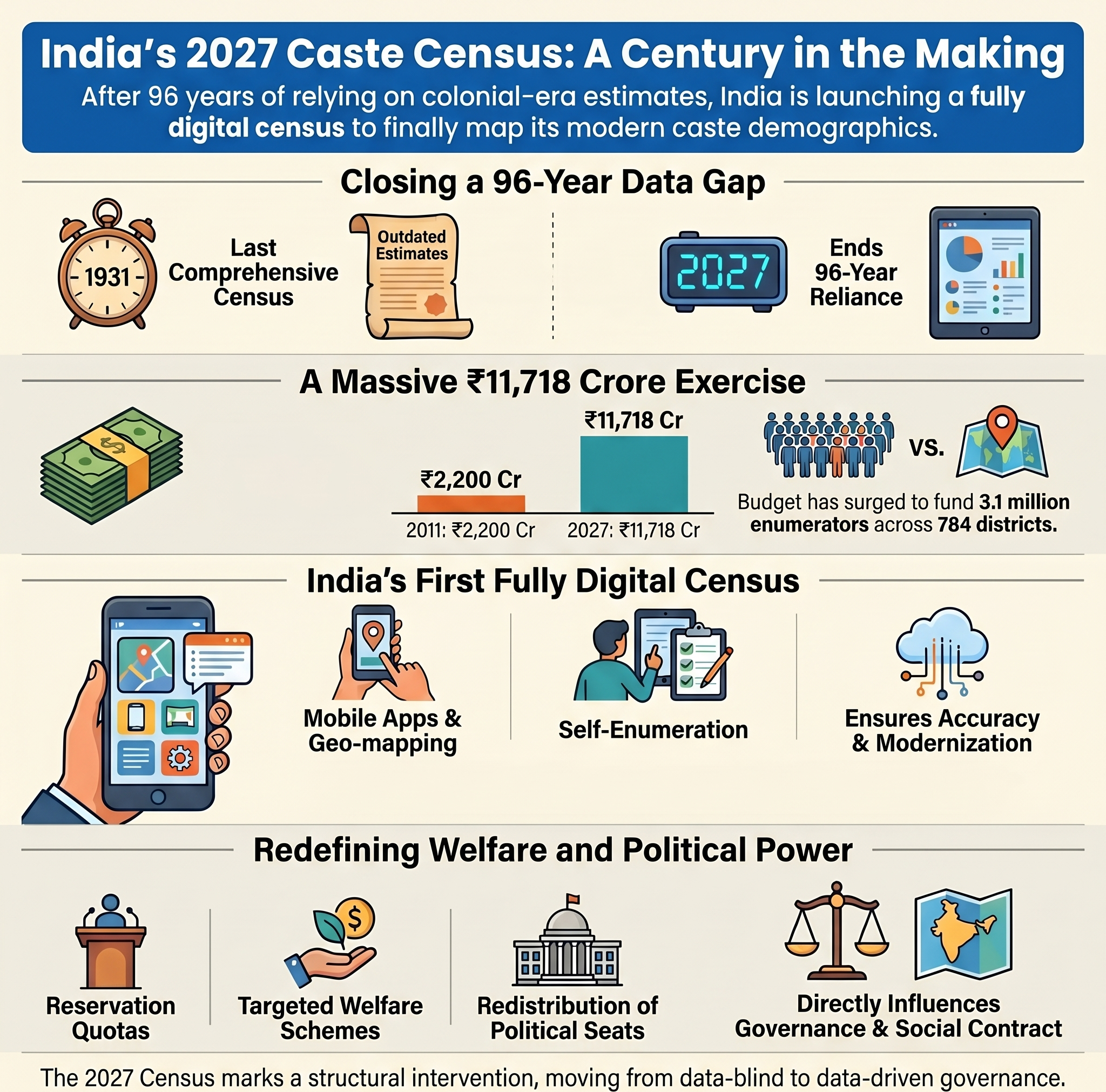
The article highlights that Census 2027 will include caste enumeration after nearly a century (since 1931), marking a major policy shift with deep implications for welfare targeting, reservation politics, and federal power balance. It presents this as both a data-correction exercise and a politically sensitive reform.
2. Detailed Breakdown of Key Arguments
(1) Historical Gap in Caste Data
- Last comprehensive caste census: 1931 (British period)
- Post-independence:
- Only SC/ST data collected
- OBC data based on Mandal estimates (1931 extrapolation)
Implication:
Policy-making has relied on outdated and indirect data, leading to:
- estimation errors
- political contestation
(2) Census 2027 as a Structural Shift
- First full caste enumeration in independent India
- Fully digital census (apps, geo-mapping, self-enumeration)
Significance:
- Modernisation + expansion of scope
- Data becomes central to governance
(3) Administrative Scale and Complexity
- ~31 lakh enumerators + supervisors
- Coverage:
- 784 districts
- 36 states/UTs
- Cost escalation:
- ₹2,200 crore (2011) → ₹11,718 crore (2027)
Inference:
- Massive logistical exercise
- Reflects both delay and technological shift
(4) Link with Delimitation
- Census data will feed into:
- Delimitation exercise (post-2026)
Critical implication:
- Redistribution of political representation
- Potential North-South tension
(5) Welfare and Reservation Implications
- Accurate caste data → better targeting of:
- reservations
- welfare schemes
- Current situation:
- Claims of under/over-representation
(6) Political Sensitivity
- Article notes:
- “politically charged moment”
- Why?
- Caste data influences:
- electoral mobilisation
- policy demands
- identity politics
(7) Past Precedent: SECC 2011
- Socio-Economic and Caste Census conducted
- Data:
- Never officially released (caste part)
Lesson:
- Data collection ≠ data transparency
(8) Technology and Self-Enumeration
- Digital census:
- reduces errors
- increases participation
- Risk:
- misreporting / identity inflation
(9) Federal Implications
- Southern states:
- fear loss of representation
- Northern states:
- population advantage
Core issue:
Balancing demographic reality vs federal equity
(10) Timing and Delay
- Census delayed since 2021 (COVID + administrative reasons)
- Result:
- Data gap since 2011
3. Author’s Stance
- Balanced but cautious
- Recognises:
- importance of data
- political risks
Tone:
- Informational with implicit concern about:
- political consequences
- federal tensions
4. Biases in the Article
(1) Implicit Technocratic Bias
- Assumes:
- better data = better policy
(2) Mild Political Skepticism
- Suggests caste census is politically sensitive without fully exploring benefits
(3) Limited Social Perspective
- Less discussion on:
- caste discrimination realities
- grassroots impact
5. Pros and Cons of the Policy
Pros
Evidence-based policymaking
- Accurate caste-wise data
Better targeting of welfare
- Reduces inclusion/exclusion errors
Transparency in reservations
- Rationalisation possible
Academic and research value
- Reliable socio-economic insights
Cons
Risk of identity politics intensification
- Caste mobilisation may increase
Data misuse
- Political manipulation
Administrative challenges
- Large-scale data collection errors
Social fragmentation
- Reinforcement of caste identities
6. Policy Implications
(1) Reservation Policy Reform
- Reassessment of:
- quotas
- creamy layer criteria
(2) Federal Balance
- Need for safeguards in:
- delimitation
- representation
(3) Data Governance Framework
- Ensure:
- privacy
- transparency
- responsible use
(4) Institutional Strengthening
- Census must remain:
- autonomous
- credible
(5) Social Justice Policies
- Better design of:
- targeted welfare
- affirmative action
7. Real-World Impact
Short-Term
- Political debates intensify
- Demand for sub-categorisation of OBCs
Medium-Term
- Changes in:
- reservation policies
- welfare targeting
Long-Term
- Reshaping of:
- political representation
- social justice framework
8. UPSC GS Linkages
GS Paper II
- Welfare schemes
- Federalism
- Representation and governance
GS Paper I
- Social structure
- Caste system
GS Paper III
- Data governance
- Digital infrastructure
Essay Topics
- “Caste census: tool of justice or political instrument?”
- “Data-driven governance in India”
9. Critical Analytical Insight
The caste census reflects a fundamental dilemma: whether quantifying identity leads to social justice or entrenches social divisions.
10. Balanced Conclusion
The article rightly highlights:
- Data vacuum in caste statistics
- Administrative scale
- Political sensitivity
However:
- It does not deeply evaluate:
- transformative potential of accurate data
- safeguards against misuse
11. Way Forward
- Ensure:
- transparent data release
- Decouple:
- census data from immediate political use
- Build:
- consensus across states
- Introduce:
- independent oversight mechanisms
Final Editorial Takeaway
Caste enumeration in Census 2027 is not merely a statistical exercise—it is a structural intervention in India’s social contract. Its success will depend not just on data collection, but on how responsibly that data is interpreted, institutionalised, and insulated from short-term political exploitation.
