

India–China Border Talks: A Step Towards Stabilisation

India–China Border Talks: A Step Towards Stabilisation
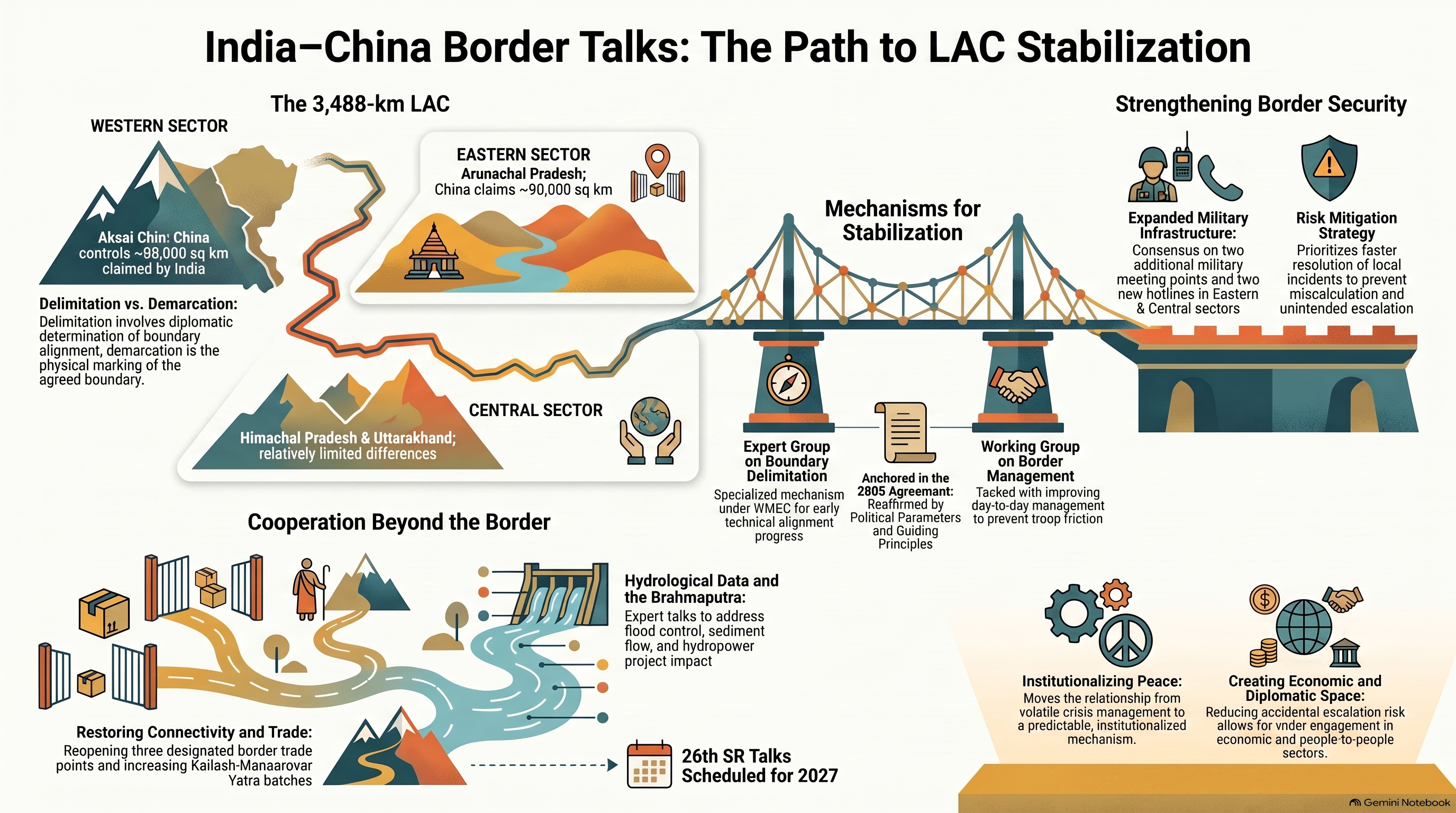
The 25th round of Special Representative (SR) talks between NSA Ajit Doval and Chinese Foreign Minister Wang Yi resulted in an eight-point consensus to accelerate boundary discussions, strengthen military communication and reduce the risk of incidents along the LAC.
Boundary Dispute at a Glance
India and China have differing perceptions of the approximately 3,488-km LAC.
|
Sector |
Major Dispute |
|
Western |
Aksai Chin; China controls ~38,000 sq km claimed by India |
|
Eastern |
Arunachal Pradesh; China claims ~90,000 sq km |
|
Central |
Parts of Himachal Pradesh and Uttarakhand; relatively limited differences |
The 2020 eastern Ladakh crisis disrupted bilateral relations, making peace and tranquillity along the LAC essential for normalisation.
“Early and Substantial Harvest”
Both sides reaffirmed negotiations for a fair and mutually acceptable boundary settlement based on the 2005 Agreement on Political Parameters and Guiding Principles.
Two mechanisms under the WMCC will support the process:
- Expert Group on Boundary Delimitation: Work towards early progress on boundary alignment.
- Working Group on Border Management: Improve management of the disputed frontier.
Delimitation determines the boundary alignment, while demarcation physically marks an already agreed boundary.
Strengthening Border Security Communication
- Two additional military meeting points.
- Two additional military hotlines in the Eastern and Central sectors.
- Faster resolution of local incidents through diplomatic and military channels.
These measures aim to prevent miscalculation, misunderstanding and escalation.
Beyond the Border Dispute
|
Area |
Recent Step |
|
Border trade |
Reopening of three designated trading points |
|
Pilgrimage |
Increased batches for Kailash-Mansarovar Yatra |
|
Rivers |
Expert-level talks on trans-border rivers |
|
Diplomacy |
26th SR talks to be held in India in 2027 |
Brahmaputra Concern
India and China will discuss hydrological data sharing and renewal of relevant agreements. This is important for the Brahmaputra/Yarlung Tsangpo, particularly regarding floods, sediment flows, downstream ecology and Chinese hydropower projects.
Significance for India
- Institutionalises border-management mechanisms.
- Strengthens confidence-building measures.
- Reduces chances of accidental escalation.
- Keeps boundary settlement negotiations alive.
- Creates space for wider economic and people-to-people engagement.
- Provides a platform to address trans-border river concerns.
Conclusion
The latest talks indicate movement from crisis management towards institutionalised stabilisation. While they do not represent a final boundary settlement, sustained military communication, confidence-building and gradual progress on delimitation can create conditions for broader India–China normalisation.
