

Indian Standard Time (IST): Legal Framework for Uniform Time

Indian Standard Time (IST): Legal Framework for Uniform Time
Context
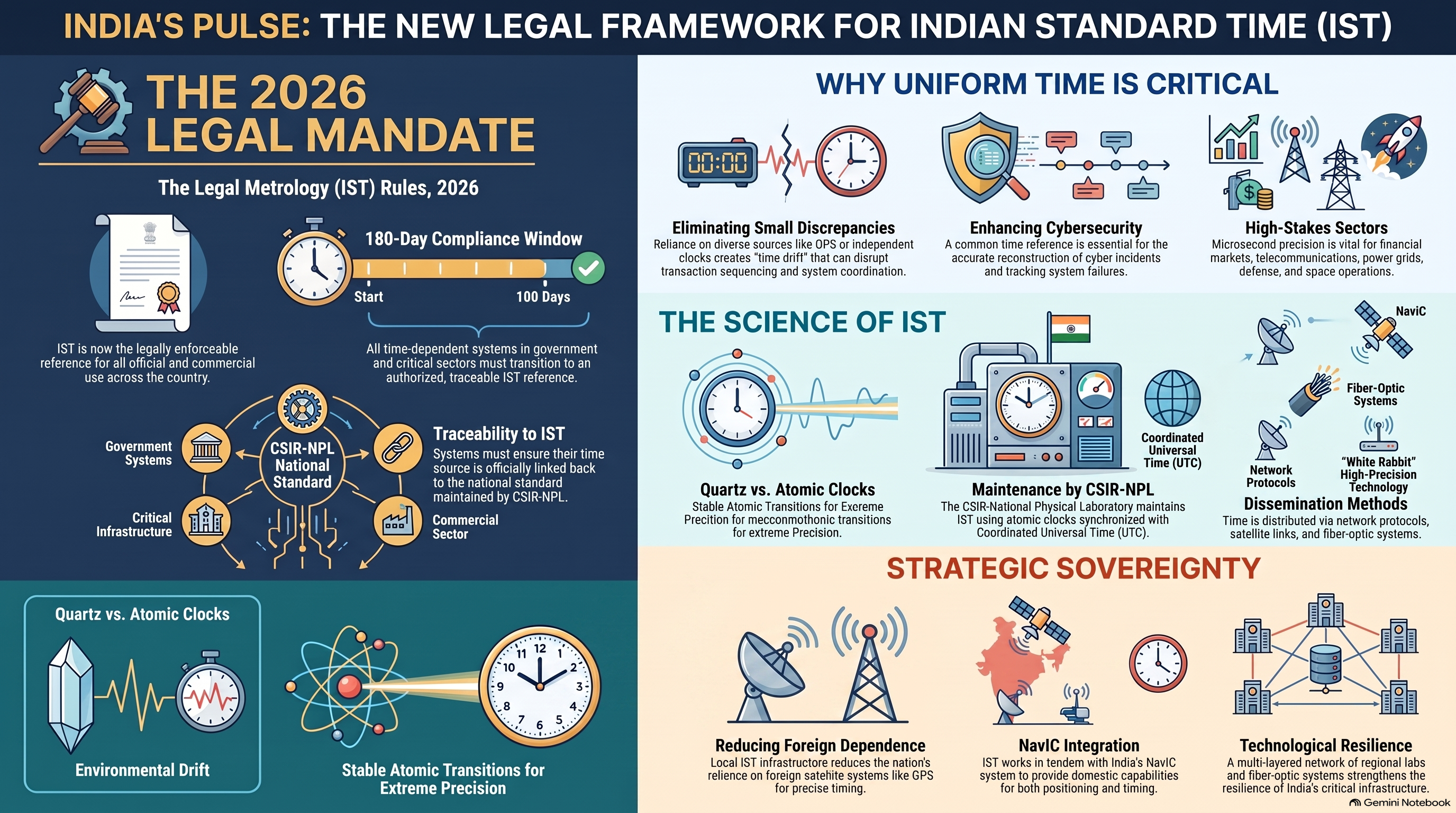
- The Legal Metrology (Indian Standard Time) Rules, 2026 make IST the legally enforceable reference for official and commercial use.
- Time-dependent systems in government and critical sectors must use an authorised, traceable IST reference within 180 days.
- The objective is to establish a common national time reference for synchronisation, cybersecurity and critical infrastructure.
Why Uniform Time Matters?
- Different organisations may derive time from GPS, overseas network servers or independent clocks, creating small but consequential discrepancies.
- A common time reference enables accurate sequencing of transactions, coordination of systems and reconstruction of cyber incidents or failures.
- It is particularly important for financial markets, telecom, power grids, defence and space systems.
India’s Time Infrastructure
- CSIR-NPL is responsible for maintaining and disseminating IST.
- NPL maintains IST using highly precise atomic clocks, synchronised with Coordinated Universal Time (UTC).
- Time can be disseminated through network protocols, satellite links and fibre-optic systems.
- White Rabbit technology enables highly precise clock synchronisation through fibre-optic networks.
- ISRO and critical infrastructure are required to maintain traceability to IST at very high precision.
Strategic Significance
- Reduces dependence on foreign satellite systems such as GPS for precise timing.
- Strengthens technological sovereignty and resilience of critical infrastructure.
- Supports secure financial transactions, telecommunications, defence operations and space activities.
- Complements India’s NavIC system by creating domestic capabilities for precise positioning and timing.
Atomic Clocks: Why They Matter
- Quartz clocks can gradually drift because their oscillations are affected by environmental and physical factors.
- Atomic clocks use highly stable atomic transitions as the frequency reference, enabling extremely precise timekeeping.
- Such precision is essential where even microsecond or nanosecond differences can affect the sequence of events.
Way Forward
India should develop a robust, multi-layered domestic time-distribution network integrating atomic clocks, NavIC, fibre-optic systems and regional reference laboratories. This would strengthen critical infrastructure resilience while reducing dependence on external timing sources.
