

India–Nepal Relations: Towards a New Development Partnership

India–Nepal Relations: Towards a New Development Partnership
Source: IE
Why in News?
India and Nepal are seeking to revitalise bilateral relations after diplomatic tensions over the boundary dispute involving Kalapani, Lipulekh and Limpiyadhura.
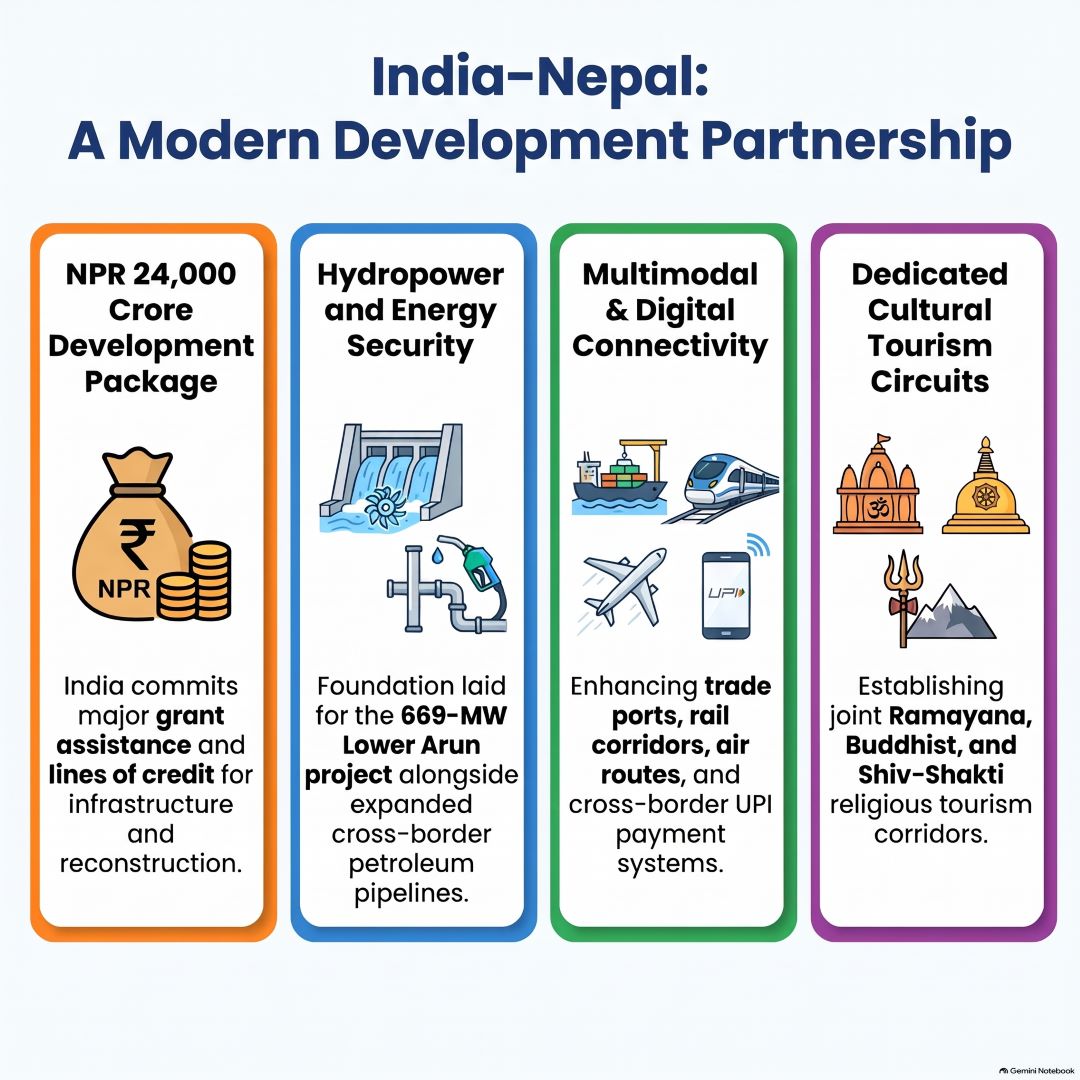
- During Nepal PM Balendra Shah's first bilateral visit to India, India announced a development cooperation package of NPR 24,000 crore (approximately ₹15,000 crore).
- Both countries signed eight MoUs and adopted a 10-pillar Joint Vision Document titled 'Viksit Bharat and Samunnat Nepal: Re-imagining the Partnership'.
- The objective is to transform traditional cultural and geographical ties into a modern development partnership.
Economic and Connectivity Cooperation
- Development Assistance: Grant assistance and line of credit for infrastructure, reconstruction and energy projects.
- Trade and Transit: Nepal will gain access to India's Kandla and Paradip ports for international trade.
- Economic Zones: Plans for SEZs, IT parks and export-oriented manufacturing facilities near the border.
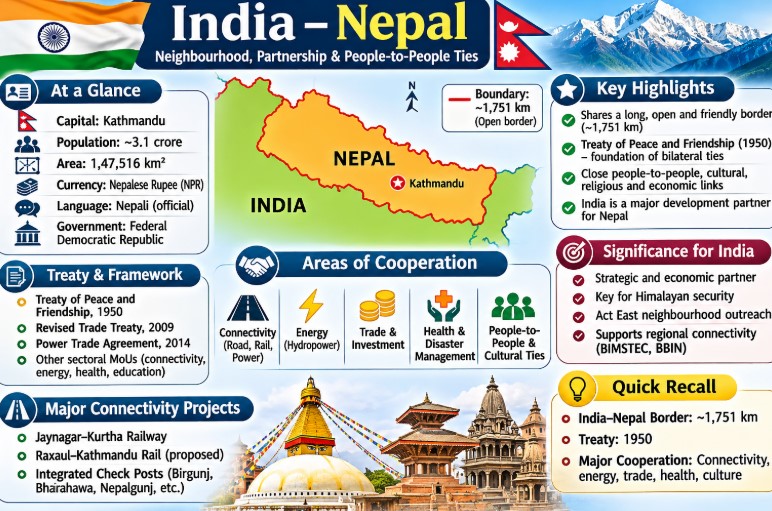
- Transport Connectivity: Saryu-Kamala Express (Ayodhya–Janakpur), Dharchula–Darchula Bridge and expansion of Integrated Check Posts (ICPs).
- Railways: Jayanagar–Bardibas and Jogbani–Biratnagar rail links.
- Digital Connectivity: UPI linkage for cross-border digital payments.
- Air Connectivity: Proposed Kathmandu–Bhairahawa–Lucknow two-way air corridor.
Energy Partnership
Nepal's hydropower potential complements India's growing energy demand.
- Lower Arun Project: Foundation stone laid for the 669-MW hydropower project.
- Arun-3: Commitment to timely completion.
- Petroleum Connectivity: Phase II of the Motihari–Amlekhgunj pipeline inaugurated; Siliguri–Jhapa pipeline proposed.
- Energy Security: Cooperation in electricity trade and supply of fuel, fertilisers and essential commodities.
Emerging Areas of Cooperation
|
Sector |
Key Initiatives |
|
Technology |
AI, start-ups, digital parks and data centres |
|
Space |
Satellite development, remote sensing and disaster management |
|
Education |
Proposed IIT campus, scholarships and academic exchanges |
|
Healthcare |
Jan Aushadhi Kendras and laboratory upgradation |
|
Agriculture |
Agro-Industrial Park in Chitwan and ICAR Centre of Excellence |
|
Culture |
Nalanda Centre at Lumbini and university cooperation |
|
Sports |
Cricket academy and sports infrastructure |
Cultural and Religious Cooperation
Both countries share civilisational links associated with Ram, Sita and Buddha. Three religious tourism circuits are proposed:
- Ramayana Circuit: Ayodhya–Janakpur.
- Buddhist Circuit: Lumbini–Bodh Gaya–Sarnath–Kushinagar.
- Shiv-Shakti Circuit: Kathmandu (Pashupatinath)–Varanasi.
Major Challenges
- Boundary Dispute: Kalapani, Lipulekh and Limpiyadhura remain contentious.
- 1950 Treaty: Both sides recognise the need to review the Treaty of Peace and Friendship according to contemporary realities.
- Water Sharing: Differences over river utilisation, hydropower and flood management.
- Trust Deficit: Nepal's concerns regarding sovereignty, economic dependence and perceived Indian interference.
- Trade Asymmetry: India accounts for approximately 62% of Nepal's merchandise trade.
- Institutional Monitoring: A High-Level Monitoring Group, led by Nepal's Foreign Secretary and India's Ambassador to Nepal, will meet every six months to review implementation.
Way Forward
- Respect Nepal's sovereignty and follow mutual non-interference.
- Resolve boundary and water-sharing disputes through sustained dialogue.
- Ensure timely implementation of infrastructure and energy projects.
- Promote private investment, manufacturing and regional value chains.
- Strengthen educational, cultural and youth exchanges.