

India–New Zealand Free Trade Agreement: Trade Liberalisation and Strategic Significance

Why in News?
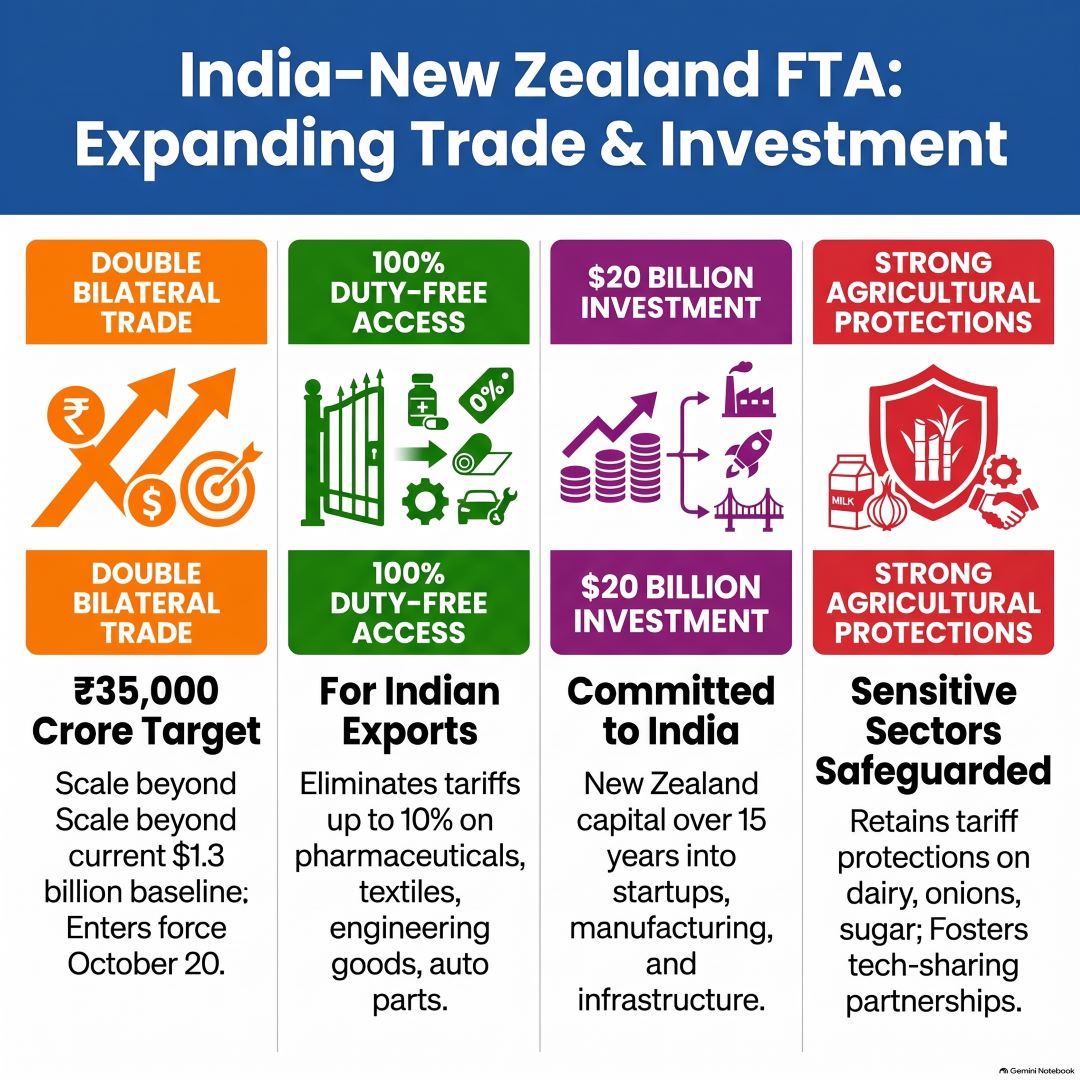
- The India–New Zealand Free Trade Agreement (FTA) has been ratified and is scheduled to enter into force on 20 October.
- Both countries aim to double bilateral trade to ₹35,000 crore over the next 4–5 years.
- Bilateral trade stood at around $1.3 billion in 2024–25, with India being New Zealand’s 9th-largest export market.
- The agreement seeks to deepen economic ties between two countries with shared links through the Commonwealth, parliamentary democracy and growing economic complementarity.
Key Trade Provisions
- Indian exports: New Zealand will provide duty-free access to 100% of Indian exports.
- Major Indian export sectors include:
- Pharmaceuticals
- Engineering goods
- Textiles
- Ceramics and carpets
- Automobiles and auto components
- New Zealand currently imposes tariffs of up to 10% on several of these products; their removal improves the competitiveness of Indian exporters.
- New Zealand exports: Around 95% of New Zealand’s exports to India will receive either tariff-free access or significantly reduced tariffs.
- New Zealand’s major exports include:
- Agricultural products
- Timber
- Wool
- Specialised manufactured goods
Protection of Sensitive Sectors and Agriculture
- Agriculture remained one of the most sensitive areas of negotiation because of New Zealand’s highly competitive dairy and horticulture sectors.
- India has retained protection for several sensitive products, including:
- Dairy
- Onions
- Almonds
- Chickpeas
- Peas
- Artificial honey
- Sugar
- Other specified agricultural products
- This reflects India’s broader negotiating approach of liberalising industrial and manufactured goods while protecting vulnerable agricultural sectors.
- New Zealand’s expertise in kiwifruit cultivation and apiculture could instead support technology and productivity partnerships with Indian farmers.
- The agreement therefore attempts to combine market access with protection of sensitive domestic livelihoods.
Investment, MSMEs and Technology Cooperation
- New Zealand has committed $20 billion in investment into India, expected to be deployed over 15 years across areas such as startups, manufacturing and infrastructure.
- An Agricultural Productivity Partnership will combine:
- New Zealand’s agricultural technology and expertise.
- India’s large agricultural base and expanding consumer market.
- Indian MSMEs, artisans, handloom workers and weavers could benefit from improved access to the New Zealand market.
- New Zealand companies could also use India as a manufacturing base because of:
- Larger labour availability.
- Competitive production costs.
- India’s growing domestic market.
- Access to multiple markets through India’s preferential trade arrangements.
- The agreement can therefore facilitate not only trade in goods but also technology transfer, investment and integration into global value chains.
Significance for India
- Export competitiveness: Duty-free access can improve the competitiveness of Indian ceramics, carpets, textiles, pharmaceuticals and auto components in New Zealand.
- Agricultural protection: Exclusion of major sensitive farm products provides safeguards for vulnerable Indian producers while allowing greater liberalisation elsewhere.
- Investment diversification: The proposed $20 billion investment commitment could strengthen FDI inflows, although its 15-year implementation horizon means benefits will materialise gradually.
- MSME and artisan integration: Better market access can help smaller Indian producers enter international markets.
- Trade diversification: Greater engagement with New Zealand forms part of India's broader effort to expand preferential market access amid global tariff uncertainty and changing supply chains.
- Strategic dimension: Stronger economic ties can complement existing people-to-people links, including the large Indian-origin community, skilled migration, education and sporting connections.
- Overall, the FTA reflects an approach of export expansion + investment attraction + technology cooperation + calibrated protection of sensitive sectors.
