

India–New Zealand FTA: $20 bn investment pledge, duty-free access for exports
Indian Express
1. Core Theme
The article highlights the strategic and economic significance of the India–New Zealand Free Trade Agreement (FTA), focusing on:
- Trade liberalisation
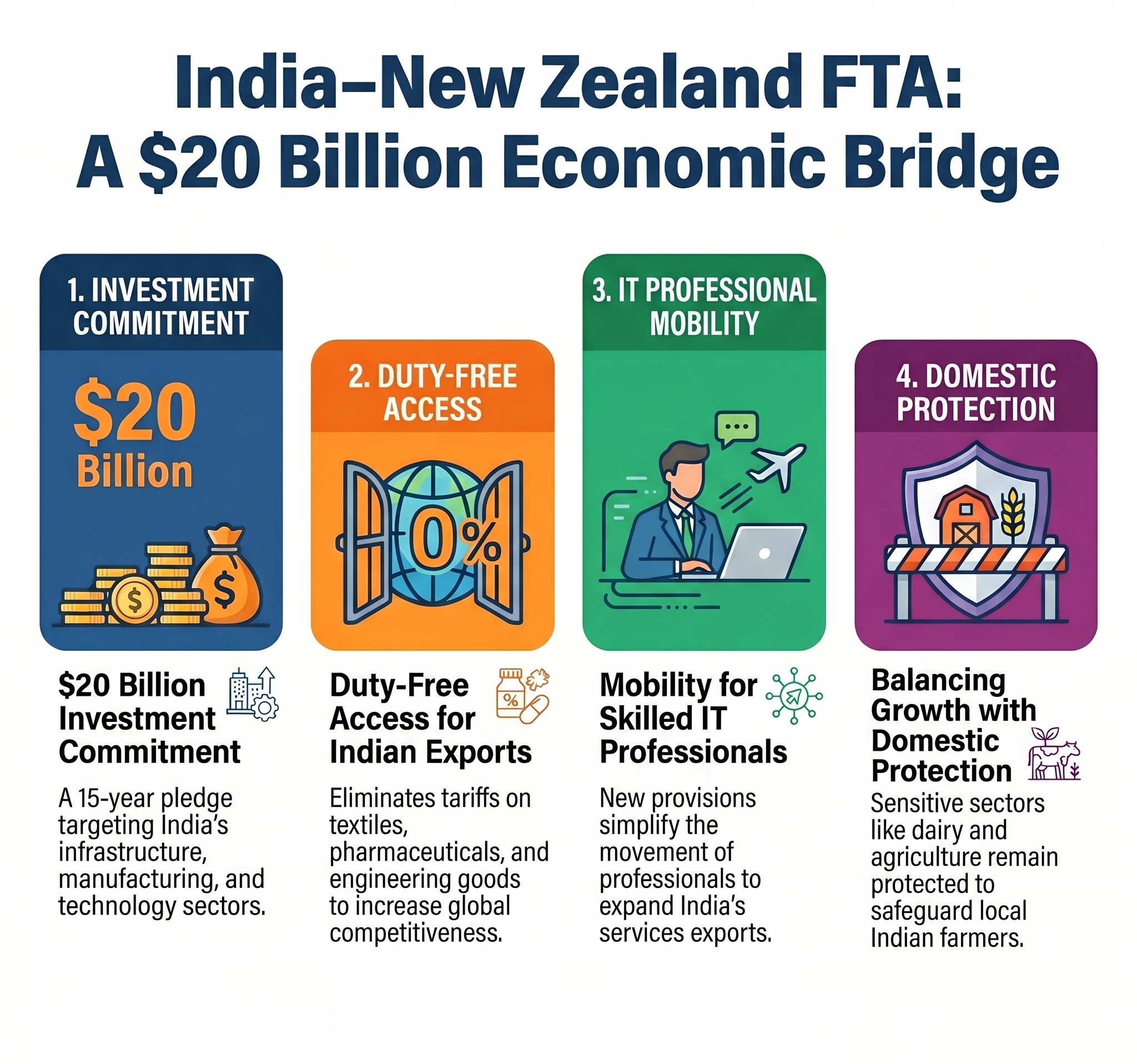
- Investment commitments (~$20 billion over 15 years)
- Sectoral opportunities
- Integration into global value chains
2. Key Arguments
(1) FTA as a Growth Catalyst
- India and New Zealand conclude long-pending FTA negotiations
- Expected outcomes:
- Duty-free access to New Zealand market
- Enhanced bilateral trade
- Investment inflows
Inference:
FTA seen as a tool for economic expansion and diversification
(2) Investment Commitment
- $20 billion investment pledge over 15 years
- Target sectors:
- Infrastructure
- Manufacturing
- Technology
Implication:
Boost to India’s capital formation and job creation
(3) Export Opportunities for India
- Sectors likely to benefit:
- Textiles
- Pharmaceuticals
- Engineering goods
- Agricultural products
- Duty-free access improves:
- Competitiveness
- Market penetration
(4) Services Sector Gains
- India’s strength:
- IT
- Skilled professionals
- FTA provisions:
- Easier mobility of professionals
- Expanded services exports
(5) Agricultural Sensitivities
- New Zealand’s strength:
- Dairy sector
- India’s concern:
- Protection of domestic farmers
Outcome:
Sensitive sectors likely excluded or protected
(6) Supply Chain Integration
- FTA enables:
- Participation in global value chains
- Reduces:
- Tariff and non-tariff barriers
(7) Strategic Diversification
- Reduces dependence on:
- Traditional trade partners
- Enhances:
- Indo-Pacific economic engagement
(8) Ease of Doing Business
- Regulatory simplification
- Improved investment climate
(9) Long-Term Economic Gains
- Increased:
- Trade volume
- Investment
- Technology transfer
(10) Challenges Acknowledged
- Domestic industry competitiveness
- Adjustment costs for MSMEs
- Implementation complexity
3. Author’s Stance
- Clearly pro-FTA and pro-liberalisation
- Emphasises:
- economic opportunities
- strategic gains
- Tone:
- optimistic and forward-looking
4. Biases in the Article
(1) Pro-Trade Liberalisation Bias
- Highlights benefits:
- exports, investment
- Underplays risks:
- trade deficits
- domestic industry stress
(2) Limited Agricultural Perspective
- Dairy concerns mentioned but not deeply analysed
(3) Investment Optimism
- Assumes:
- full realisation of $20 bn pledge
5. Pros and Cons
Pros
Boost to exports
- Duty-free access enhances competitiveness
Investment inflow
- Supports infrastructure and manufacturing
Strategic diversification
- Reduces dependence on limited markets
Services expansion
- Leverages India’s comparative advantage
Cons
Risk to domestic sectors
- Dairy, agriculture
MSME vulnerability
- Increased competition
Trade imbalance possibility
Implementation challenges
- Regulatory coordination
6. Policy Implications
(1) Trade Policy Shift
- Move towards:
- bilateral and regional FTAs
(2) Domestic Competitiveness
- Strengthen:
- MSMEs
- manufacturing
(3) Agricultural Safeguards
- Protect:
- small farmers
(4) Skill Development
- Enhance:
- workforce readiness for global markets
(5) Regulatory Reforms
- Simplify:
- trade procedures
- investment norms
7. Real-World Impact
Short-Term
- Increased investor confidence
- Export boost in select sectors
Medium-Term
- Integration into global value chains
- Job creation
Long-Term
- Structural transformation of economy
- Enhanced global trade position
8. UPSC GS Linkages
GS Paper II
- International relations
- Bilateral agreements
GS Paper III
- Indian economy
- Trade policy
- Globalisation
Essay Topics
- “Free trade vs protectionism”
- “Role of FTAs in India’s economic growth”
9. Critical Insight
The article reflects India’s evolving strategy from trade protectionism to calibrated global integration, balancing domestic sensitivities with external opportunities.
10. Balanced Conclusion
The FTA presents:
- Significant opportunities:
- exports, investment, services
But also requires:
- Careful management of:
- domestic sector vulnerabilities
11. Way Forward
- Adopt:
- phased liberalisation
- Strengthen:
- domestic industries
- Ensure:
- effective implementation
Final Editorial Takeaway
The India–New Zealand FTA represents a strategic step toward deeper global integration, but its success will depend on India’s ability to align domestic competitiveness with external openness while safeguarding vulnerable sectors.
