

India's Air Pollution Crisis: An Institutional Problem, Not a Knowledge Gap

India's Air Pollution Crisis: An Institutional Problem, Not a Knowledge Gap
Source: The Indian Express
Why in News?
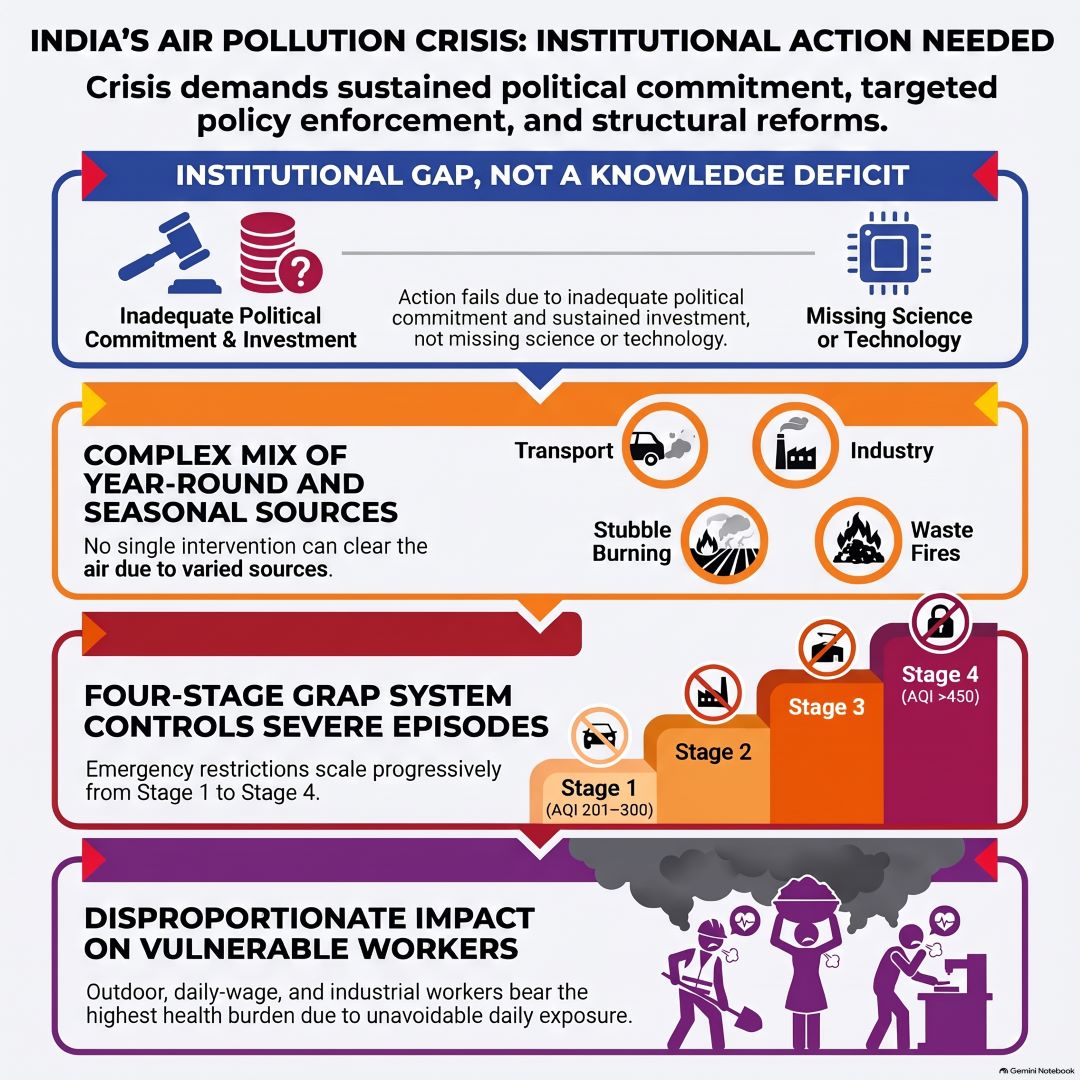
A recent report says India's air pollution problem is not caused by lack of scientific knowledge or technology, but by inadequate institutional attention, political commitment and sustained investment.
Background
- Air pollution is often seen as a Delhi-NCR and winter problem, but unhealthy air affects large parts of India all year, outdoors and indoors.
- North India has severe winter episodes because of many emission sources and weather that limits dispersion, so pollutants build up near the surface. Weather affects how pollutants disperse and accumulate, but it does not create the emissions.
- The National Clean Air Programme (2019) sets city-level targets to cut particulate pollution in non-attainment cities. The Air (Prevention and Control of Pollution) Act, 1981 is the main law, and PM2.5 means particles under 2.5 microns that enter deep into the lungs.
- This links to the 7 November note on GRAP Stage III and the 3 November note on firecrackers.
|
GRAP 3
· GRAP 3 refers to Stage 3 of the Graded Response Action Plan, an emergency air pollution control framework implemented in Delhi-NCR when air quality reaches or is expected to reach the Severe category. It introduces stronger measures to reduce emissions and protect public health.
· GRAP stands for Graded Response Action Plan. It is a step-by-step pollution control system in which restrictions become stricter as air quality deteriorates.
· Meaning of GRAP Stage 3: GRAP 3 is the third level of the action plan and is designed to control severe air pollution. It includes restrictions on certain vehicles, dust-generating construction work and other activities that contribute to pollution.
· Implementation in Delhi-NCR: The plan applies across Delhi and the National Capital Region, including adjoining areas of Haryana, Uttar Pradesh and Rajasthan. Specific restrictions, such as vehicle bans, may apply only to designated districts.
· Authority Responsible for GRAP: The Commission for Air Quality Management (CAQM) reviews air quality conditions, activates GRAP stages and coordinates pollution control measures with state governments and implementing agencies.
· Preventive Approach: GRAP 3 does not necessarily need the AQI to cross 400 before action is taken. Authorities can bring in Stage 3 measures in advance if weather forecasts indicate that pollution may rise to severe levels.
GRAP 3 Air Quality Index (AQI) Criteria
The Air Quality Index (AQI) measures air pollution levels and helps authorities decide when stronger control measures are needed. Under the revised GRAP framework, four stages are linked to different AQI ranges
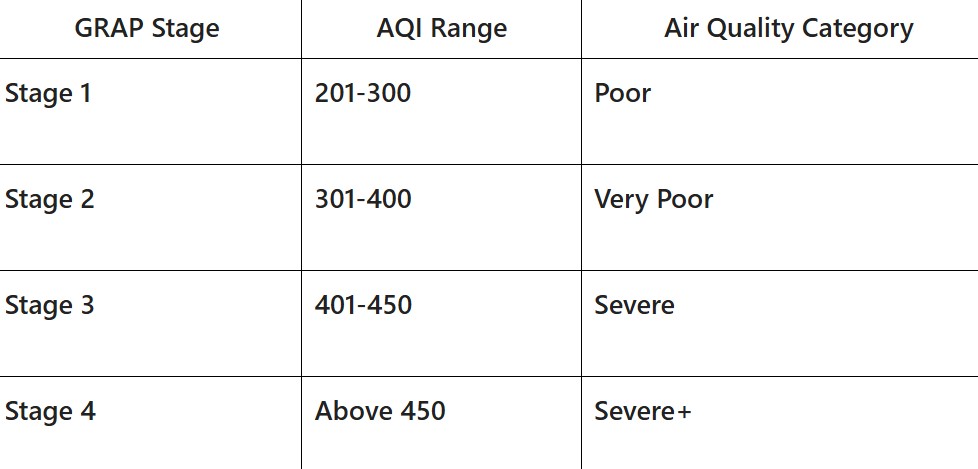
· GRAP Stage 1 – Poor Air Quality: Stage 1 applies when the AQI is between 201 and 300. It focuses on controlling road dust, enforcing pollution norms, preventing open waste burning and monitoring construction activities.
· GRAP Stage 2 – Very Poor Air Quality: Stage 2 applies when the AQI is between 301 and 400. It adds measures such as stricter dust control, higher parking charges and staggered government office timings.
· GRAP Stage 3 – Severe Air Quality: Stage 3 applies when the AQI is between 401 and 450. It brings stricter restrictions on certain petrol and diesel vehicles, construction activities and school operations.
· GRAP Stage 4 – Severe+ Air Quality: Stage 4 applies when the AQI goes above 450. It includes stronger restrictions on the movement of heavy goods vehicles and extra steps to reduce pollution and protect public health.
· Advance Implementation Based on Forecasts: The CAQM looks at current AQI readings, expected weather conditions and pollution forecasts before activating a GRAP stage. So Stage 3 may be imposed before the citywide AQI reaches 401 if severe pollution is expected.
· Difference Between Local and Citywide AQI: A single monitoring station recording an AQI above 400 does not automatically mean Stage 3 is active across Delhi-NCR. The CAQM considers the overall situation and officially announces the applicable restrictions.
Key Highlights
- Seasonal sources: Agricultural residue burning, firecrackers during festivals, and burning of firewood, dung cakes and waste for heating in colder months.
- Year-round sources: Transport, household fuels for cooking and heating, industry and fossil-fuel power plants, open waste burning from weak municipal waste management, and construction dust.
- Because there are many sources, no single intervention or focus on one seasonal cause can solve the problem.
- Unequal exposure: Street vendors and construction workers, sanitation workers and farmers, communities next to industrial facilities, and women who cook for long hours with polluting fuels are most exposed. Daily-wage workers often put earning a living ahead of avoiding polluted air.
Conclusion
India knows the sources of its air pollution. What it needs is sustained institutional attention, political commitment and investment in structural reforms that also protect the most exposed communities.