

India’s Arctic Narrative

India’s Arctic Narrative
Why in News?
- A Parliamentary Standing Committee on External Affairs, in its report titled “India’s Role and Presence in the Arctic and Antarctic Regions”, highlighted the gap between India’s Arctic ambitions and its institutional and operational capabilities.
- The findings come in the context of India’s Arctic Policy, 2022.
India’s Arctic Engagement
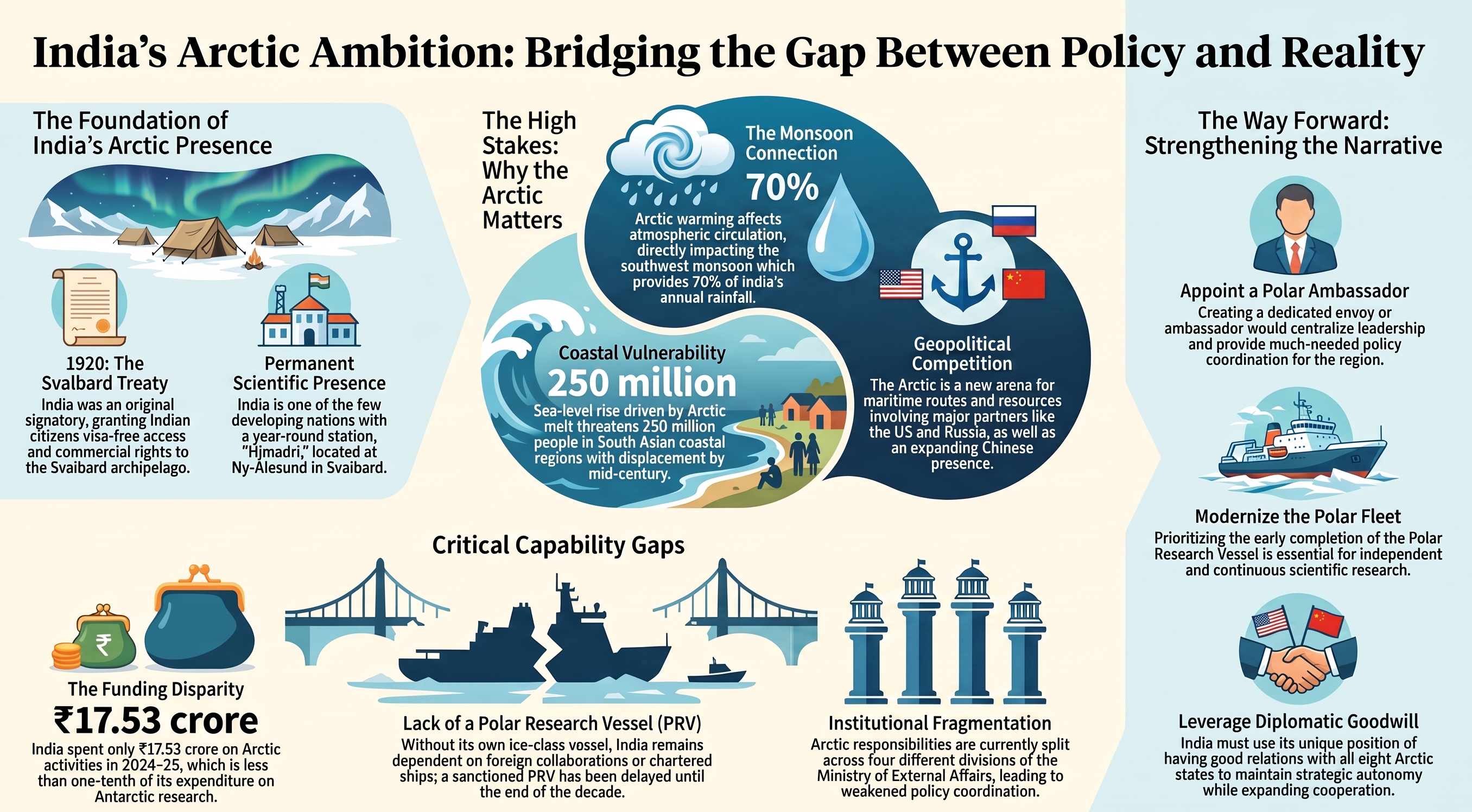
- India’s Arctic engagement dates back to the Svalbard Treaty of 1920, to which it was a signatory as part of the British Dominion.
- The treaty allows Indian citizens to visit the Svalbard archipelago without a visa and undertake certain commercial activities there.
- India is among the few developing countries with a permanent scientific presence in the Arctic.
- India operates the Himadri research station at Ny-Ålesund in Svalbard.
- However, India’s engagement has remained largely focused on scientific research despite the Arctic’s growing climate and geopolitical importance.
Why the Arctic Matters to India?
- Arctic warming and shrinking sea ice can influence atmospheric circulation and may affect the Indian monsoon.
- Agriculture contributes around 18% of India’s GDP and supports more than half of its population, while around 70% of annual rainfall comes from the southwest monsoon.
- Arctic-driven sea-level rise also has implications for India’s long coastline and vulnerable coastal populations across South Asia.
- More than 250 million people in vulnerable South Asian coastal regions could potentially be affected by mid-century, creating implications for migration, humanitarian assistance and national security.
Geopolitical Importance
- The Arctic is increasingly becoming an arena of competition over maritime routes, energy resources and critical minerals.
- The US and Russia, two of India’s major strategic partners, are Arctic states.
- China, although not an Arctic state, has expanded its Arctic research, infrastructure and shipping capabilities.
- India has diplomatic goodwill with all eight Arctic states, strengthened through engagement with the Nordic countries and improving relations with Canada.
- This provides India with an important diplomatic advantage.
Major Capability Gaps
- India does not have a dedicated Polar or Arctic Ambassador.
- Arctic responsibilities are divided among four divisions of the Ministry of External Affairs, potentially weakening policy coordination.
- India also lacks a dedicated Polar Research Vessel (PRV).
- Without an ice-class research vessel, Indian Arctic research remains heavily dependent on Svalbard and foreign collaborations or chartered vessels.
- A PRV was sanctioned in 2014 but has still not been delivered, with completion now expected only towards the end of the decade.
- China, by comparison, has developed a larger polar fleet and has used an acquired icebreaker as an interim capability.
Funding Gap
- India spent only about ₹17.53 crore on Arctic activities in 2024–25.
- This was less than one-tenth of its Antarctic expenditure.
- The low level of funding appears disproportionate to the Arctic’s implications for India's climate security, coastline, scientific interests and geopolitical position.
Way Forward
- India needs to translate the framework of the 2022 Arctic Policy into stronger institutional and operational capabilities.
- A dedicated Polar Ambassador or envoy could provide greater policy coordination.
- Early completion of a Polar Research Vessel would strengthen independent and continuous scientific research.
- Greater and sustained funding is required for polar research, climate modelling, logistics and strategic studies.
- India should deepen cooperation with Arctic states while maintaining strategic autonomy and engagement with both Western and Russian partners.
Significance
- The Arctic is no longer only a distant scientific research zone for India; its changing climate has implications for the monsoon, sea-level rise and coastal security, while its geopolitical importance is increasing.
- India already possesses historical legitimacy, scientific presence and diplomatic goodwill in the region.
- The key challenge is to convert these advantages into sustained institutional capacity and strategic presence.
