

India’s Emerging Homegrown Innovation Ecosystem

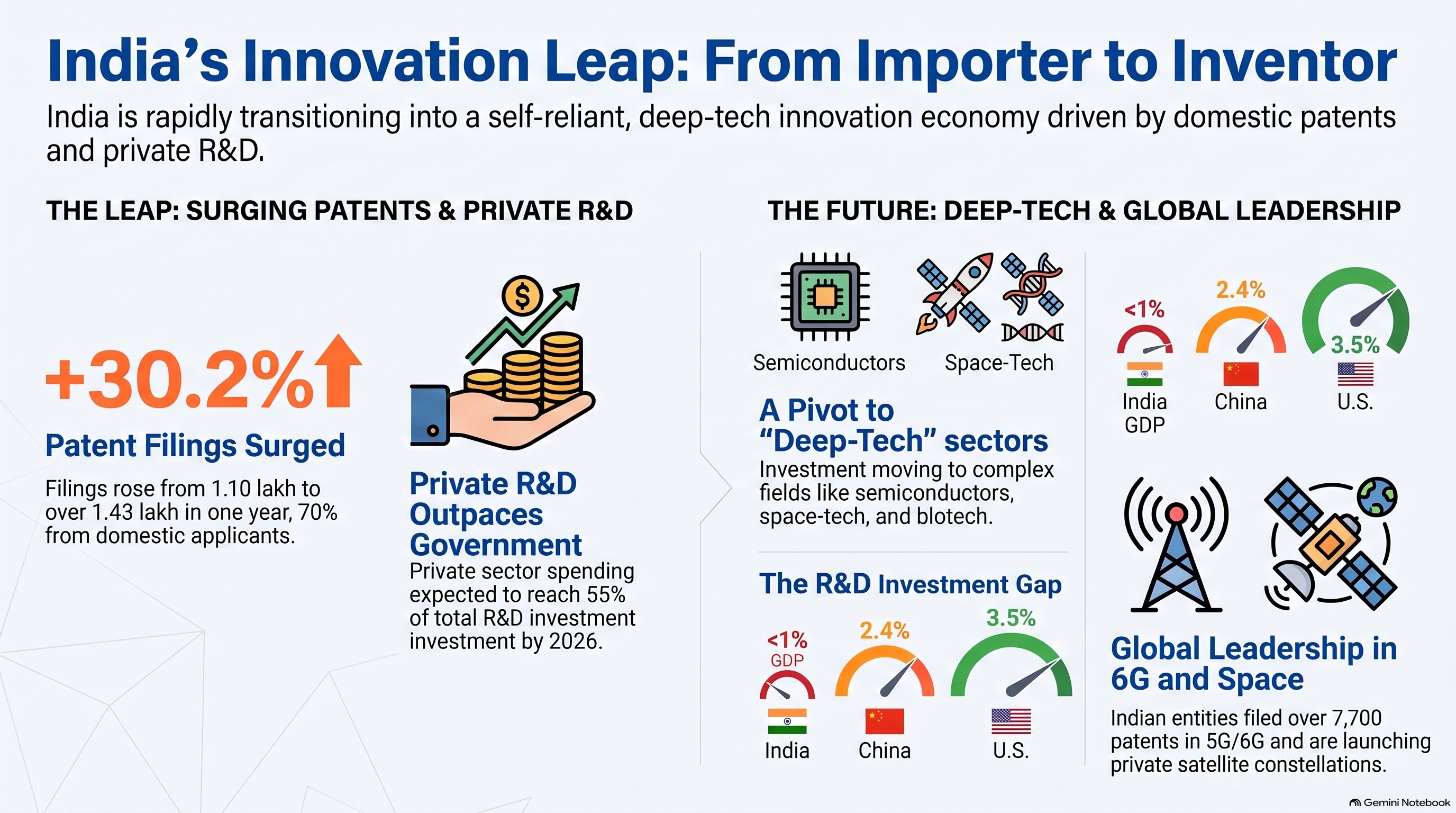
Source: The Hindu
India’s Innovation Landscape: From Importer to Innovator
- India is gradually developing the three institutional foundations of an innovation economy:
- Public research institutions.
- Corporate R&D.
- Deep-tech entrepreneurship.
- Technologies that were earlier largely imported are increasingly being developed domestically through collaboration among research institutions, industry and startups.
- Patent filings increased from over 1.10 lakh in 2024–25 to more than 1.43 lakh in 2025–26, registering a 30.2% rise.
- Domestic applicants now account for nearly 70% of patent filings.
- However, patent filings alone do not indicate successful innovation:
- India had just over 2.4 lakh patents in force in 2025, compared with 5.7 million in China, 3.5 million in the US and 2.1 million in Japan.
- This points towards challenges involving patent grants, abandonment and commercialisation.
- India spends just under 1% of GDP on R&D, compared with around 2.4% in China and 3.5% in the US.
- Thus, the central challenge is moving from higher patent activity to commercially successful, technology-driven innovation.
Three Emerging Pillars of the Ecosystem
- Public research:
- Government-supported institutions continue to undertake long-gestation and strategically important research.
- DRDO laboratories have demonstrated indigenous capabilities in advanced semiconductor technologies.
- Corporate R&D:
- Private-sector R&D spending exceeded combined government R&D spending for the first time in 2024.
- Private R&D is expected to account for around 55% of total R&D spending in 2025–26.
- Increasing corporate investment can strengthen technology development and commercialisation.
- Deep-tech startups:
- India’s startup ecosystem is moving beyond conventional service platforms towards complex manufacturing, space technology, biotechnology and semiconductor applications.
- More than $2.5 billion in deep-tech commitments have been made by members of the India Deep Tech Alliance.
- The convergence of public research, corporate R&D and startups is creating an innovation pipeline from basic research to commercial applications.
Strategic Technologies and Intellectual Property
- Gallium Nitride (GaN) technology:
- DRDO’s Solid State Physics Laboratory (Delhi) and Gallium Arsenide Enabling Technology Centre (Hyderabad) developed GaN monolithic microwave integrated circuits (MMICs).
- GaN technology is important for advanced radar, space systems, 5G/6G communications, electric-vehicle chargers and renewable-energy inverters.
- India is among a small group of countries with this technological capability.
- AGNIT Semiconductors, a spin-off from IISc’s Centre for Nano Science and Engineering, is translating indigenous GaN technology into commercial applications.
- 6G and standards:
- Bharat 6G Alliance members have made more than 7,700 patent filings across 5G and 6G technologies, including over 4,400 foreign filings.
- Members also made nearly 3,000 technical contributions to 3GPP in the previous year, around 15 times the 2020 level.
- Jio Platforms entered the top 20 international patent filers in the 2025 WIPO Patent Cooperation Treaty rankings.
- Ownership of patents and participation in global standards bodies are increasingly important because they determine who captures economic value from emerging technologies.
Deep-Tech Innovation: Space and Healthcare
- Space technology:
- Pixxel Space is developing hyperspectral imaging technology, with six satellites in orbit and a planned constellation of 18–24 satellites.
- Skyroot Aerospace’s Vikram-1 launch and Agnikul Cosmos’s work on reusable launch vehicles demonstrate growing private-sector capabilities in space technology.
- Healthcare:
- ImmunoACT, incubated at IIT Bombay with Tata Memorial Centre, developed NexCAR19, India’s first indigenous CAR-T cell therapy.
- The therapy has helped reduce the cost of advanced cancer treatment substantially compared with conventional CAR-T therapies.
- Remidio Innovative Solutions uses smartphone-enabled retinal imaging and AI to detect conditions such as diabetic retinopathy and glaucoma.
- Support from institutions such as BIRAC helps bridge the gap between scientific research and commercial healthcare applications.
- These examples demonstrate how indigenous research can combine affordability, technological capability and commercial scalability.
Challenges and Way Forward
- India’s innovation ecosystem remains incomplete despite rapid progress.
- Key challenges include:
- Low overall R&D expenditure as a share of GDP.
- Weak conversion of patents into commercially viable products.
- Limited funding between patent development and the first paying customer — the “translational gap”.
- Need for greater patent-examiner capacity and faster IP processing.
- Lack of standardised technology-transfer terms for publicly funded intellectual property.
- Need for stronger links between universities, government laboratories, industry and startups.
- India needs to increase both public and private R&D investment while strengthening mechanisms for technology transfer and commercialisation.
- Public research should generate foundational technologies, academia should nurture talent and research capabilities, and startups and industry should scale these technologies into markets.
- The emerging ecosystem indicates a gradual shift from India being primarily a services and technology-implementing economy towards one capable of generating its own intellectual property, strategic technologies and industrial capabilities.
