

India’s Forgotten Rice Varieties Are Making a Comeback

India’s Forgotten Rice Varieties Are Making a Comeback
Context:
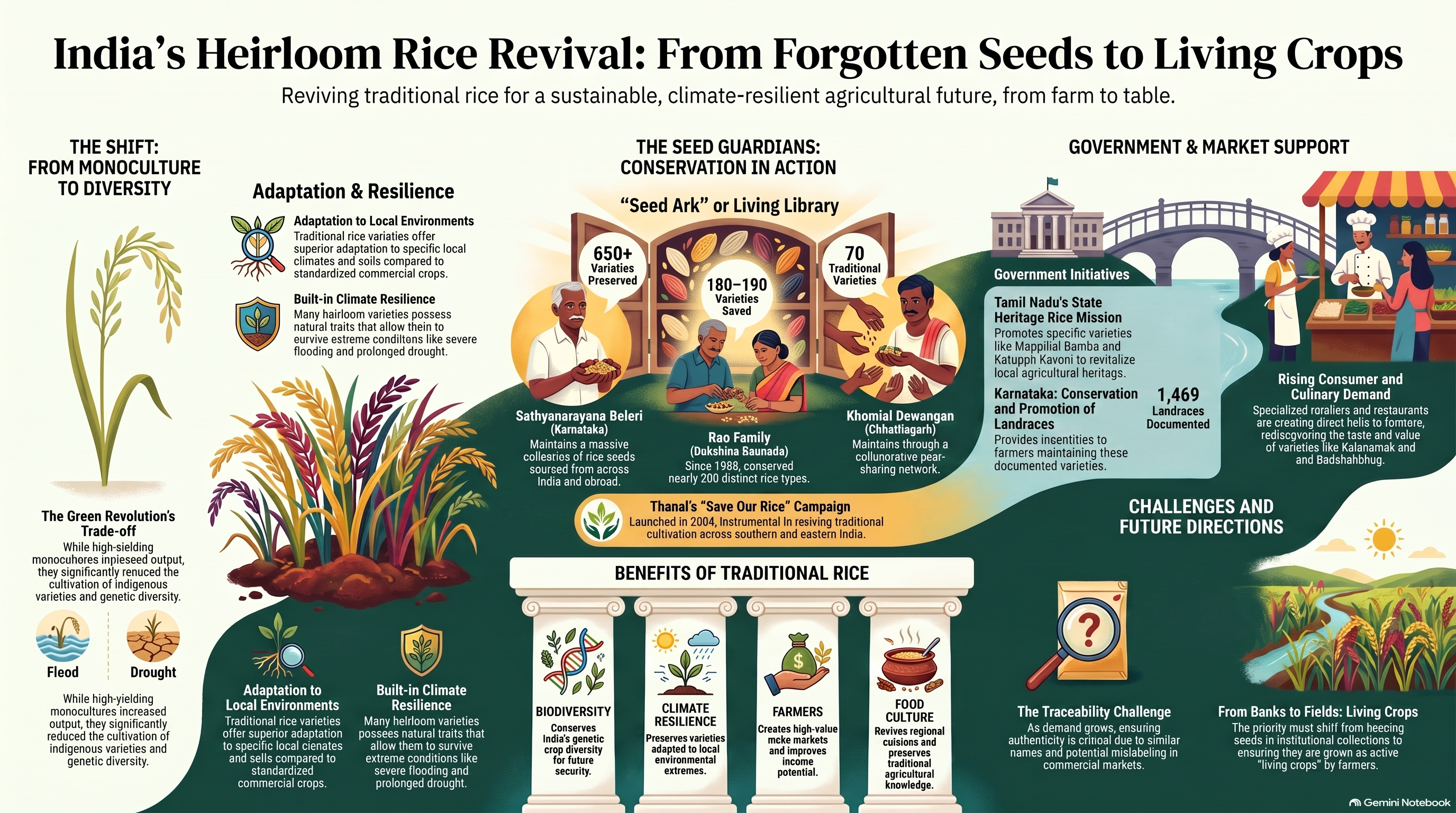
Traditional rice varieties that declined during the Green Revolution are gradually returning to farms, markets and kitchens. Farmers, seed conservators, NGOs, governments and restaurants are driving this revival, linking rice conservation with biodiversity, climate resilience and cultural heritage.
Why Traditional Rice Matters?
The Green Revolution encouraged high-yielding monocultures, reducing the cultivation of many indigenous varieties. However, traditional rice can offer:
- Greater adaptation to local climates and soils
- Traits such as flood and drought resilience
- Genetic diversity for future crop improvement
- Distinct nutritional, culinary and cultural value
Seed Guardians and Conservation
Farmers and conservationists are preserving traditional varieties through seed banks and field cultivation.
- Sathyanarayana Beleri of Karnataka maintains 650+ rice seed varieties collected from India and abroad.
- The Rao family in Dakshina Kannada has conserved around 180–190 varieties since 1988.
- In Chhattisgarh, Khemlal Dewangan maintains around 70 traditional varieties through a farmer-to-farmer seed network.
- Thanal’s Save Our Rice campaign, launched in 2004, helped revive traditional rice cultivation across southern and eastern India.
Government Support
· Tamil Nadu’s State Heritage Rice Mission promotes varieties such as Mappillai Samba, Karuppu Kavuni, Thooyamalli, Poongar, Kaatuyanam and Kichili Samba.
· Karnataka has documented 1,469 traditional paddy landraces under its Conservation and Promotion of Landraces Programme and provided incentives to farmers maintaining viable seed varieties.
From Farm to Market
Demand for heirloom rice is increasing as consumers rediscover their taste and cultural value. Varieties such as Kaima/Jeerakasala, Kalanamak, Mappillai Samba, Karuppu Kavuni and Badshahbhog are finding renewed demand.
Restaurants are also promoting indigenous rice through regional cuisines, while specialised retailers are creating direct links between farmers and consumers.
Major Challenge: Traceability
Growing demand has created a new concern: authenticity.
Different traditional varieties can have similar names, while commercially sold rice may sometimes be incorrectly labelled. Reliable seed banks, farmer-level documentation, geographical identification and traceability systems are therefore essential.
Significance
|
Dimension |
Importance |
|
Biodiversity |
Conserves India's genetic crop diversity |
|
Climate resilience |
Preserves varieties adapted to local environmental conditions |
|
Farmers |
Creates niche markets and better-value crops |
|
Food culture |
Revives regional cuisines and traditional knowledge |
|
Agriculture |
Provides genetic resources for future crop improvement |
Way Forward
- Strengthen community seed banks and custodian farmers.
- Support cultivation rather than keeping varieties only in institutional collections.
- Improve scientific documentation and traceability.
- Promote GI registration and local branding where appropriate.
- Link traditional varieties with climate-resilient agriculture.
- Build stronger farmer–consumer–restaurant supply chains.
Conclusion
India’s heirloom-rice revival is more than a return to traditional food. It is an effort to conserve agricultural biodiversity, strengthen climate resilience, support farmers and preserve cultural heritage. The priority should be to ensure that these varieties remain living crops in farmers’ fields, rather than merely preserved specimens in seed banks.
