

India's GenZ Opportunity: Course-Correcting Jobless Growth

India's GenZ Opportunity: Course-Correcting Jobless Growth
Relevance: GS Paper III (Indian Economy, Employment, Industrial Policy) | Essay linkage (Demographic Dividend, Youth Unemployment)
Why in the News?
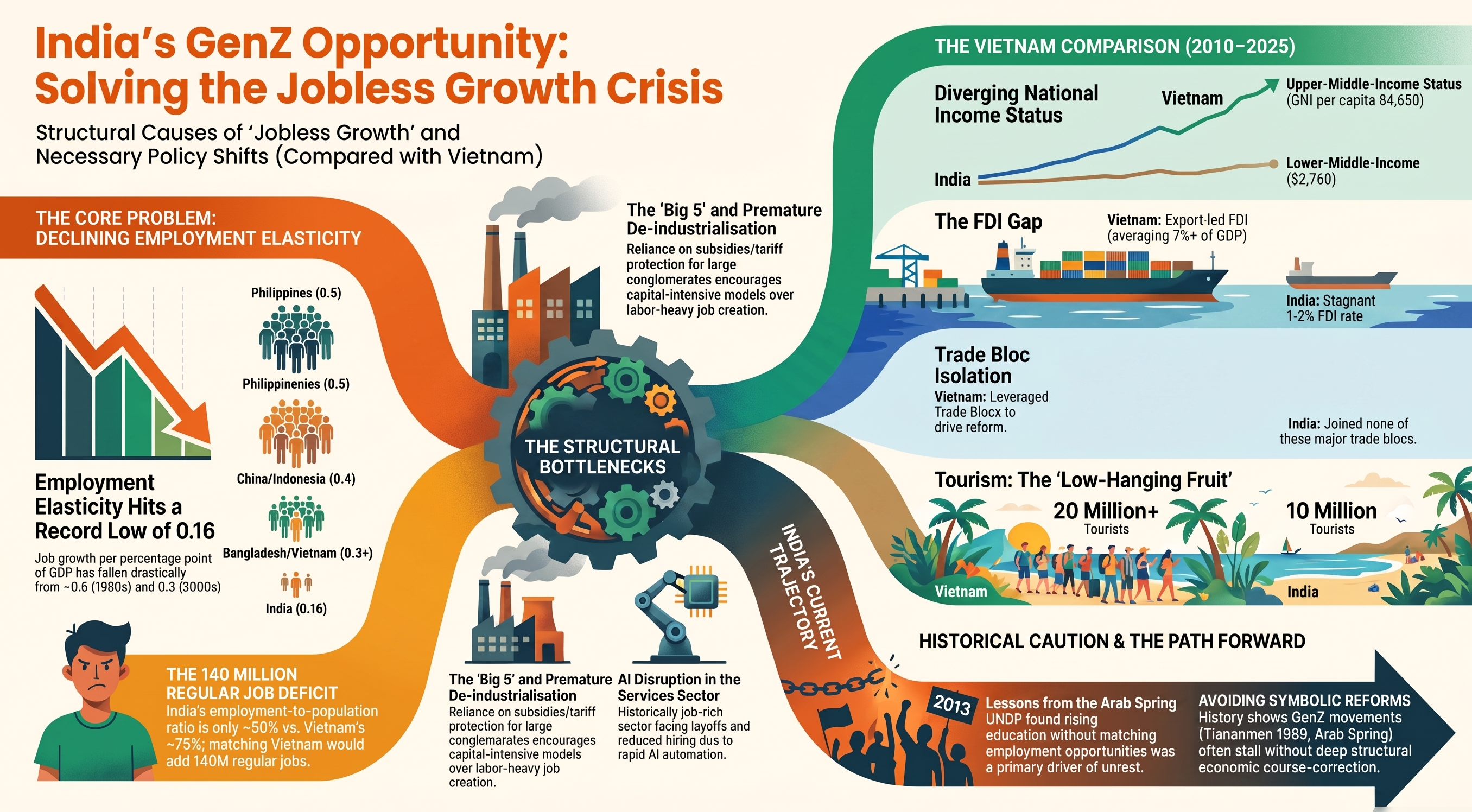
The NEET-leak-triggered Jantar Mantar protests ended with the government promising education reforms, but the author argues the unrest reflects deeper structural anger over inequality and jobless growth — echoing the UNDP's 2013 finding that rising education without matching jobs was a major driver of the Arab Spring, and paralleling recent youth unrest in Bangladesh and Nepal.
The Core Problem: Declining Employment Elasticity
India's GDP has grown, but employment elasticity (job growth per percentage point of GDP growth) has fallen from ~0.5 in the 1980s to 0.3 in the 2000s to just 0.16 today — among the lowest globally, compared to over 0.3 for Bangladesh and Vietnam, 0.4 for China and Indonesia, and 0.5 for the Philippines. India's employment-to-population ratio (~50%) trails Vietnam's (~75%); had it been 10 percentage points higher, India would have had 140 million more people in regular jobs.
Why: A Crony-Capitalist, Capital-Intensive Model
The author attributes this to India's reliance on big business (the "Big 5") for industrial development via subsidies and tariff protection, which may be causing "premature de-industrialisation" rather than job creation — the same big-business-protective instinct that also derailed earlier farm reforms. Even the historically job-generating services sector is now seeing layoffs due to AI disruption.
The Vietnam Comparison
Vietnam, behind India in 2010, has since moved to upper-middle-income status (GNI per capita $4,650 in 2025) while India remains lower-middle-income ($2,760). Investment levels are similar, but Vietnam relied heavily on export-led FDI — net FDI averaging over 7% of GDP (10-12% in early years) versus India's 1-2% (now declining as investors exit). Vietnam achieved this by joining major trade blocs (ASEAN Free Trade Area, CPTPP, RCEP, EU FTA) and using them to drive domestic reform; India has joined none of these and has even weakened existing bilateral investment treaties, while still struggling to finalise a US trade deal or ratify its EU FTA. Vietnam also draws over 20 million tourists annually (India: ~10 million, excluding NRI visits) — the author calls tourism a "low-hanging fruit" India underuses despite its cultural heritage.
The Historical Caution
Most "GenZ movements" have not produced lasting reform — the Arab Spring was largely crushed; recent regime changes in India's neighbourhood haven't delivered meaningful structural reform; even China's reforms stalled for three years after Tiananmen Square (1989) before resuming in 1992. The author argues India can choose a different path, but only if these protests translate into genuine course correction rather than symbolic exam-reform gestures alone.
Significance for Mains
- Connects directly to the demographic dividend vs. demographic disaster debate — a recurring GS III/Essay theme.
- Offers a clear comparative framework (India vs. Vietnam vs. China) on FDI-led vs. protection-led industrialisation strategies, useful for questions on industrial policy and trade agreements (RCEP, CPTPP).
- Links to earlier-covered themes: youth unemployment data (JustJobs Network note), India's manufacturing "blind spot" (Ajay Srivastava's NREPM proposal), and the CJP protest analysis — together forming a comprehensive picture of the jobs-education-unrest nexus in current affairs.
- Raises the specific policy tool of trade-bloc membership as a reform-forcing mechanism, relevant to India's ongoing FTA negotiations (UK, EU, and stalled US talks).
