

India's Green Law Needs Baselines, Not Snapshots

India's Green Law Needs Baselines, Not Snapshots
Source: The Hindu
Why in news?
The Supreme Court's 22 August decision overturned the National Green Tribunal's (NGT) December 2017 judgment on the Art of Living's World Culture Festival. The festival was held from 11 to 13 March 2016 on 25 hectares of the Yamuna floodplain in Delhi. The NGT had ordered ₹5 crore as environmental compensation. The Supreme Court ordered a refund, asking whether the organisers had caused additional damage to an already degraded floodplain.
Static background
- NGT Act, 2010: Created the NGT to decide environmental cases quickly. It applies sustainable development, the precautionary principle and the polluter pays principle. Section 15 deals with relief, compensation and restoration.
- Polluter pays principle: Those who cause environmental harm bear the cost of remedying it. It was accepted in Indian law in Indian Council for Enviro-Legal Action v. Union of India (1996) and Vellore Citizens Welfare Forum v. Union of India (1996).
- Article 21 includes the right to a healthy environment, and Articles 48A and 51A(g) set the State's and citizens' duties.
- Floodplains absorb floodwater and recharge groundwater. The NGT's 2015 order in Manoj Misra v. Union of India was about protecting the Yamuna floodplain.
The Supreme Court's decision and the polluter pays principle
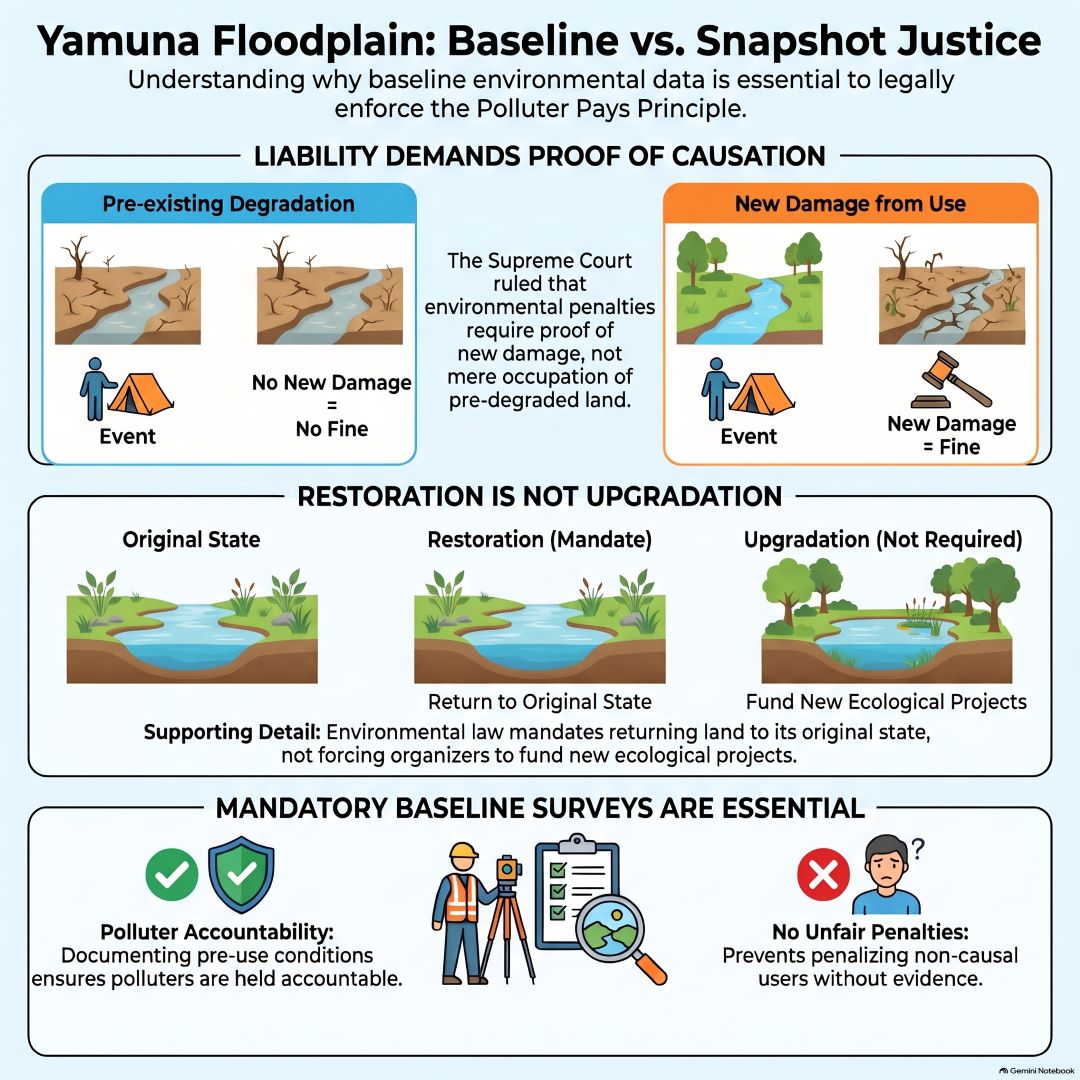
- The principle holds that those responsible for environmental damage bear compensation and restoration costs. Liability must rest on demonstrable responsibility, not mere occupation of land.
- The central question was whether the festival caused additional damage or the destruction already existed.
- The Court stressed that environmental penalties need evidence of causation and individual responsibility.
- The approach is legally sound, but uncertainty should not become an excuse to escape environmental accountability.
A tribunal that decided too early
|
1. Premature finding of liability
2. Pre-existing degradation
3. Restoration versus ecological upgradation
|
|
Major Environmental Legislations in India These laws can be linked to the issue of environmental monitoring and regulatory enforcement.
5. Important Institutions and Their Functions
|
Conclusion
Environmental accountability needs evidence of the land's condition before use. Mandatory baseline surveys, together with equitable apportionment under Section 17(2), would let the polluter pays principle work without punishing the innocent or excusing the harmful.