

India’s new climate targets are modest but significant
Indian Express
1. Key Arguments
A. Incremental Enhancement of NDCs
Targets show continuity rather than transformation.
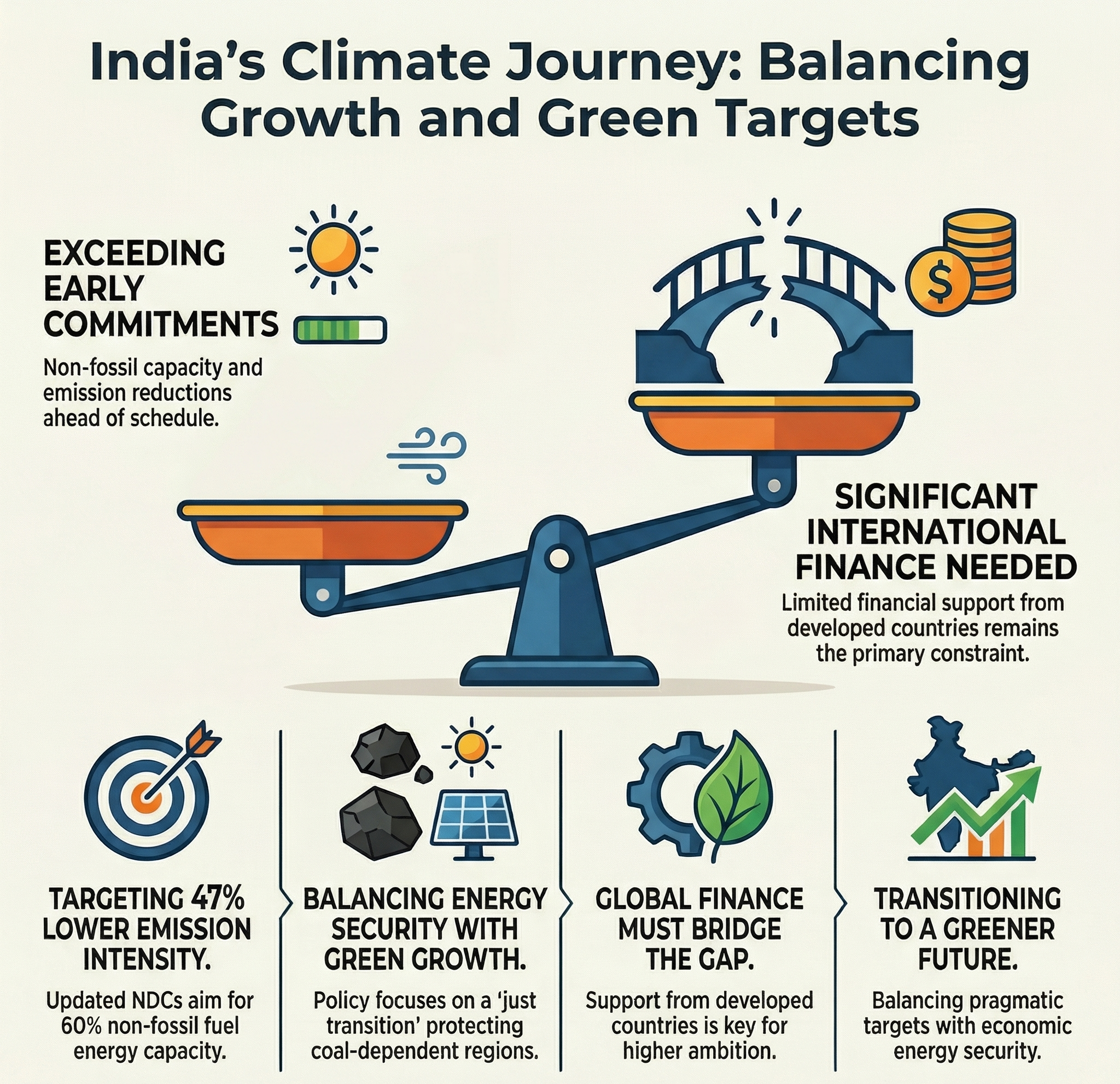
Emission intensity reduction (47%) and 60% non-fossil capacity indicate progress but not a radical shift.
B. India’s Strong Track Record
India has already met or exceeded earlier commitments.
Non-fossil capacity and emission reductions are ahead of schedule.
C. Climate Finance Constraints
Limited financial support from developed countries restricts ambition.
Failure of global climate finance commitments reduces policy space.
D. Global Geopolitical Context
Shifts in global politics (e.g., retreat from climate leadership by major economies) affect India’s approach.
India balances climate action with energy security and economic growth.
E. Emphasis on Flexibility and Sovereignty
India prefers self-determined pathways over externally imposed targets.
Maintains policy autonomy in climate commitments.
F. Need for Long-Term Investment
Energy transition requires sustained financing and infrastructure.
Renewables, storage, and grid modernisation are critical.
2. Author’s Stance
Balanced with mild critique
Acknowledges progress
Recognises India’s achievements and commitment.
Questions ambition levels
Suggests targets could be more aggressive.
3. Biases and Limitations
Climate ambition bias
Assumes higher targets are always preferable, underplaying development constraints.
Limited domestic political economy analysis
Internal challenges like coal dependence and employment are not deeply explored.
Global finance emphasis
May overattribute constraints to external factors.
4. Strengths (Pros)
Contextual analysis
Links national targets with global developments.
Data-backed discussion
Provides measurable indicators and progress.
Balanced tone
Recognises both achievements and gaps.
5. Weaknesses (Cons)
Limited sectoral breakdown
Energy, transport, and industry transitions are not deeply analysed.
Insufficient focus on implementation challenges
Execution barriers need more attention.
Underexplored adaptation dimension
Focus is more on mitigation than resilience.
6. Policy Implications
A. Scaling Renewable Energy
Accelerating solar, wind, and storage deployment
Reducing reliance on fossil fuels.
B. Climate Finance Mobilisation
Leveraging domestic and international funding
Green bonds, multilateral financing.
C. Strengthening Energy Infrastructure
Modernising grids and storage systems
Ensuring reliability of renewable energy.
D. Balancing Growth and Sustainability
Integrating climate goals with economic development
Just transition for coal-dependent regions.
E. Enhancing Adaptation Measures
Building climate resilience
Infrastructure, agriculture, and water systems.
7. Real-World Impact
Environmental Impact
Reduction in carbon intensity
Progress towards climate goals.
Economic Impact
Investment opportunities in green sectors
Job creation and industrial growth.
Energy Security
Diversification of energy sources
Reduced import dependence.
Challenges
Resource constraints and transition costs
Balancing affordability and sustainability.
8. UPSC GS Paper Linkages
GS Paper III (Environment & Economy)
- Climate change
- Energy transition
- Sustainable development
GS Paper II (International Relations)
- Paris Agreement
- Climate diplomacy
GS Paper I (Geography)
- Resource distribution
- Environmental challenges
9. Balanced Conclusion
India’s climate targets reflect pragmatic ambition—progressive yet cautious.
While they signal commitment, achieving global climate goals will require greater ambition, supported by finance and technology.
10. Future Perspective
Towards higher ambition with support
Scaling targets as capacity improves.
Strengthening global cooperation
Ensuring equitable climate finance.
Technological innovation
Advancing clean energy solutions.
Holistic climate strategy
Balancing mitigation, adaptation, and development.
Final Insight
India’s climate journey is not just about targets—it is about navigating the complex intersection of growth, equity, and sustainability in a changing world.
