

India's Top 100 Cities Drive Consumption Growth
India's Top 100 Cities Drive Consumption Growth
Source: The Times of India (03-07-2026)
Why in News?
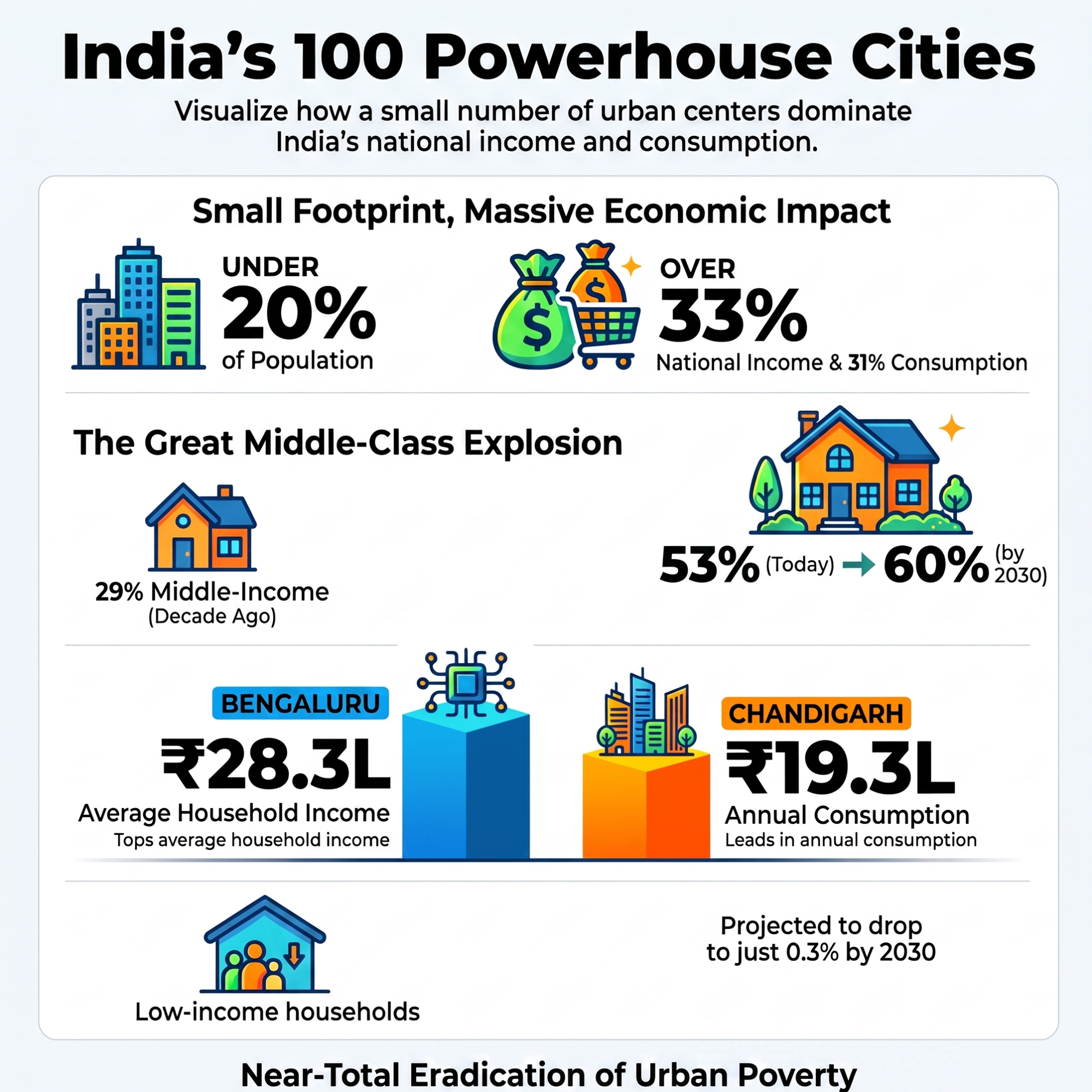
A report titled "Many Urban Indias" by People Research on India's Consumer Economy (PRICE) and Tata Sons highlights the growing role of India's top 100 cities in driving income, consumption and the expansion of the middle class.
Key Findings
- India's top 100 cities account for:
- Less than 20% of the country's population.
- Over one-third of national household income.
- 31% of total household consumption.
- Urban India is witnessing rapid expansion of the middle- and high-income population.
Classification of Indian Cities
|
Category |
Population |
Average Annual Household Income |
|
Big Six |
Above 10 million |
₹23 lakh |
|
Boomtowns |
2.5–10 million |
₹17 lakh |
|
Breakout Cities |
1.5–2.5 million |
₹14 lakh |
|
Frontier Cities |
0.5–1.5 million |
₹12 lakh |

Income Trends
Middle-Income Households (₹6–36 lakh annually)
- Share increased from 29% to 53% during the last decade.
- Expected to reach 60% of households in the top 100 cities by 2030.
- Hyderabad has the highest proportion of middle-income households.
High-Income Households (Above ₹36 lakh annually)
- Increased from 3% to 12% over the last decade.
- Projected to approach 20% by 2030.
- Highest concentration in:
- Delhi
- Mumbai
- Pune
- Fastest growth observed in:
- Raipur
- Thoothukudi
- Kannur
Low-Income Households (Below ₹1.5 lakh annually)
- Share expected to decline sharply.
- Projected to constitute only 0.3% of households in the top 100 cities by 2030.
Highest Average Household Income (2025–26 Estimates)
|
City |
Average Household Income |
|
Bengaluru |
₹28.33 lakh |
|
Chandigarh |
₹28.32 lakh |
|
Delhi |
₹25.9 lakh |
|
Mumbai |
₹25.7 lakh |
|
Pune |
₹23.2 lakh |
Highest Household Consumption Expenditure
|
City |
Annual Household Consumption |
|
Chandigarh |
₹19.3 lakh |
|
Thiruvananthapuram |
₹17.6 lakh |
|
Tiruppur |
₹17.1 lakh |
|
Surat |
₹15.5 lakh |
|
Bengaluru |
₹15.1 lakh |

Significance
- Demonstrates the increasing role of urban India as the engine of economic growth.
- Reflects rising household incomes and consumption-led growth.
- Expanding middle class is likely to drive demand for housing, education, healthcare, consumer goods and financial services.
- Highlights the emergence of Tier-II and Tier-III cities as new growth centres.
Challenges
- Growing regional disparities in income and consumption.
- Pressure on urban infrastructure and public services.
- Rising housing and living costs.
- Persistent urban inequality despite income growth.
- Need for balanced regional development.
Way Forward
- Promote planned urbanisation and sustainable city development.
- Strengthen infrastructure in emerging Tier-II and Tier-III cities.
- Improve affordable housing, public transport and basic urban services.
- Encourage employment-intensive manufacturing and services.
- Foster inclusive urban growth through skill development and social protection.
Conclusion
India's top 100 cities are becoming the principal drivers of income generation and consumption, supported by a rapidly expanding middle class. Ensuring balanced, sustainable and inclusive urbanisation will be critical for maintaining long-term economic growth.
Final Takeaway
Urban India is emerging as the primary engine of consumption-driven growth. The rise of middle-income households and the growing importance of emerging cities present significant opportunities, but balanced urban development and inclusive growth remain essential.
