

India’s trade strategy in a multipolar world
The Hindu
I. Core Context
The article examines India’s evolving trade strategy in response to a shifting global order marked by geopolitical fragmentation, supply-chain realignments, and the emergence of multiple economic poles. It highlights India’s shift from cautious engagement in Free Trade Agreements (FTAs) to an assertive and diversified trade diplomacy strategy.
The focus areas include:
- New-generation FTAs with developed economies
- Strategic autonomy within interdependence
- Integration into global value chains
- Diversification of export markets
II. Key Arguments Presented
1. From Defensive to Proactive Trade Policy
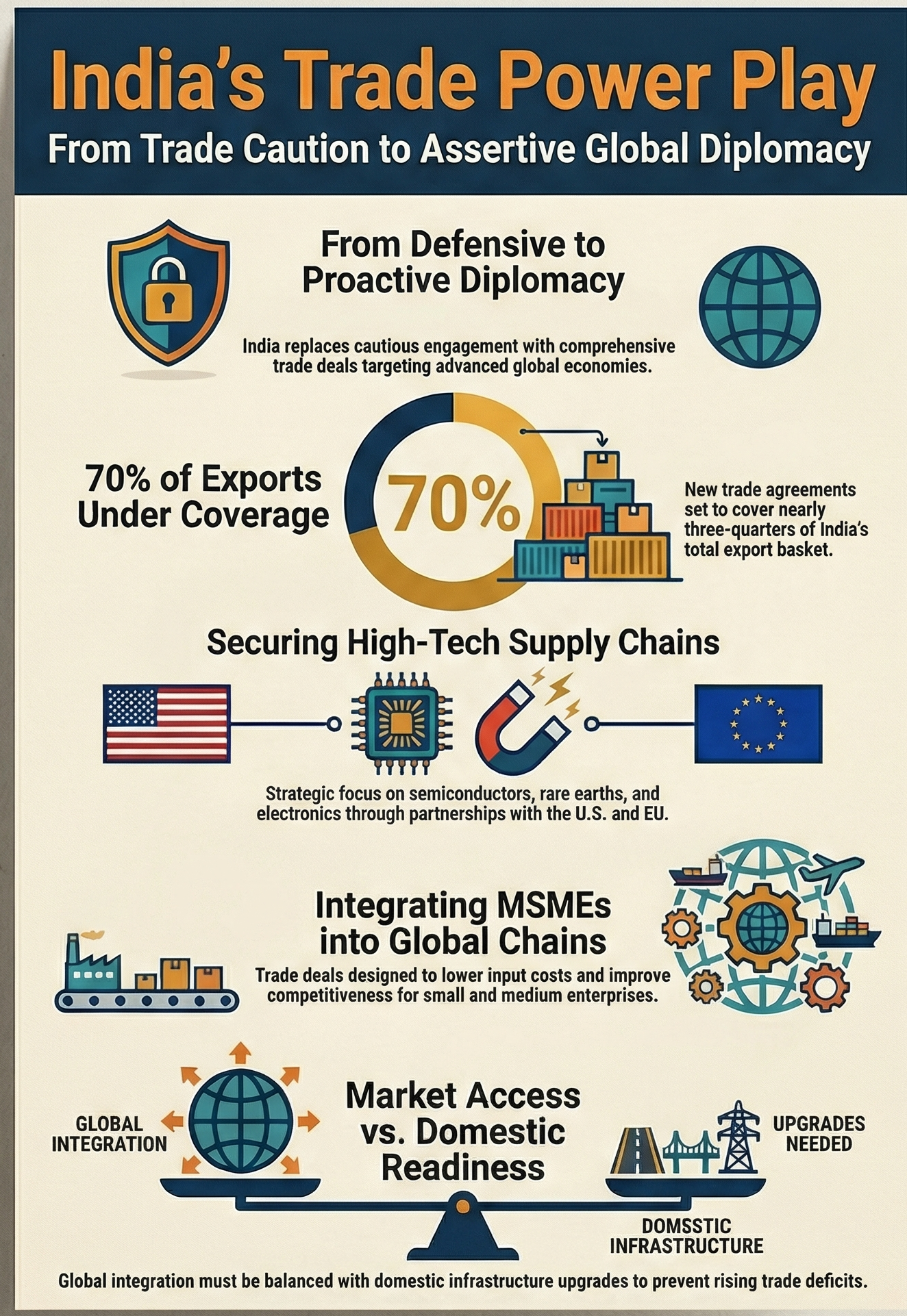
For years, India adopted a cautious approach to FTAs, fearing deindustrialisation and trade deficits. The article argues that:
- India has now embraced comprehensive FTAs
- Engagement extends to advanced economies like the EU, UK, UAE, Australia, and the U.S.
- Nearly 70% of India’s export basket may soon be covered by trade agreements
This marks a structural shift in India’s external economic policy.
2. India–EU FTA as Transformational
The EU agreement is described as:
- A major breakthrough after decades of negotiation
- Expanding access to textiles, pharmaceuticals, leather, chemicals, and marine products
- Enhancing regulatory cooperation and digital trade
The article frames it as a cornerstone of India’s global trade repositioning.
3. The U.S. Deal and Strategic Sectors
The piece highlights the interim framework with the U.S., focusing on:
- Reciprocal tariff reductions
- Cooperation in rare earths and semiconductors
- Strengthening electronics manufacturing
Trade is presented as intertwined with industrial and strategic priorities.
4. Integration into Global Value Chains
FTAs are portrayed as:
- Facilitating MSME integration
- Improving competitiveness
- Lowering input costs
- Enabling seamless cross-border supply chains
The article suggests deeper global integration as essential for economic scaling.
5. Trade as Geopolitical Instrument
The strategy is not purely economic. It aims to:
- Diversify dependence
- Reduce overreliance on a single geography
- Strengthen diplomatic leverage
- Shape global trade norms
III. Author’s Stance
The tone is supportive and optimistic.
The article strongly endorses:
- Trade liberalisation
- Strategic diversification
- Integration with developed markets
It positions FTAs as essential to India’s ambition of becoming a leading economic power.
IV. Possible Biases and Limitations
1. Underplaying Domestic Vulnerabilities
The article does not fully address:
- Trade deficits
- Sectoral dislocation risks
- Agriculture sensitivity
- Impact on small manufacturers
FTAs can create winners and losers.
2. Limited Discussion on Implementation Challenges
Complex FTAs require:
- Standards harmonisation
- Regulatory capacity
- Infrastructure readiness
Execution difficulties are understated.
3. Optimistic Growth Assumptions
The assumption that market access automatically translates into export expansion may overlook:
- Supply-side bottlenecks
- Logistics inefficiencies
- Skill gaps
V. Pros and Cons of the Strategy
Pros
• Diversifies export markets
• Reduces overdependence on single country
• Enhances competitiveness
• Attracts investment
• Integrates India into high-value supply chains
Cons
• Risk of import surge
• Pressure on domestic industries
• Regulatory adjustment costs
• Exposure to global shocks
VI. Policy Implications
1. Domestic Competitiveness Reform
FTAs must be complemented by:
- Infrastructure modernisation
- Logistics efficiency
- Skill development
- Technology upgrading
Trade openness without competitiveness can widen deficits.
2. MSME Integration
Support measures needed:
- Credit access
- Quality certification assistance
- Digital trade enablement
3. Strategic Autonomy
India must balance:
- Global integration
- Domestic industrial policy
- National security concerns
4. Institutional Strengthening
Trade negotiations require:
- Technical expertise
- Regulatory harmonisation capacity
- Dispute resolution preparedness
VII. Real-World Impact
Short-term:
- Increased export opportunities
- Investment signalling
Medium-term:
- Structural supply-chain shifts
- Greater technology inflows
Long-term:
- Stronger global trade presence
- Enhanced diplomatic leverage
- Potential reconfiguration of domestic industry
Failure to align domestic reforms may:
- Increase trade deficits
- Create sectoral distress
- Undermine public support for FTAs
VIII. UPSC Relevance
GS Paper II
• India’s foreign policy
• Economic diplomacy
• Global governance
GS Paper III
• External sector and trade policy
• Global value chains
• Industrial policy and competitiveness
Essay Themes
• Strategic autonomy in a multipolar world
• Trade liberalisation and development
• Globalisation and national interest
IX. Balanced Conclusion and Future Perspective
India’s trade strategy reflects a calibrated embrace of interdependence in a multipolar world. The pivot toward comprehensive FTAs signals confidence and ambition.
However, trade agreements are frameworks—not guarantees. Their success depends on:
- Domestic capacity
- Institutional readiness
- Policy coherence
- Political consensus
If complemented by structural reforms and industrial competitiveness, India’s trade expansion can accelerate its journey toward economic leadership. Without such alignment, market access may outpace manufacturing readiness.
In a multipolar world, resilience lies not in isolation but in diversified, strategic integration.
