

India’s Workforce Continues to Be Largely Informal

India’s Workforce Continues to Be Largely Informal
Why Formalisation Remains a Challenge?
- The 1991 economic reforms dismantled industrial licensing, opened the economy to foreign investment and accelerated growth, but did not produce a large-scale shift from informal to formal employment.
- A 2002 UNICEF working paper, using NSS 50th Round data, estimated that 80.3% of non-agricultural employment was informal in 1993–94, involving about 100.5 million of 124.6 million workers.
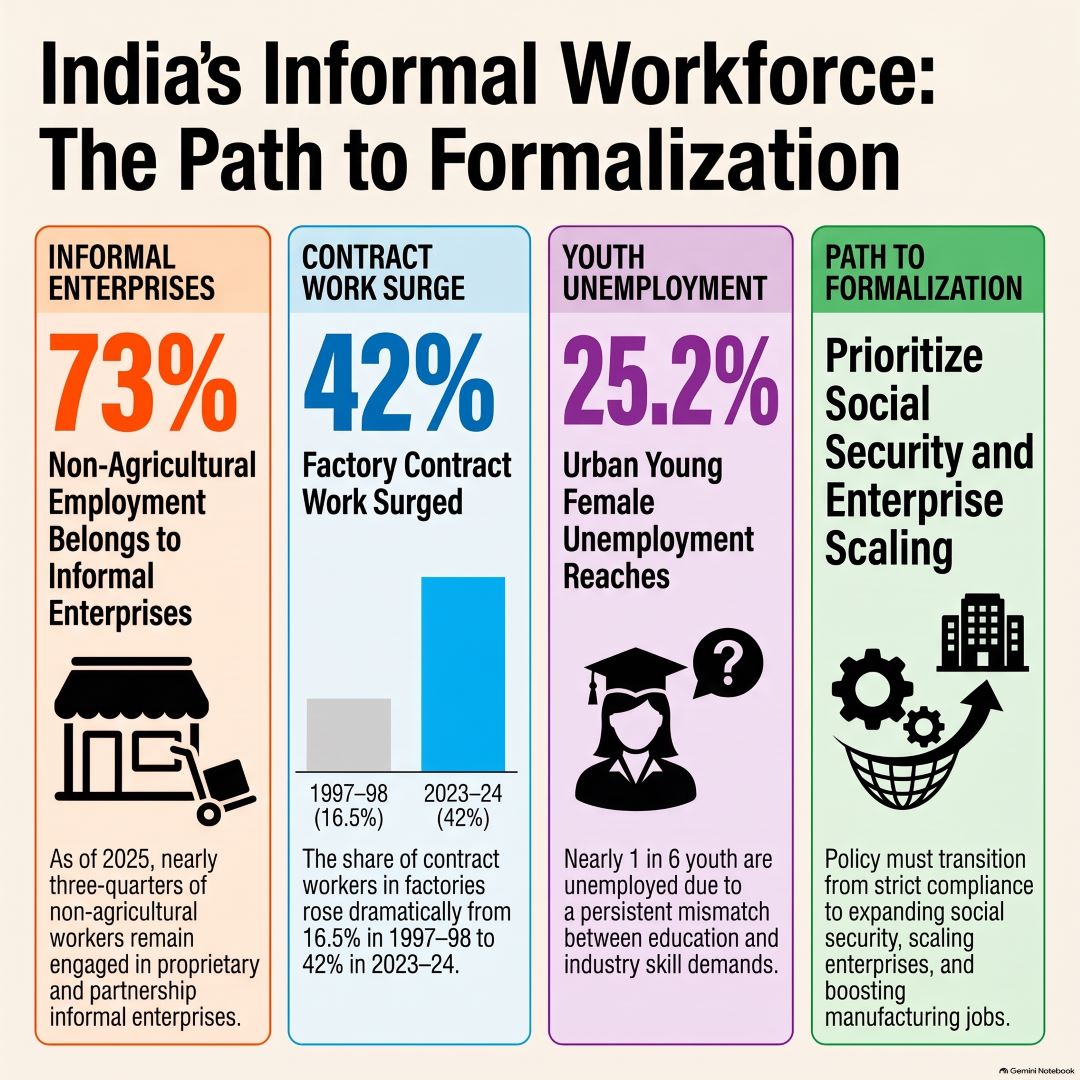
- According to the latest PLFS annual report, around 73% of non-agricultural workers in 2025 were engaged in proprietary and partnership enterprises classified as informal-sector enterprises.
- The persistence of informality is linked to structural factors such as:
- Dominance of micro and small enterprises.
- Weak manufacturing-led employment generation.
- Skill gaps.
- Earlier industrialisation strategies that were relatively capital-intensive.
- Unlike East Asian economies, India did not experience sufficiently large-scale manufacturing expansion capable of absorbing workers moving out of agriculture.
Labour Regulations and Contractualisation
- Liberalisation eased restrictions on industry, but employment compliance requirements remained complex.
- Multiple registrations, returns and threshold-linked obligations under the earlier labour framework created incentives for some firms to:
- Remain below statutory employment thresholds.
- Fragment operations.
- Hire workers through contractors.
- Avoid documented employer–employee relationships.
- Contractualisation expanded beyond small firms to large companies and public-sector employment.
- Contract workers constituted only 16.5% of factory workers in 1997–98, but their share rose to 42% in 2023–24, according to ASI data.
- The nature of informality has therefore evolved from traditional informal employment towards contractual, outsourced and gig work, including in logistics and transport.
Policy Response: From Regulation to Social Security
- India has progressively introduced measures aimed at employment generation and formalisation:
- 1991: New Industrial Policy — liberalisation of licensing and investment rules.
- 1993: Prime Minister’s Rozgar Yojana — subsidised credit for unemployed youth.
- 1999: Swarnjayanti Gram Swarozgar Yojana — rural self-employment.
- 2005: National Rural Employment Guarantee Act — legal guarantee of rural wage employment.
- 2008: Unorganised Workers’ Social Security Act.
- 2011: National Manufacturing Policy — targeted 100 million additional manufacturing jobs.
- 2014: Make in India — investment and manufacturing-led employment.
- 2016: PM Rojgar Protsahan Yojana — incentives for formal hiring.
- 2019: Four Labour Codes — consolidation of 29 central labour laws.
- 2020: PLI schemes — manufacturing investment and employment.
- 2021: e-Shram — database of unorganised workers.
- 2025: Pradhan Mantri Vikas Bharat Rozgar Yojana — incentives for formal job creation.
- The policy approach has increasingly shifted from formalisation through compliance alone towards social-security coverage, workforce visibility and incentives for formal employment.
- Measures such as ELI, EPFO expansion and e-Shram seek to bring diverse forms of workers into the formal social-security ecosystem.
- The four Labour Codes consolidate laws relating to:
- Wages
- Industrial relations
- Occupational safety
- Social security
- However, the article notes that legislation alone cannot transform the labour market; broader economic and employment reforms are necessary.
Youth Employment and Skills Mismatch
- The challenge extends beyond informality to the economy’s ability to generate suitable employment for young workers.
- Nearly one in six labour-force participants aged 15–29 were unemployed during April–June 2026.
- Youth unemployment was higher among young women at 19.6%, rising to 25.2% in urban areas.
- The article highlights a persistent mismatch between higher education and industry requirements.
- International examples such as Germany, Italy, Switzerland and Australia show the potential of coordinated systems involving governments, industry associations and training institutions to identify skill requirements and design vocational programmes.
Way Forward: From Informality to Productive Formal Employment
- India’s formalisation challenge cannot be addressed through registration and compliance alone.
- Key priorities include:
- Enabling firms to scale up rather than remain artificially small.
- Expanding manufacturing-led employment.
- Reducing incentives for excessive contractualisation and fragmented employment.
- Expanding meaningful social-security coverage across formal, informal and gig work.
- Aligning higher education and vocational training with industry demand.
- Improving wages, occupational safety and predictable employment protections.
- Building stronger government–industry–training institution partnerships for skill development.
- The experience since 1991 suggests that economic growth does not automatically translate into formal employment; formalisation requires productive job creation, enterprise scaling, skills matching and effective worker protection
