

Indigenous Knowledge Systems (IKS): India’s Living Ecological Inheritance

Indigenous Knowledge Systems (IKS): India’s Living Ecological Inheritance
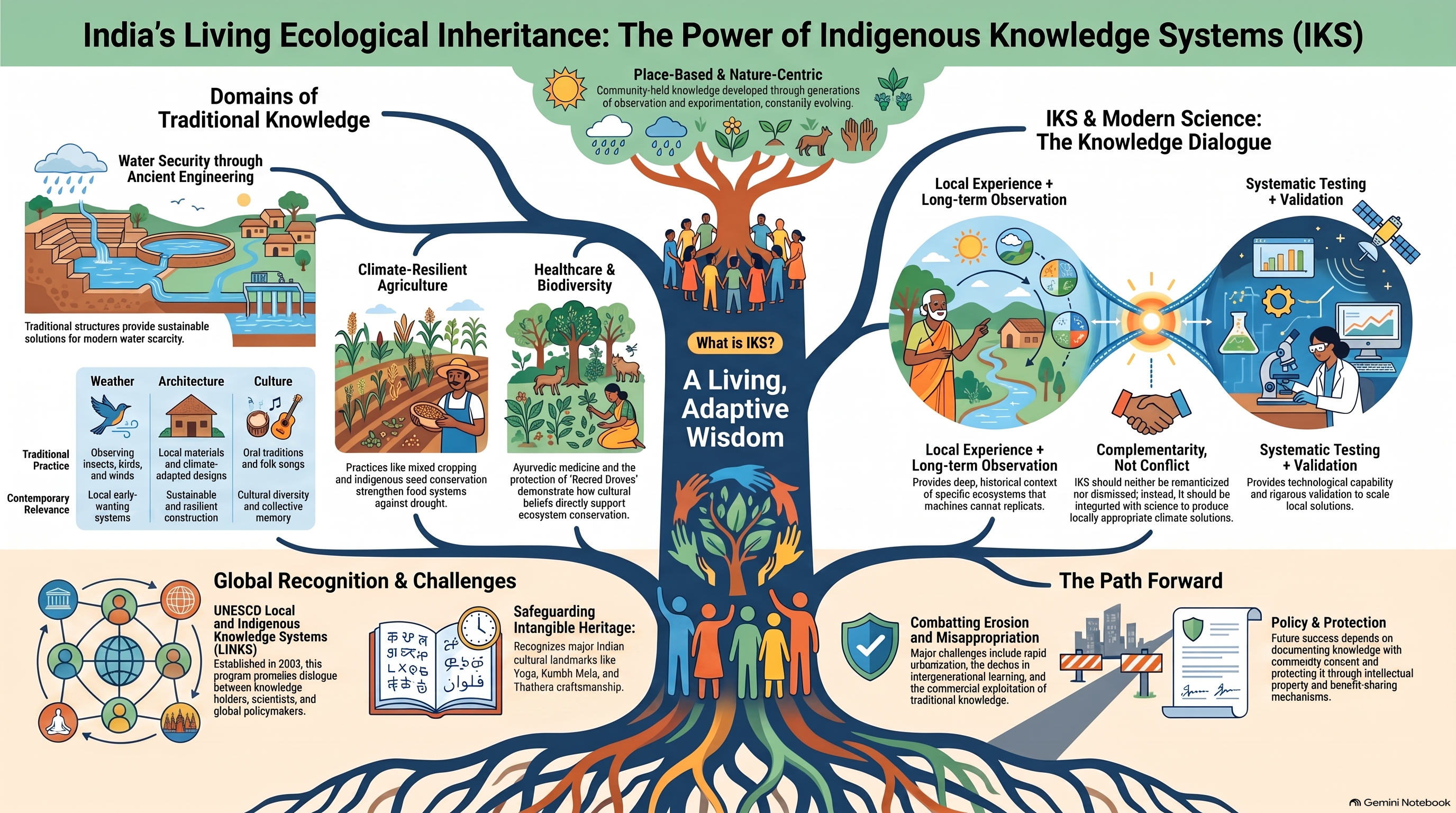
What is Indigenous Knowledge?
· Indigenous Knowledge Systems (IKS) are place-based, community-held knowledge developed through generations of observation, experimentation and interaction with nature.
· They encompass agriculture, water management, weather forecasting, medicine, architecture, biodiversity conservation, crafts, languages, rituals and oral traditions.
· A key feature is that IKS is living and adaptive, rather than a fixed body of ancient practices.
India’s Rich IKS Traditions
|
Domain |
Traditional Knowledge |
Contemporary Relevance |
|
Water |
Johads, tanks, stepwells, rainwater harvesting |
Water security |
|
Agriculture |
Mixed cropping, seed conservation, crop rotation |
Climate-resilient farming |
|
Biodiversity |
Sacred groves, community conservation |
Ecosystem protection |
|
Weather |
Observation of insects, birds, plants and winds |
Local early-warning systems |
|
Medicine |
Ayurveda and medicinal-plant knowledge |
Healthcare and biodiversity research |
|
Architecture |
Local materials and climate-adapted designs |
Sustainable and resilient construction |
|
Culture |
Oral traditions, folk songs, languages, rituals |
Cultural diversity and collective memory |
Why IKS Matters Today?
· Climate resilience: Long-term local observations can complement scientific climate and disaster-risk assessments.
· Sustainable development: Practices based on restraint, resource recycling and local ecosystems can reduce ecological stress.
· Food and water security: Indigenous seeds, traditional crops and water-harvesting systems can strengthen resilience to drought and climate variability.
· Biodiversity conservation: Sacred groves and community-based practices demonstrate how cultural beliefs can support ecosystem protection.
UNESCO and IKS
UNESCO’s Local and Indigenous Knowledge Systems (LINKS) programme, established in 2002, promotes dialogue between indigenous knowledge holders, scientists and policymakers.
India has also engaged with UNESCO’s framework for safeguarding intangible cultural heritage. Examples include:
- Yoga
- Kumbh Mela
- Durga Puja in Kolkata
- Traditional craftsmanship of the Thatheras of Jandiala Guru
|
· The International Decade of Indigenous Languages (2022–2032) highlights the importance of language preservation, as languages often contain unique ecological classifications, medicinal knowledge and oral histories. · IKS and Modern Science: Complementarity, Not Conflict · IKS should neither be romanticised as inherently correct nor dismissed as primitive. · The appropriate approach is knowledge dialogue: · Indigenous knowledge → local experience + long-term observation · Modern science → systematic testing + validation + technological capability · Their integration can produce locally appropriate solutions for climate adaptation, biodiversity conservation and disaster management. |
Major Challenges
- Rapid urbanisation and changing lifestyles
- Decline in intergenerational transmission
- Linguistic erosion
- Environmental degradation
- Commercialisation and misappropriation of traditional knowledge
- Lack of documentation and scientific validation
Way Forward
- Document local knowledge with community consent.
- Involve traditional knowledge holders in research and policymaking.
- Integrate relevant IKS into education and climate-adaptation programmes.
- Protect traditional knowledge through intellectual-property and benefit-sharing mechanisms.
- Preserve indigenous languages alongside cultural practices.
- Combine traditional ecological knowledge with modern scientific methods.
