

Inflation Targeting in India: Does It Work?

Inflation Targeting in India: Does It Work?
Context
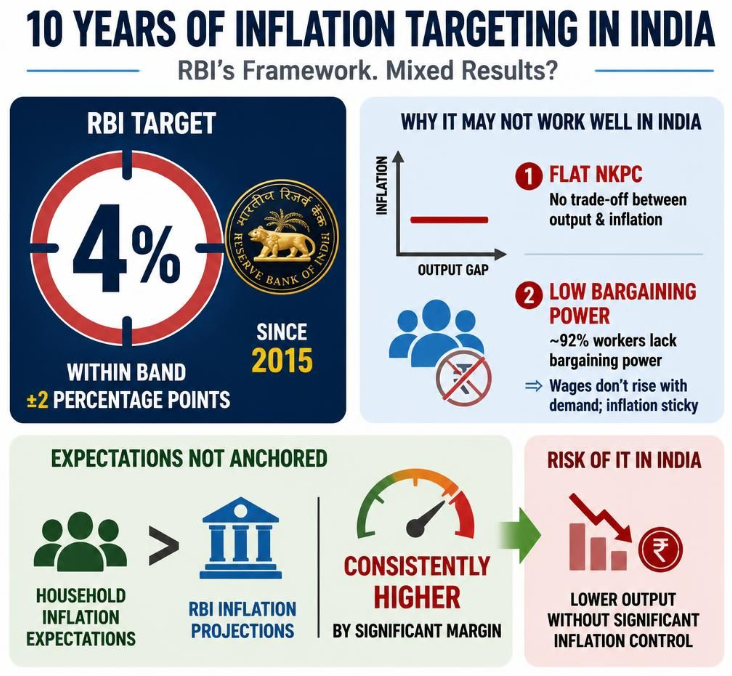
India completed a decade of Flexible Inflation Targeting (FIT) in 2026. Under the framework, the RBI targets CPI inflation at 4%, with a tolerance band of 2–6%. The debate now is whether monetary policy can effectively control inflation without imposing excessive costs on growth.
How Inflation Targeting Works?
- Adopted formally in 2016 following the Urjit Patel Committee.
- RBI uses the repo rate to influence demand, inflation and expectations.
- Monetary Policy Committee (MPC) determines the policy rate.
- Inflation remaining outside the 2–6% band for three consecutive quarters constitutes a failure of the framework.
- The framework balances price stability with growth.
Why It Has Helped?
- CPI inflation has been lower on average after adoption of FIT than in the preceding period.
 Provides a clear nominal anchor and reduces uncertainty.
 - Greater predictability in prices can support investment and macroeconomic stability.
- Helps RBI communicate a credible medium-term inflation objective.
Why Its Effectiveness Is Questioned?
- Flat New Keynesian Phillips Curve (NKPC): Output expansion may have little effect on inflation, weakening the conventional trade-off between growth and inflation.
- Weak wage bargaining power: Around 92% of workers are in the informal sector, limiting the wage-price channel.
- Unanchored expectations: Household inflation expectations have often remained above RBI projections.
- Supply-side inflation: Food, fuel and climate-related shocks cannot be effectively controlled through higher interest rates.
- Risk of stagflation: If monetary tightening reduces demand and output without adequately addressing supply-driven inflation, growth may suffer without sufficient price relief.
Way Forward
- Strengthen inflation-expectation anchoring through credible communication.
- Coordinate monetary policy with supply-side measures in food and energy markets.
- Improve agricultural supply chains, storage and market integration to reduce food-price volatility.
- Avoid excessive reliance on interest rates when inflation is primarily supply-driven.
- Periodically review the inflation target and framework using evidence on India's changing economic structure.
Conclusion
FIT has improved India's monetary-policy credibility and helped moderate inflation, but it is not a complete solution. India's structural supply constraints and weak Phillips-curve relationship require a broader approach combining credible monetary policy with fiscal, agricultural and supply-side reforms.
