

Iran's Disruptive Strategy and Its Global Consequences
Iran's Disruptive Strategy and Its Global Consequences
Relevance: GS Paper II (International Relations, India's Foreign Policy, West Asia) | GS Paper III (Energy Security, International Trade Routes)
Context
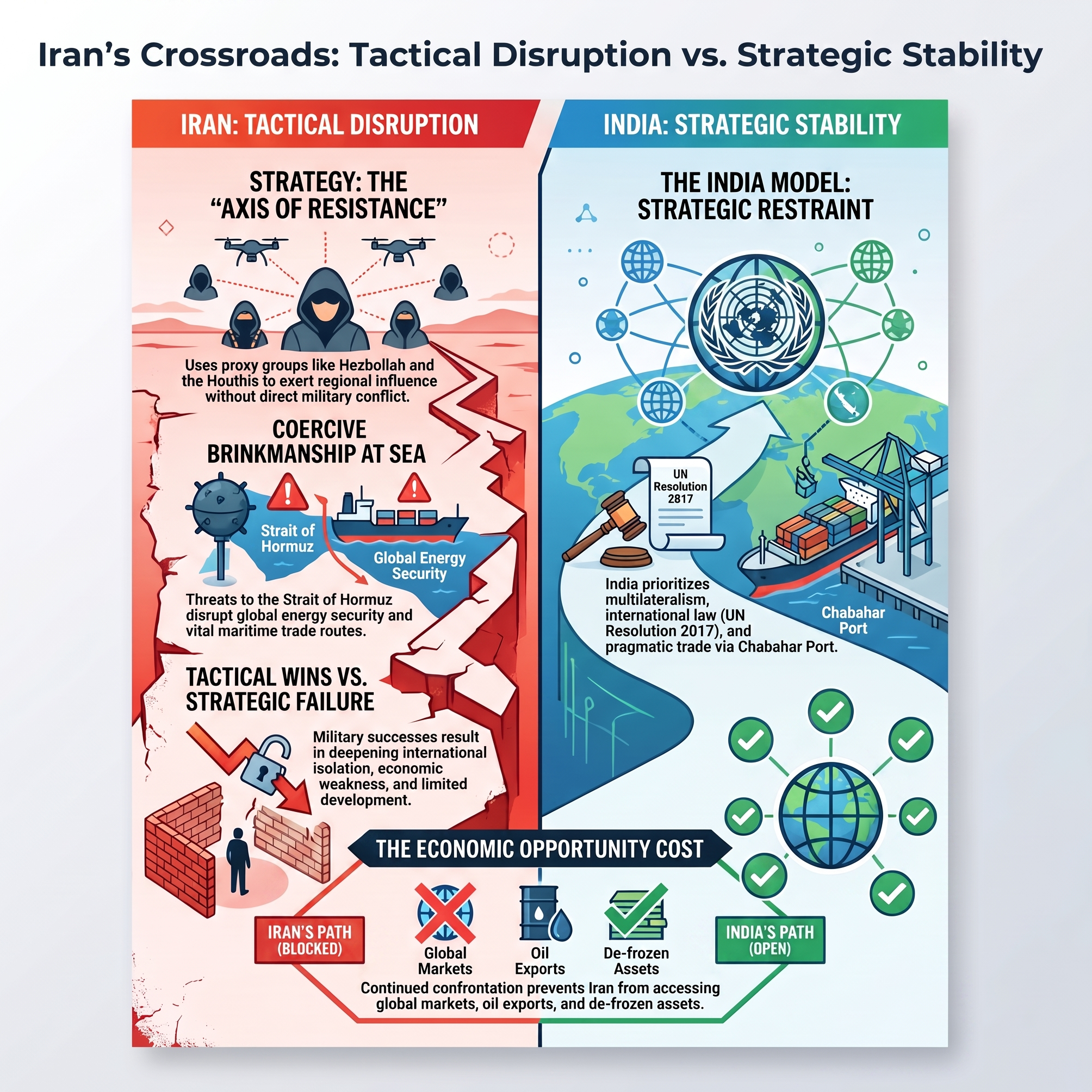
- Iran's recent actions in the Strait of Hormuz have intensified concerns over regional stability, global energy security, and the future of West Asian geopolitics.
- While these actions may deliver short-term tactical gains, they risk becoming long-term strategic failures by deepening Iran's international isolation, weakening its economy, and straining relations with neighbouring Gulf states.
- In contrast, India's emphasis on multilateralism and diplomacy is presented as a more sustainable model for achieving international influence.
Iran's Strategy of Disruption
- Since the Iran-Iraq War, Iran has projected itself as a champion of Islamic resistance against Western influence and Israel.
- This ideological position evolved into support for proxy organisations — Hezbollah, Hamas, and the Houthis — collectively known as the "Axis of Resistance."
- Through these proxies, Iran expanded regional influence without engaging in large-scale direct military confrontation.
- While this created operational successes in challenging adversaries and maintaining pressure on the U.S. and Israel, it also widened Iran's diplomatic isolation.
- Iran's closest strategic partners today remain Russia, China, and North Korea — reflecting a foreign policy centred on confrontation rather than cooperation.
- Overall, tactical victories have come at the cost of reduced international legitimacy, weaker economic integration, and limited long-term development opportunities.
India's Approach
- India has maintained a pragmatic relationship with Iran based on energy security, trade, and the Chabahar Port, while balancing broader foreign policy interests.
- Even during periods of Western sanctions, India protected its national interests by maintaining limited energy imports before gradually diversifying its oil sources.
- During the recent regional crisis, India adopted a policy of strategic restraint — avoiding direct mediation while encouraging dialogue through quiet diplomacy.
- India's support for UN Security Council Resolution 2817, which condemned attacks on Gulf Cooperation Council (GCC) countries and international shipping, reflected its commitment to international law and maritime security.
- This balanced approach aligns with India's vision of a multipolar world, where disputes are resolved through cooperation and consensus rather than military confrontation.
Regional Consequences of Iran's Actions
- Iran's attacks on shipping through the Strait of Hormuz, along with its proposal to impose preferential transit rates for selected countries, represent a policy of coercive brinkmanship.
- Such actions threaten one of the world's most important maritime trade routes, creating uncertainty for oil-importing nations and disrupting global commerce.
- Countries like India — whose economic growth depends heavily on uninterrupted energy supplies and secure trade corridors — are particularly vulnerable to prolonged regional instability.
- Domestically, Iran has emerged from recent conflicts politically hardened, with the growing influence of the Islamic Revolutionary Guard Corps (IRGC) and conservative clerics suggesting future policy may continue favouring limited confrontation below the threshold of full-scale war.
- This environment reduces prospects for moderation while increasing the risk of recurring regional tensions.
The Choice Before Iran
- Iran possesses significant economic potential as an upper-middle-income economy with vast energy resources.
- Opportunities such as the de-freezing of assets, expanding oil exports, and greater participation in global markets could generate sustained economic growth and improve citizen welfare.
- However, realising these opportunities requires replacing confrontation with diplomatic engagement.
- Continued reliance on proxy warfare, coercive tactics, and threats to international navigation will likely prolong economic isolation and discourage foreign investment.
- Greater cooperation with the international community would strengthen regional stability while allowing Iran to benefit from expanded trade and energy partnerships.
Conclusion
Iran stands at a critical crossroads between continued confrontation and constructive engagement. While recent military actions have demonstrated tactical capability, they have also deepened diplomatic isolation, economic uncertainty, and regional instability. Lasting national progress depends on economic integration, international cooperation, and responsible diplomacy rather than coercion. Compared with Iran's disruptive strategy, India's commitment to dialogue, consensus, and strategic autonomy is presented as offering a more effective model for navigating an increasingly interconnected and multipolar world.
