

ISRO’s 300-Satellite Push and Space Station by 2035

ISRO’s 300-Satellite Push and Space Station by 2035
Context
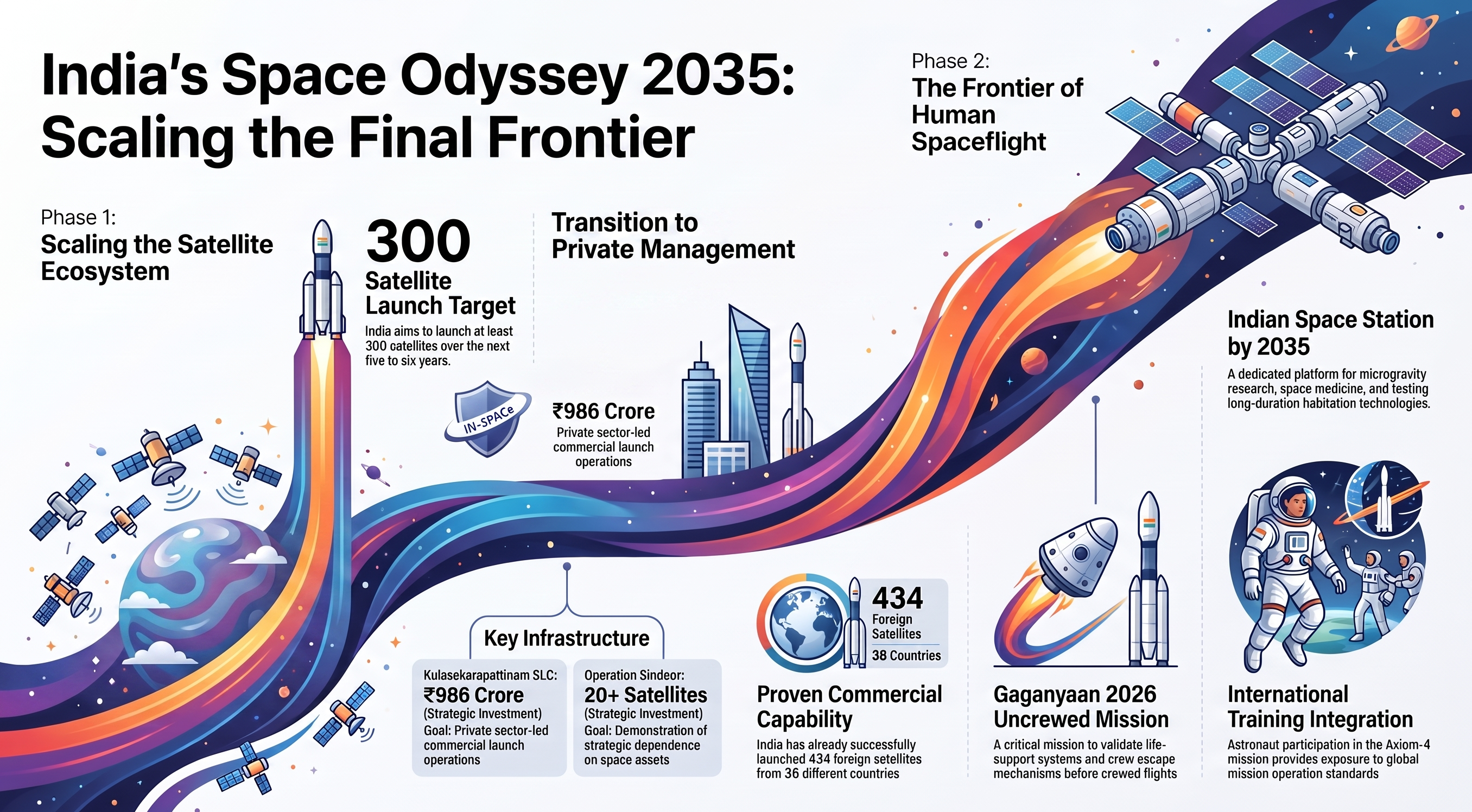
India is entering a new phase of its space programme, marked by a shift from state-led developmental space activities towards a more integrated model involving commercialisation, strategic applications and human spaceflight. ISRO Chairman V. Narayanan has stated that India aims to launch at least 300 satellites over the next five–six years and establish its own space station by 2035. The proposed timeline is accompanied by the planned uncrewed Gaganyaan mission by the end of 2026 and greater participation of private players in space infrastructure.
India’s Expanding Space Ambitions
· The target of 300 satellites reflects the rapidly expanding role of space-based infrastructure in India's economy and national security. India has already demonstrated considerable capability in the commercial launch of foreign satellites, having launched 434 satellites from 36 countries.
· The growing satellite constellation can support communication, navigation, Earth observation, weather forecasting, agriculture, disaster management, resource mapping and defence applications.
· The reported use of more than 20 satellites during Operation Sindoor also illustrates the increasing strategic dependence of modern military operations on space-based assets.
· The proposed Indian Space Station by 2035 represents the next major technological frontier. Beyond being a symbol of India's space capabilities, it could serve as a platform for microgravity research, space medicine, material science, biological experiments and testing technologies for long-duration human missions.
· It would also provide operational experience in orbital habitation, docking and crew management, strengthening India's capabilities for future lunar and deep-space missions.
Gaganyaan as the Technological Foundation
The Gaganyaan programme is central to India's transition towards human spaceflight. The immediate focus on uncrewed missions is intended to validate the reliability of the human-rated launch vehicle, crew module, environmental control and life-support systems, crew escape mechanisms and recovery procedures before undertaking crewed missions. The experience accumulated through Gaganyaan will consequently provide an important technological and institutional foundation for the proposed space station.
India's participation in the Axiom-4 mission, through astronaut Shubhanshu Shukla's journey to the International Space Station, has further strengthened India's human-spaceflight experience. Such missions provide Indian astronauts and scientists exposure to international standards of astronaut training, mission operations and scientific experimentation.
Growing Role of the Private Sector
· A significant dimension of India's emerging space ecosystem is the increasing transfer of operational responsibilities to private industry.
· IN-SPACe has initiated the process of handing over the operations and management of the Small Satellite Launch Complex (SLC) at Kulasekarapattinam, Tamil Nadu, to an Indian private entity, with the project involving an estimated investment of ₹986 crore.
· This is consistent with the Indian Space Policy 2023, which seeks to expand private participation across satellite manufacturing, launch services, space applications and associated infrastructure.
· ISRO's proposed technical guidance, training and handholding during the transition reflects a changing institutional relationship: ISRO increasingly functions as a technology developer and strategic enabler, while private enterprises are expected to drive commercial scale and market-oriented operations.
Strategic and Economic Significance
· India's space ambitions have both developmental and strategic dimensions. A larger satellite constellation can strengthen communication and Earth-observation capabilities, while enhancing resilience in critical infrastructure. In the security domain, satellites are increasingly important for intelligence, surveillance, reconnaissance, secure communication and navigation.
· At the economic level, India's growing space sector can contribute to the global space economy, particularly in small-satellite manufacturing, launch services, satellite-based applications and downstream services. Dedicated launch infrastructure such as the Kulasekarapattinam facility can help India respond to the rapidly expanding demand for small-satellite launches.
Challenges
· The transition towards a space station and a large satellite constellation will require sustained investment and technological reliability. Human spaceflight involves substantially higher safety standards than conventional satellite missions. India will need to strengthen capabilities in orbital docking, life-support systems, space medicine, radiation protection, crew safety and long-duration habitation.
· At the same time, increasing satellite deployment raises concerns relating to space debris, orbital congestion, spectrum management and the militarisation of outer space. Greater private participation also requires effective regulation, liability mechanisms, cybersecurity standards and mechanisms to ensure that commercial expansion remains consistent with national security objectives.
Conclusion
The target of 300 satellites and an Indian space station by 2035 signifies a qualitative transformation in India's space journey. The challenge is no longer merely to demonstrate the ability to reach space, but to develop a sustainable, commercially competitive, strategically secure and technologically advanced space ecosystem. If supported by effective public-private collaboration and sustained investment in R&D, India's space programme can become an important pillar of Viksit Bharat 2047 and India's emergence as a major global space power.