

ISRO's Brain Drain: A Wake-up Call for India's Space Sector

ISRO's Brain Drain: A Wake-up Call for India's Space Sector
Relevance: GS Paper III (Science and Technology – Indigenization of Technology, Space Policy; Indian Economy – Government Budgeting, Public Sector Undertakings) | GS Paper II (Governance – Government Policies and Interventions, Autonomy of Institutions)
Why in News?
India's space sector is witnessing two contrasting developments — the success of private player Skyroot's Vikram-1 rocket (first end-to-end private space mission), and a wave of resignations of senior scientists from ISRO, exposing structural weaknesses in the public space agency.
Background
Two Simultaneous Developments
|
Positive Development |
Negative Development |
|
Skyroot (founded by ex-ISRO engineers) successfully test-flew Vikram-1, India's first fully private rocket mission |
Dozens of senior scientists at URSC, VSSC, and other ISRO centres have resigned or taken premature retirement |
|
Upgraded Vikram-2 planned next year to enter the LEO satellite launch market |
Department of Space has directed personnel on critical missions not to leave until project completion |
Key Programmes Affected
- Gaganyaan – Human Spaceflight Mission
- NGLV – Next Generation Launch Vehicle
- Bharatiya Antariksh Station – India's planned space station
Are the Two Trends Linked?
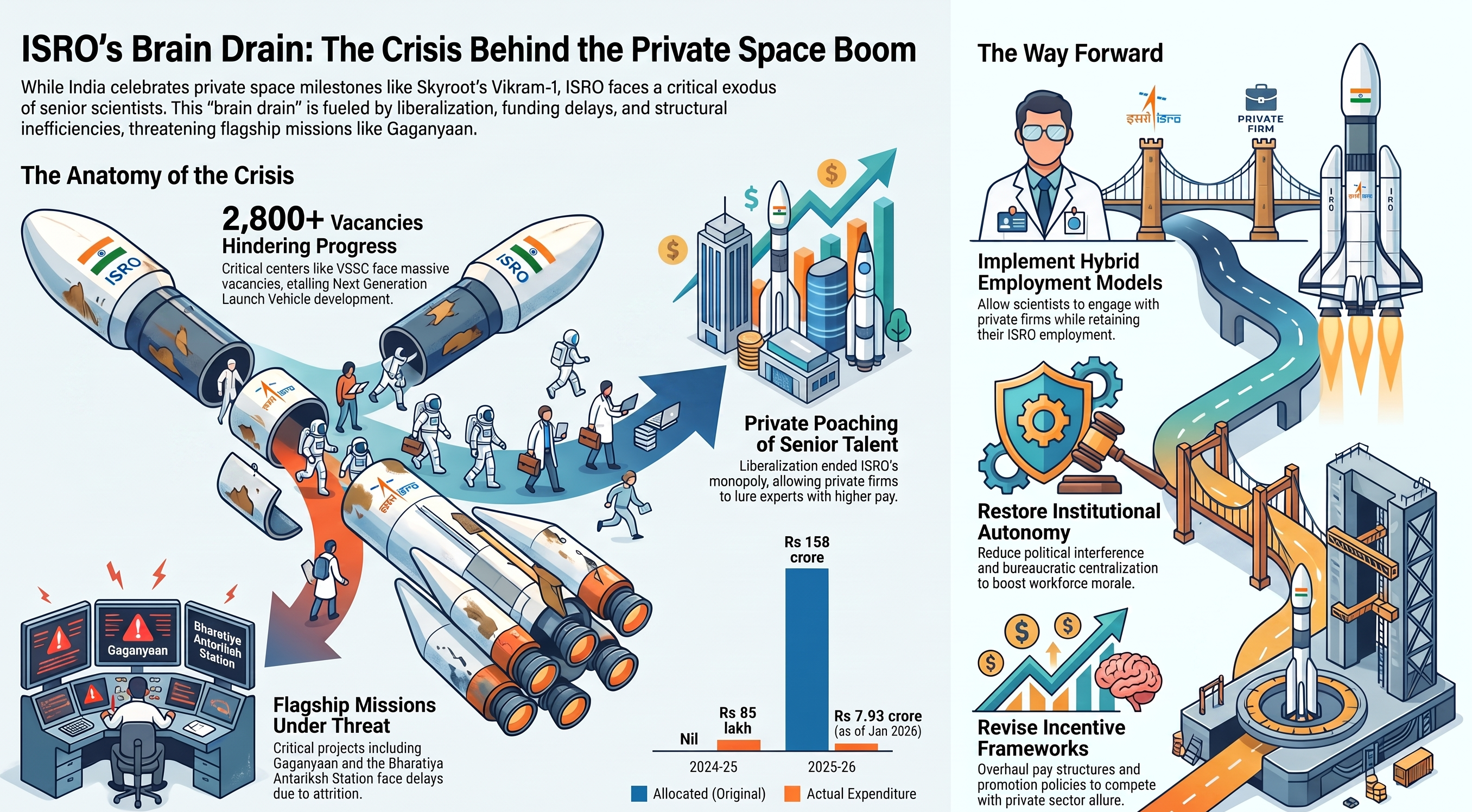
Yes. The exodus is a direct consequence of the government's space sector liberalization policy, which:
- Ended ISRO's monopoly over launching rockets from Indian soil
- Allowed private firms to build and launch rockets/satellites
- Directed ISRO to share its facilities with private companies
This enabled private players to poach experienced ISRO talent using competitive pay and challenging assignments.
Historical Parallels of Public-to-Private Talent Migration
- NASA → US private space industry (SpaceX, etc.)
- ECIL & CMC → Private IT sector during India's IT boom
- HAL facing similar attrition
- DRDO labs post opening of defence production to private sector
Structural Issues Within ISRO
Vacancies (Parliamentary Committee, March 2026)
- 2,800+ vacancies against sanctioned strength of ~18,000 posts
- ~500 vacant posts at VSSC alone (critical for NGLV)
Funding Delays — Case Study: NGLV Project
|
Year |
Allocated |
Revised Estimate |
Actual Expenditure |
|
2024-25 |
Nil in initial budget |
Rs 3 crore |
Rs 85 lakh |
|
2025-26 |
Rs 158 crore |
Rs 39.76 crore |
Rs 7.93 crore (till Jan 31, 2026) |
- NGLV approved by Cabinet in 2024 with a 96-month timeline; first test flight targeted in 84 months
- Chronic under-utilisation of even the reduced allocations
Other Contributing Factors
- Repeated PSLV failures
- Delays in Gaganyaan
- Centralisation of decision-making
- Growing bureaucratic and political interference
- Resultant low morale and workforce disenchantment
Way Forward
- Beyond diktats: Restricting resignations through administrative orders is not a sustainable solution
- Anticipatory governance: Government and ISRO should have foreseen the fallout of privatization on the parent organisation
- Morale-boosting measures: Address root causes of dissatisfaction — mission failures, delays, stagnation
- Institutional reforms:
- Allow scientists to engage with private firms for a limited period while retaining ISRO employment
- Permit scientists to launch their own ventures in non-critical areas
- Revise pay structures, promotion policies, and incentive frameworks
- Restore institutional autonomy: Reduce political interference in scientific institutions
