

Jai Vigyan, Jai Anusandhan – Building India’s Research and Innovation Ecosystem

Jai Vigyan, Jai Anusandhan – Building India’s Research and Innovation Ecosystem
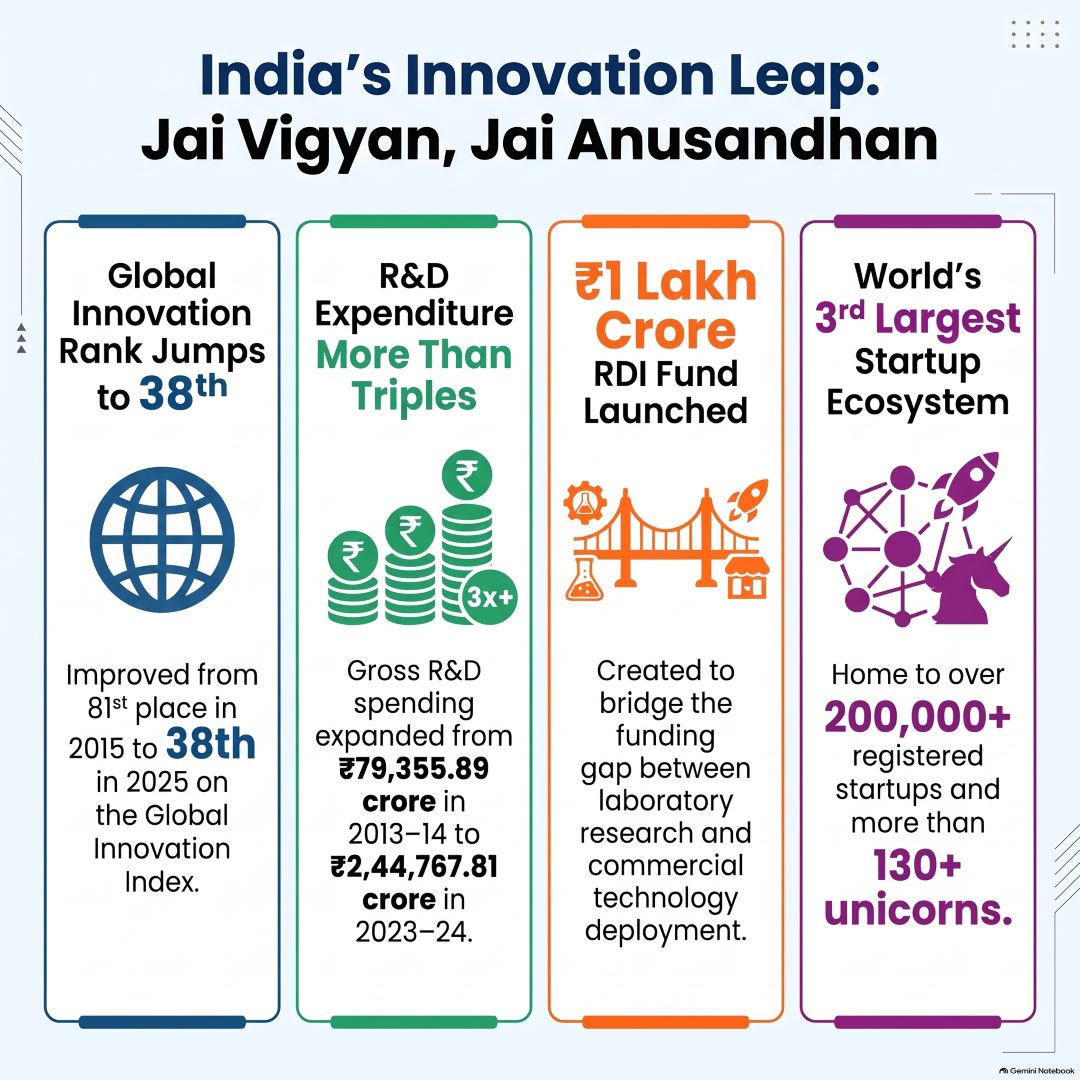
India’s Progress in Research and Innovation
- On January 3, 2019, at the Indian Science Congress, the Prime Minister articulated the vision of “Jai Jawan, Jai Kisan, Jai Vigyan, Jai Anusandhan”, highlighting research and innovation as drivers of Viksit Bharat 2047.
- Global Innovation Index (GII): India improved from 81st position in 2015 to 38th in 2025.
- Scientific publications: India ranks third globally in the volume of scientific and engineering publications.
- Gross Expenditure on Research and Development (GERD): Increased from ₹79,355.89 crore in 2013–14 to ₹2,44,767.81 crore in 2023–24, reaching approximately 0.84% of GDP.
- Private-sector participation: The private sector’s share of GERD rose from 32.2% to 45.2% over the same period.
- Despite this progress, increasing R&D expenditure as a proportion of GDP remains essential to strengthen global competitiveness and indigenous technological capabilities.
Strengthening the Institutional Framework
- Anusandhan National Research Foundation (ANRF): Established under the ANRF Act, 2023, it supports research across universities, colleges and laboratories and promotes collaboration among academia, industry and government. It also seeks to expand research beyond established institutions into State universities and colleges.
- Research, Development and Innovation (RDI) Fund: The ₹1 lakh crore fund aims to mobilise private investment in high-impact research and emerging technologies.
- The RDI Fund addresses the “valley of death”—the funding gap between laboratory research and commercialisation, when technologies require pilot-scale testing, demonstration and product development.
- Women in Science: WISE-KIRAN, Gender Advancement for Transforming Institutions (GATI) and Vigyan Jyoti promote women’s participation in science, technology, engineering and mathematics (STEM), widening the scientific talent pool and improving access to research opportunities.
|
The Evolution of a National Vision The slogan has expanded over decades, reflecting the shifting priorities and growing ambitions of the Indian nation:
Strategic Impact of "Jai Anusandhan" The addition of "Jai Anusandhan" (Hail Research) marks a transition toward a knowledge-driven economy. Several key initiatives have operationalized this vision:
|
Mission-Mode Capabilities in Emerging Technologies
- National Quantum Mission: Develops capabilities in quantum computing, communication, sensing, metrology, materials and devices, while supporting research groups and start-up spin-offs.
- IndiaAI Mission: Promotes AI infrastructure, datasets, skills and foundational models, alongside responsible AI development.
- India Semiconductor Mission: Ten approved projects across six States—comprising two semiconductor fabrication facilities and eight packaging units—aim to strengthen domestic manufacturing. The proposed Semicon 2.0 phase emphasises equipment, materials, indigenous intellectual property, industry-led R&D and talent development.
- Biotechnology: The BioE3 Policy promotes high-performance biomanufacturing, including bio-based chemicals, enzymes, precision biotherapeutics and space biotechnology. India’s bioeconomy grew from approximately $10 billion in 2014 to $195.3 billion in 2025 and is projected to reach $300 billion by 2030.
- Deep Ocean Mission and Mission Mausam: Strengthen ocean-resource exploration, climate understanding, weather forecasting and environmental security.
Private Participation and Citizen-Centric Innovation
- Space sector: The Indian Space Policy, 2023, and IN-SPACe have expanded private participation in launch services, satellite manufacturing and downstream applications. India’s ecosystem includes more than 400 space start-ups, according to the supplied article.
- Nuclear energy: The Sustainable Harnessing of Advancement of Nuclear Energy for Transforming India (SHANTI) Act provides a framework for greater private-sector participation, subject to applicable licensing, safety and regulatory requirements.
- Digital Public Infrastructure (DPI): Built around the JAM trinity—Jan Dhan, Aadhaar and mobile connectivity—India’s digital ecosystem includes UPI, DigiLocker, Account Aggregator and the Ayushman Bharat Digital Mission.
- Agricultural technology: Satellites, drones, remote sensing, Geographic Information Systems (GIS) and AI support crop monitoring, precision farming, yield estimation and farmer advisories, improving agricultural productivity and public-service delivery.
Start-up Ecosystem and Way Forward
- Startup India, launched in 2016, placed entrepreneurship at the centre of India’s development strategy. India is the world’s third-largest start-up ecosystem, with more than two lakh registered start-ups and over 130 unicorns, as cited in the article.
- Seed Fund Scheme and Fund of Funds improve access to early-stage and growth capital; the Credit Guarantee Scheme facilitates debt finance.
- Atal Innovation Mission and NIDHI promote innovation, incubation and entrepreneurship; BioNEST supports biotechnology incubation, while iDEX encourages defence innovation and indigenous technology development.
- India must increase sustained R&D investment, strengthen industry–academia collaboration and improve technology transfer and commercialisation.
- Wider access to research funding, skilled human capital, scientific infrastructure and risk-tolerant finance is necessary to develop deep-tech enterprises and reduce dependence on imported technologies.
The vision of “Jai Vigyan, Jai Anusandhan” requires India to convert scientific knowledge into indigenous technologies, globally competitive enterprises and better public services. Sustained research investment, inclusive innovation and effective commercialisation will be essential to achieving strategic autonomy and Viksit Bharat 2047.
To pick up a draggable item, press the space bar. While dragging, use the arrow keys to move the item. Press space again to drop the item in its new position, or press escape to cancel.