

Karmayogi Sankalpa: Citizen-Centric Civil Service Leadership

Karmayogi Sankalpa: Citizen-Centric Civil Service Leadership
Source: The Hindu
Why in News?
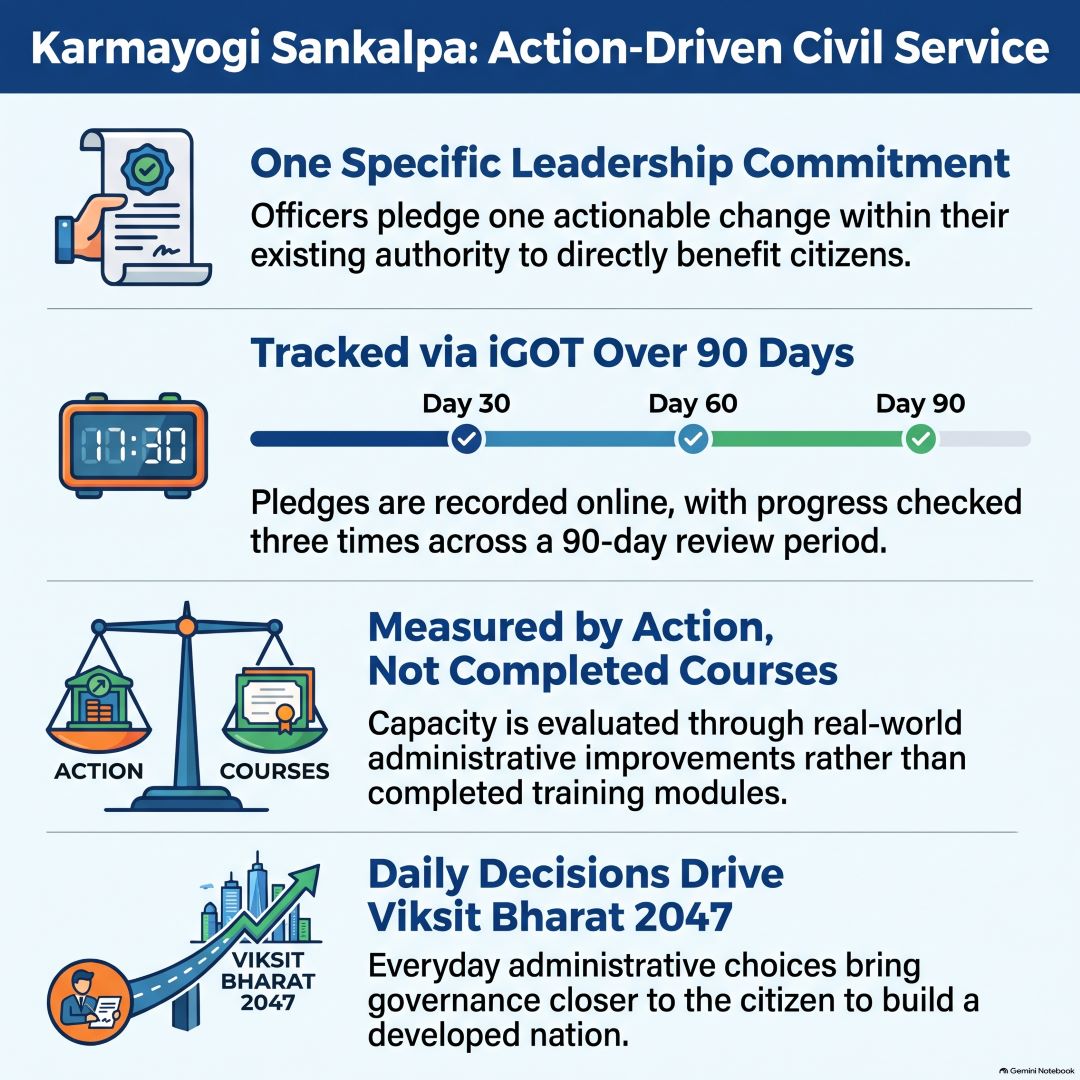
The Cabinet Secretary launched the Karmayogi Sankalpa at Bharat Mandapam on 17 November 2026, at the close of the National Workshop on Leadership as Mission convened by NITI Aayog. Every public servant is asked to make one specific improvement in their leadership practice within their existing authority, so that Viksit Bharat 2047 rests on responsive, accountable and citizen-centric administration.
Background
- Mission Karmayogi (National Programme for Civil Services Capacity Building, 2020) aims to move the civil services from a rule-based approach to a role-based, competency-driven one.
- It has the iGOT Karmayogi platform for technology-enabled learning, a competency framework of behavioural (attitudes, ethics, interpersonal skills), functional (skills for specific roles) and domain (sector knowledge) competencies, and continuous capacity building.
- Mission Karmayogi was approved by the Union Cabinet in September 2020, and a Capacity Building Commission oversees it.
- Karmayogi Sankalpa turns what officers have learnt into concrete administrative action.
|
What is the Karmayogi Sankalpa?
|
Courses or conduct: how should capacity be measured?
- Mission Karmayogi: Launched in 2020, the mission aims to move the civil service from a rule-based orientation (following procedure) to a role-based one (delivering what a post is meant to achieve).
- Learning with direction: iGOT made learning available to every government employee at any level and place. A competency framework (the behaviour, job skills and subject knowledge a post needs) tells officers what to learn.
- From learning to action: The Sankalpa argues capacity is measured by change in practice, not courses completed. Eg. A district officer visits an Anganwadi centre before each nutrition review and hears of a stock-out early.
- Development through daily decisions: Viksit Bharat by 2047, the goal of a developed India, depends on public servants’ daily decisions, not on policy alone. Each decision brings the state closer to the citizen or leaves the citizen waiting.
Challenges
- Self-reported change: Officers describe their own outcomes, so follow-ups cannot easily confirm whether citizens felt any difference.
- Follow-up at scale: Tracking lakhs of individual pledges, each with its own action and date, strains a single platform team.
- Short tenures: Frequent transfers can move an officer before the dated action is complete.
- Limits of one officer’s authority: Problems that need budgets, rule changes or other departments stay outside the pledge.
|
“[2024, GS4, 10 marks] Q. Mission Karmayogi is aiming for maintaining a very high standard of conduct and behaviour to ensure efficiency for serving citizens and in developing oneself. How will this scheme empower the civil servants in enhancing productive efficiency and delivering the services at the grassroots level?” |