

Kartarpur Corridor: Religious Heritage and India–Pakistan Relations

Source: The Hindu
Why in News?
· The Kartarpur Corridor has again come into focus after the BSF and Punjab Police prevented a delegation of Sikh devotees, led by officiating Akal Takht Jathedar Giani Kuldeep Singh Gargaj, from approaching the Zero Line along the International Border.
· The delegation planned to participate in a joint prayer with the Pakistan Sikh Gurdwara Parbandhak Committee and seek the reopening of the corridor. Security agencies cited border protocols and operational concerns for denying permission.
Religious and Historical Significance
The corridor connects Dera Baba Nanak in Gurdaspur, Punjab, with Gurdwara Darbar Sahib Kartarpur in Narowal district, Pakistan.
- Gurdwara Kartarpur Sahib is associated with Guru Nanak Dev, who spent the last 18 years of his life there.
- The shrine is located only about 4.7 km from the Indian border.
- After Partition, the shrine remained on the Pakistani side.
- For decades, devotees gathered at Dera Baba Nanak and viewed the shrine from a distance through binoculars.
- This gave rise to the demand for “khule darshan deedar”, meaning unrestricted access to historic Sikh shrines located across the border.
The Jassar Bridge, which had earlier provided an informal route for pilgrims, was destroyed during the 1965 India-Pakistan War, further restricting access.
From Proposal to Opening
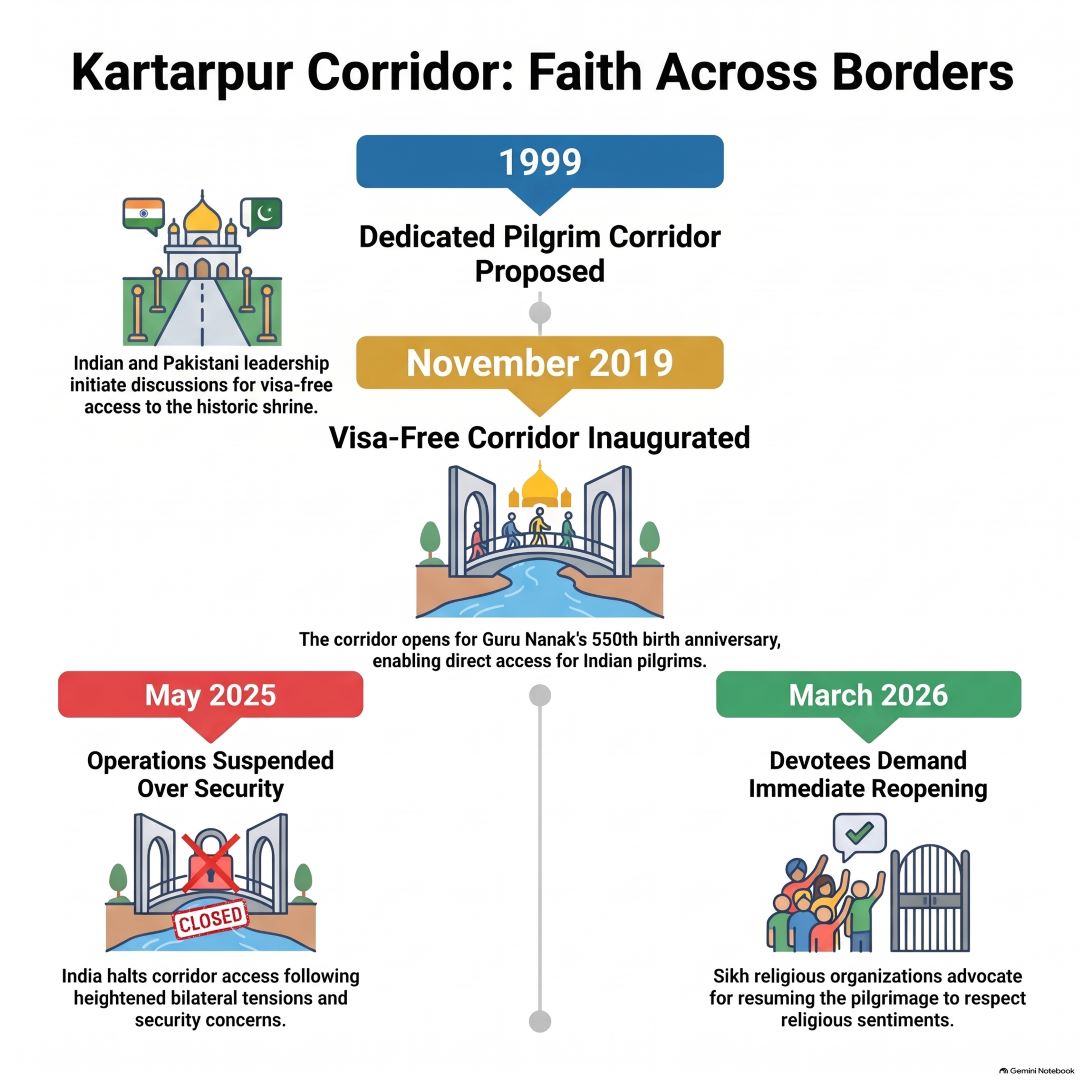
The idea of a dedicated Kartarpur corridor was first discussed in 1999 during talks between Prime Minister Atal Bihari Vajpayee and Pakistan's Prime Minister Nawaz Sharif.
- November 2018: Foundation stones were laid on both sides of the border.
- 9 November 2019: The Kartarpur Corridor was inaugurated.
- The opening coincided with preparations for the 550th birth anniversary of Guru Nanak Dev.
- The corridor allowed Indian pilgrims to visit Gurdwara Darbar Sahib Kartarpur without obtaining a Pakistani visa, subject to the agreed travel and security procedures.
The corridor therefore created a special channel for religious pilgrimage and people-to-people contact despite continuing political tensions between the two countries.
Suspension and Demand for Reopening
· The pilgrimage was initially suspended during the COVID-19 pandemic in 2020.
· It was subsequently suspended again following Operation Sindoor in May 2025, amid heightened tensions and security concerns between India and Pakistan. The corridor has remained closed from the Indian side.
· In March 2026, the Shiromani Gurdwara Parbandhak Committee (SGPC) passed a resolution seeking its immediate reopening, arguing that the continued suspension affects Sikh religious sentiments.
· Pakistan has opened its side of the corridor, while India continues to keep the pilgrimage suspended.
Corridor Amid Strained Bilateral Relations
· The Kartarpur Corridor illustrates how shared religious heritage can create limited avenues for engagement between India and Pakistan, even when broader diplomatic relations remain difficult.
· At the same time, its suspension shows the vulnerability of cross-border pilgrimage arrangements to changes in the security environment and bilateral relations.
· The issue also has a Punjab-specific political dimension, with different political parties and Sikh organisations making competing claims regarding their contribution to the establishment of the corridor. The involvement of religious institutions and political actors has consequently given the issue both religious significance and political salience.
