

KIGALI AMENDMENT: 10 YEARS OF HFC PHASE-DOWN AND INDIA’S COOLING CHALLENGE

KIGALI AMENDMENT: 10 YEARS OF HFC PHASE-DOWN AND INDIA’S COOLING CHALLENGE
Context
- The Kigali Amendment to the Montreal Protocol completed 10 years on 15 October 2026. It aims to phase down hydrofluorocarbons (HFCs), potent greenhouse gases widely used in refrigeration and air-conditioning.
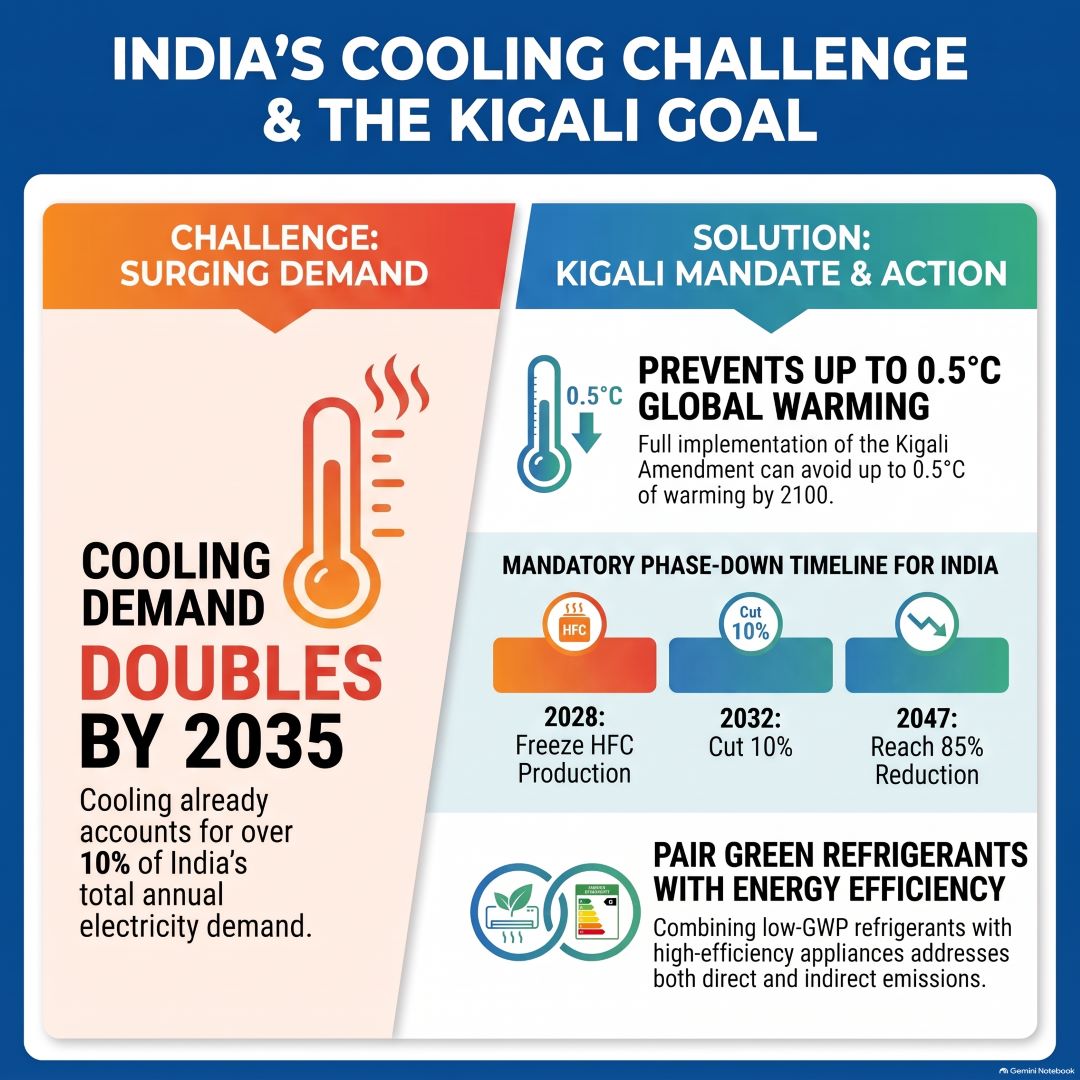
- Full implementation could prevent up to 0.5°C of global warming by 2100. India faces a major challenge as its cooling demand is projected to more than double by 2035.
What Is the Kigali Amendment?
- Montreal Protocol (1987): An international environmental treaty designed to protect the ozone layer by phasing out chlorofluorocarbons (CFCs) and other ozone-depleting substances.
- Need for the Amendment: HFCs were adopted as substitutes for CFCs because they do not deplete the ozone layer. However, many HFCs have a high global warming potential.
- Adoption: The amendment was adopted in Kigali, Rwanda, on 15 October 2016, following proposals by the Federated States of Micronesia and Mauritius in 2009.
- Entry into Force: January 2019.
- Objective: To gradually reduce HFC production and consumption rather than impose a complete ban, while promoting climate-friendly refrigerants and cooling technologies.
Climate Significance
- Global Warming Mitigation: Full implementation could avoid approximately 0.3°C–0.5°C of global warming by 2100.
- Paris Agreement: HFC reductions support efforts to limit global warming to well below 2°C while pursuing the 1.5°C goal.
- Ozone Layer Recovery: The Montreal Protocol has led to the elimination of nearly 99% of controlled ozone-depleting substances, contributing to the recovery of the ozone layer.
- Dual Climate Benefits: Combining the transition to low-global-warming-potential refrigerants with energy-efficient cooling equipment can substantially increase climate benefits.
Why Is Cooling Central to Climate Action?
- Direct Emissions: Refrigerants can escape into the atmosphere during equipment operation, servicing, leakage or disposal.
- Indirect Emissions: Air-conditioners and refrigerators consume electricity, generating emissions when the electricity comes from fossil fuels.
- Energy Efficiency: Efficient appliances reduce electricity demand, household energy bills and pressure on power-generation capacity.
- Integrated Approach: Refrigerant substitution addresses direct emissions, while improved appliance efficiency reduces indirect emissions.
India’s Cooling Challenge
|
India’s Obligations Under the Kigali Amendment
India ratified the amendment in 2021 and follows the applicable phase-down schedule for developing countries.
- 2028: Freeze HFC production and consumption at the agreed baseline.
- 2032: Reduce HFC production and consumption by 10% below the baseline.
- 2047: Achieve an 85% reduction below the baseline.
These milestones make early investment in efficient cooling systems, alternative refrigerants and refrigerant recovery important for India’s long-term compliance.
What Remains Unfinished?
- Universal Participation: The supplied report states that 175 parties had joined the amendment by early October 2026.
- Refrigerant Recovery: Existing HFCs in appliances must be recovered during servicing and disposal to prevent leakage.
- Safe Destruction: Refrigerants that cannot be reused safely need appropriate treatment or destruction.
- International Cooperation: The revived Friends of the Kigali Amendment coalition seeks wider participation, increased financing and improved refrigerant recovery.
- Technology Transition: Manufacturers need access to affordable alternatives, skilled technicians and updated equipment standards.
Financing Through the Multilateral Fund
- Establishment: The Multilateral Fund was established in 1990 and became operational in 1991 to assist developing countries in meeting the incremental costs of implementing the Montreal Protocol.
- Funding Mechanism: Developed countries provide financial contributions to support compliance by developing countries.
- Climate Benefits: The supplied report estimates that Fund-supported activities avoided emissions equivalent to approximately 50 billion tonnes of CO₂ between 1995 and 2021, at an estimated cost of around US$0.07 per tonne.
- Importance for India: Financial and technical assistance can help Indian manufacturers adopt alternative refrigerants, modernise production and improve cooling efficiency.
Why Has the Montreal Protocol Succeeded?
- Binding Timelines: Predictable phase-out and phase-down schedules encourage industries to invest in alternative technologies.
- Progressive Targets: Controls have been tightened as scientific evidence and technological alternatives have improved.
- Scientific Assessment: Expert panels assess environmental impacts, technological feasibility and available substitutes.
- Differentiated Timetables: Developing countries receive longer compliance periods and financial assistance.
- International Cooperation: Common rules reduce the risk of countries gaining competitive advantages by avoiding environmental obligations.
Can the Montreal Protocol Model Be Extended to Other Pollutants?
- Short-Lived Climate Pollutants (SLCPs): Methane, black carbon, HFCs and tropospheric ozone contribute to warming but generally have shorter atmospheric lifetimes than CO₂ or, in the case of tropospheric ozone, are secondary pollutants formed through atmospheric reactions.
- Methane: With an atmospheric lifetime of roughly 12 years, methane reductions can deliver relatively rapid climate benefits. Leak detection and repair in oil and gas systems can reduce emissions while recovering commercially usable gas.
- International Methane Cooperation: The European Union has adopted methane regulations covering leak detection, repair, measurement and restrictions on routine venting and flaring, offering lessons for wider international cooperation.
- Agricultural Emissions: In India, methane reduction from livestock requires approaches that consider small farmers’ livelihoods, animal productivity and food security.
- Black Carbon: Reductions require cleaner cooking fuels, improved combustion technologies and controls on emissions from diesel engines and other combustion sources.
Way Forward
- Strengthen Appliance Standards: Introduce and periodically update minimum energy-performance standards for air-conditioners and refrigerators.
- Promote Climate-Friendly Refrigerants: Encourage low-global-warming-potential alternatives with appropriate safety and technical standards.
- Develop Refrigerant Management Systems: Establish collection, recovery, recycling and safe-destruction infrastructure.
- Support Domestic Industry: Provide access to finance, technical assistance and research to help manufacturers transition to efficient cooling technologies.
- Expand International Cooperation: Strengthen implementation of the Kigali Amendment and explore appropriately designed agreements for other short-lived climate pollutants.
- Adopt Sustainable Cooling Policies: Integrate efficient buildings, passive cooling, urban greening and renewable electricity into national cooling strategies.
Conclusion
The Kigali Amendment demonstrates how binding international commitments, scientific cooperation and financial support can address a global environmental challenge. For India, the next phase requires combining HFC reductions with energy-efficient appliances, responsible refrigerant management and affordable cooling access. These measures can reduce emissions, limit pressure on electricity infrastructure and support climate-resilient development.