

Laser-Induced Terahertz Vibrations: A Step Towards Faster Computing
Laser-Induced Terahertz Vibrations: A Step Towards Faster Computing
Why in News?
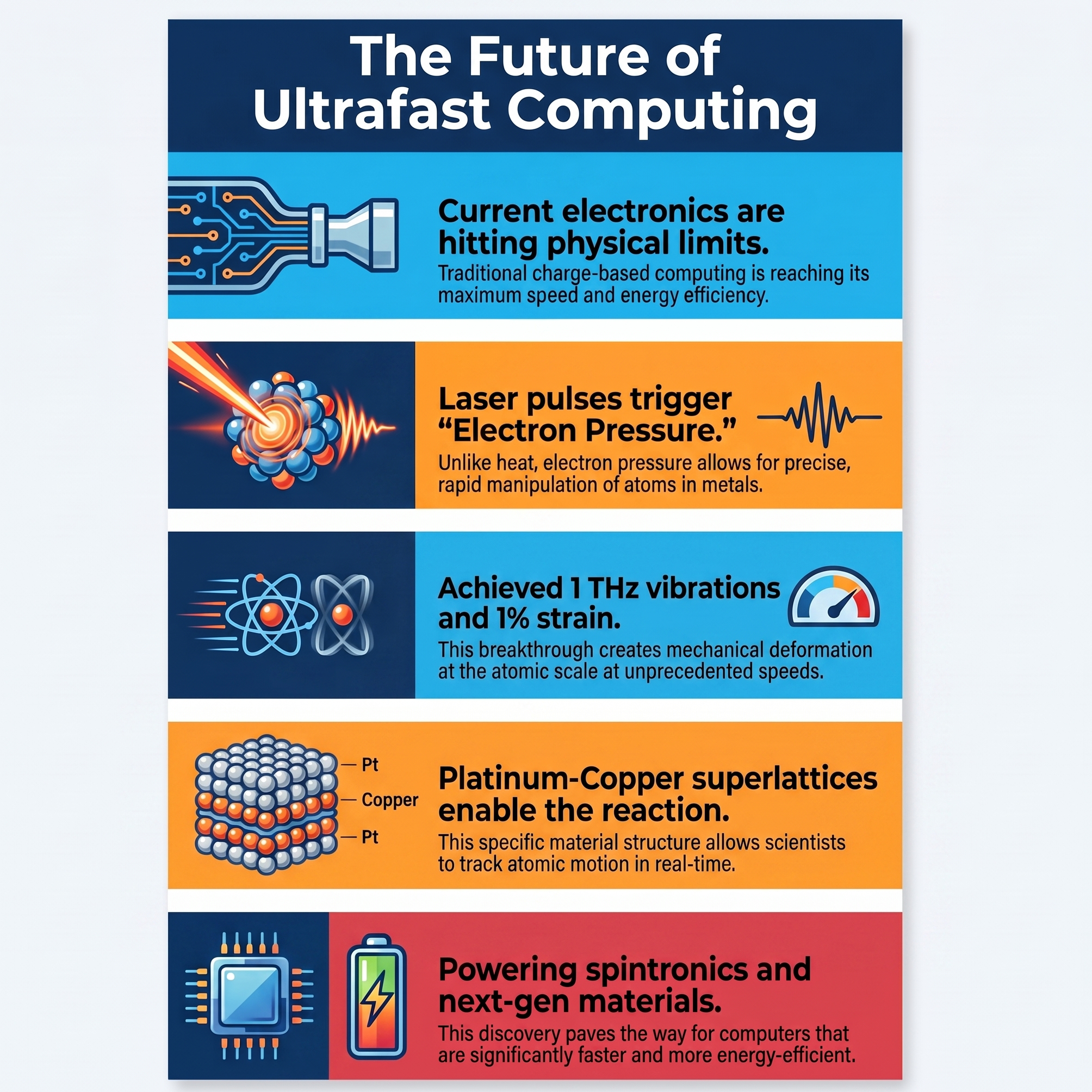
A study published in Nature Communications has demonstrated a new method of generating terahertz (THz) frequency atomic vibrations using laser pulses. The breakthrough could accelerate the development of spintronics, strain-engineered materials and next-generation computing technologies.
Background
• Conventional computing technologies are approaching physical and energy-efficiency limits, creating a need for alternative approaches beyond charge-based electronics.
• One promising avenue is strain engineering, where mechanical deformation at the atomic scale is used to modify a material's electrical, magnetic or optical properties.
• However, achieving strain at terahertz frequencies (10¹² Hz) has remained a major challenge, especially in metallic materials.
Key Findings of the Study
• Researchers used a platinum-copper superlattice and exposed it to ultrafast laser pulses.
• The experiment generated coherent atomic vibrations at 1 THz frequency with an exceptionally large 1% strain amplitude.
• Using ultrafast X-ray diffraction, scientists tracked atomic motion in real time.
• The study revealed that electron pressure, rather than heat, was responsible for driving the rapid atomic vibrations.
• This discovery provides a completely new mechanism for manipulating atoms at ultrafast timescales.
Why is the Discovery Significant?
• In metals, laser energy usually disperses rapidly through electrons, making it difficult to create localized mechanical forces.
• The newly identified electron-pressure mechanism overcomes this limitation and enables high-frequency strain generation.
• It opens new possibilities for controlling material properties at speeds required for future computing technologies.
Conclusion
The discovery that electron pressure can generate terahertz-frequency atomic vibrations marks a significant advance in materials science and computing. By enabling ultrafast strain engineering and supporting spintronic technologies, it could help overcome the limitations of conventional electronics and pave the way for faster, more energy-efficient computers.
PYQ Linkage
• Spintronics
• Nanotechnology
• Advanced Materials
• Semiconductor Technologies
• Emerging Computing Technologies
Micro Flowchart
Limits of Conventional Electronics
↓
Need for Faster Computing Technologies
↓
Laser Pulse on Platinum-Copper Superlattice
↓
Electron Pressure Generates 1 THz Atomic Vibrations
↓
1% Strain Amplitude Achieved
↓
Ultrafast Strain Engineering
↓
Advancement in Spintronics & Thermoacoustic Metamaterials
↓
with additional fragmentary burials from Mound-7 cemetery area.
