

Liberalisation Agenda Across Political Parties in India

Why in News?
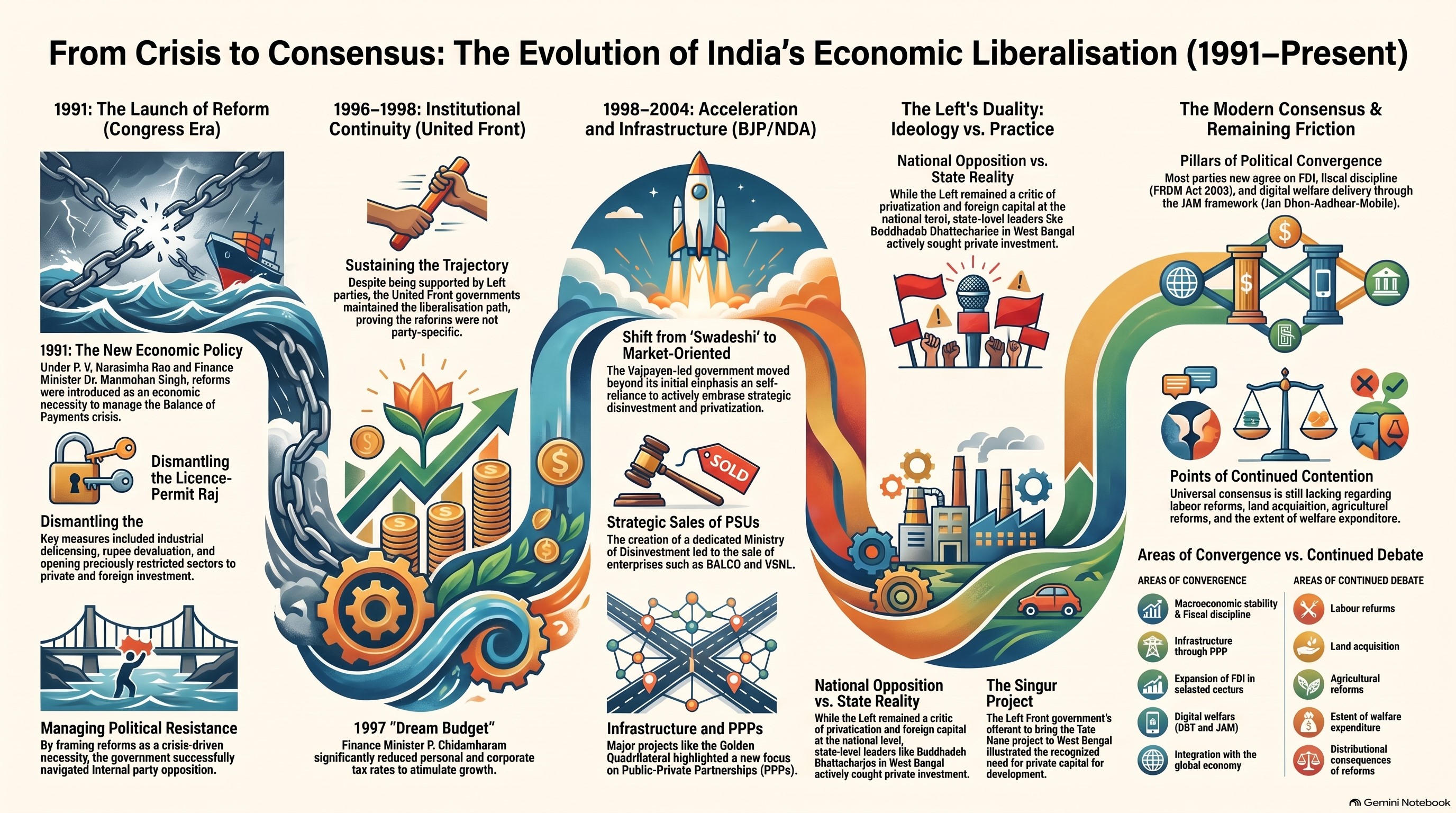
The economic reforms initiated in 1991 gradually evolved into a broad political consensus. Although political parties differed in ideology and rhetoric, governments across the political spectrum largely continued with market-oriented economic policies after coming to power.
This represents a shift from ideological opposition to “consensus through practice”, where the debate increasingly centred on the pace and distributional impact of reforms rather than their complete reversal.
Congress: Initiator of the Reform Process
The P. V. Narasimha Rao government, with Dr. Manmohan Singh as Finance Minister, introduced the New Economic Policy in 1991.
Major measures included:
- Dismantling the Licence-Permit Raj
- Rupee devaluation
- Industrial delicensing
- Opening up sectors to private participation
- Liberalising foreign investment
- Beginning public-sector disinvestment
The reforms were presented largely as an economic necessity arising from the Balance of Payments crisis, helping the government manage political resistance within the Congress.
United Front: Continuation of Reforms
The United Front governments (1996–98) continued the broad liberalisation trajectory despite support from Left parties.
Finance Minister P. Chidambaram's 1997 “Dream Budget” further reduced personal and corporate tax rates.
This demonstrated that economic reforms had acquired a degree of institutional continuity, extending beyond the Congress.
BJP/NDA: Acceleration of Reforms
The BJP initially emphasised Swadeshi and self-reliance, but the Atal Bihari Vajpayee-led NDA government adopted several significant market-oriented reforms.
Major initiatives included:
- Creation of a dedicated Ministry of Disinvestment
- Strategic sale of selected PSUs
- Disinvestment of enterprises such as BALCO and VSNL
- Expansion of infrastructure through projects such as the Golden Quadrilateral
- Greater emphasis on private investment and PPPs
Thus, the reform agenda shifted from being primarily associated with the Congress to becoming part of the broader national economic policy framework.
Left Parties: Opposition with Selective Adoption
· The Left remained a major critic of liberalisation at the national level, particularly regarding privatisation, labour reforms and the role of foreign capital.
· However, their experience at the state level demonstrated a more nuanced approach.
· For example, the Left Front government in West Bengal under Buddhadeb Bhattacharjee actively sought private investment and industrialisation, including the proposed Tata Nano project at Singur.
· This illustrates that even political groups critical of liberalisation recognised the importance of private capital and industrial investment for economic development.
Areas of Broad Political Convergence
Despite ideological differences, successive governments have broadly converged on several economic priorities:
- Macroeconomic stability and fiscal discipline
- Increasing FDI in selected sectors
- Infrastructure development through PPP
- Greater private-sector participation
- Financial and tax reforms
- Integration with the global economy
- Expansion of digital delivery of welfare through DBT and the JAM framework
The FRBM Act, 2003 also reflected the broader emphasis on fiscal discipline.
However, this consensus is not universal. Political differences continue over issues such as:
- Labour reforms
- Land acquisition
- Privatisation
- Agricultural reforms
- Extent of welfare expenditure
- Distributional consequences of liberalisation
Thus, India's post-1991 trajectory can be understood as a movement towards a broad reform consensus, where political parties may disagree over the pace, sequencing and distributional effects of reforms, while largely accepting the need for a market-oriented and globally integrated economy.
