

Life in a waiting room
The Tribune
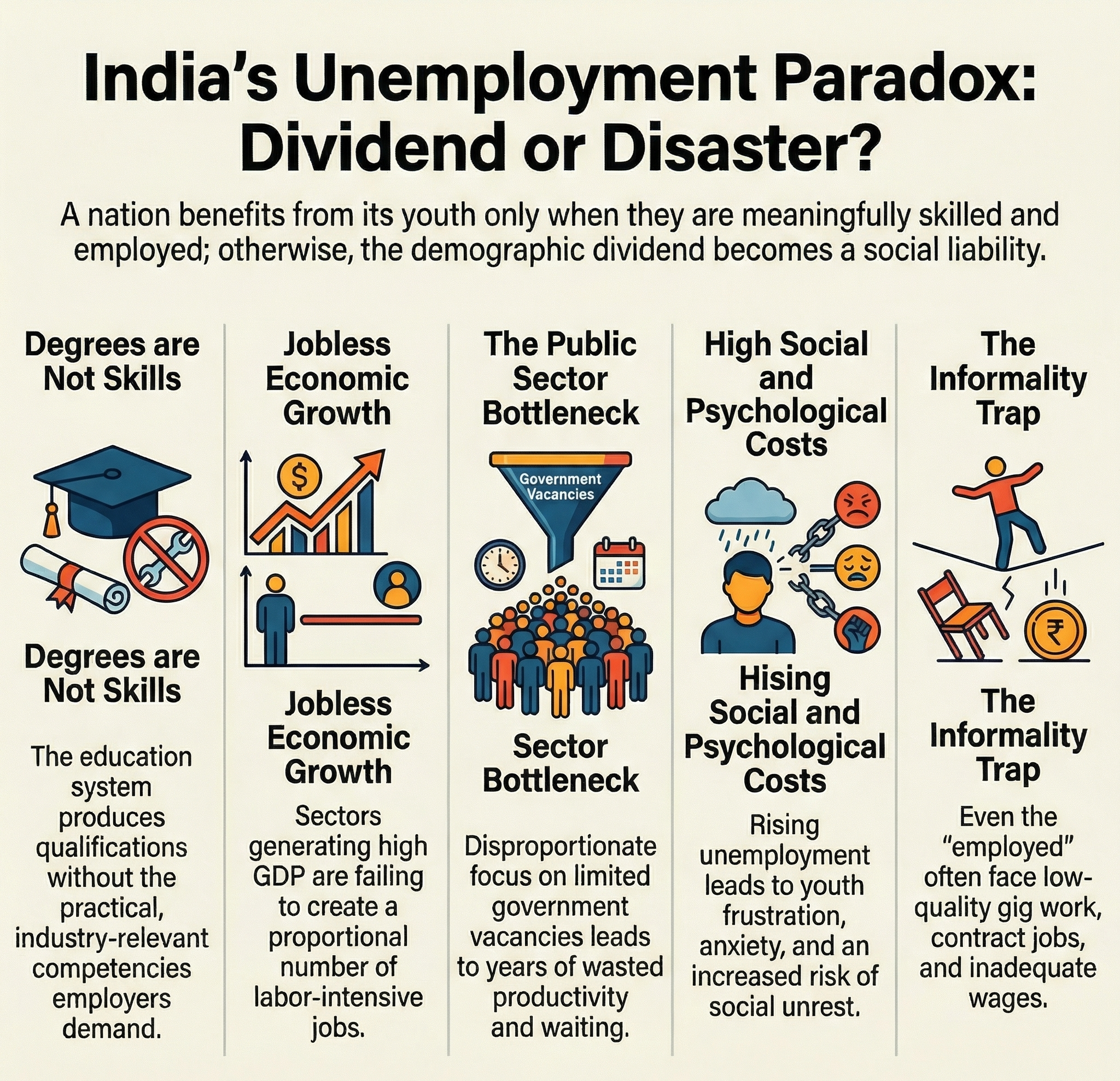
1. Key Arguments
A. Rising Educated Unemployment
Large number of graduates remain jobless despite qualifications.
Degree expansion has not translated into employability.
B. Skill–Job Mismatch
Education system produces degrees, not skills.
Employers demand practical, industry-relevant competencies which are lacking.
C. Structural Weakness in Job Creation
Economic growth is not labour-intensive enough.
Sectors generating GDP are not generating proportional employment.
D. Preference for Government Jobs
Aspirants disproportionately focus on public sector employment.
Limited vacancies vs massive demand leads to prolonged waiting periods.
E. Informalisation and Underemployment
Even employed youth face low-quality jobs.
Gig work, contract jobs, and low wages dominate.
F. Social and Psychological Costs
Unemployment leads to frustration, anxiety, and wasted productive years.
Potential for social unrest increases.
2. Author’s Stance
Critical and cautionary
Warns against complacency over demographic dividend
Highlights systemic failures.
Advocates structural reforms
Calls for aligning education with market needs.
3. Biases and Limitations
Urban-centric bias
Focus on educated youth, less on rural labour dynamics
Underrepresentation of entrepreneurship
Limited discussion on self-employment or startup ecosystem
Limited policy depth
Problem diagnosis stronger than solution detailing
4. Strengths (Pros)
Highlights a pressing national issue
Educated unemployment is central to India’s future.
Connects economy with society
Shows social consequences of economic failure.
Data-backed narrative
Uses statistics to strengthen argument.
Timely warning
Important in context of demographic transition.
5. Weaknesses (Cons)
Lacks granular policy roadmap
No detailed reform strategy.
Overemphasis on government jobs issue
Private sector dynamics need deeper exploration.
Limited global comparison
Could benefit from international best practices.
6. Policy Implications
A. Education Reform
Shift from degree-oriented to skill-oriented system
Industry-linked curriculum, vocational training.
B. Labour-Intensive Growth Strategy
Focus on manufacturing and MSMEs
Generate large-scale employment.
C. Strengthening Skilling Ecosystem
Improve quality of Skill India initiatives
Certification + employability linkage.
D. Encouraging Entrepreneurship
Startup ecosystem and credit access
Reducing dependency on jobs.
E. Public Sector Reform
Transparent and timely recruitment processes
Reducing waiting periods.
F. Social Security for Youth
Support systems for unemployed graduates
Mitigating psychological and economic stress.
7. Real-World Impact
Economic Impact
Underutilisation of human capital
Reduced productivity and growth potential.
Social Impact
Frustration, migration, and inequality
Risk of social instability.
Political Impact
Youth dissatisfaction influencing governance narratives
Long-Term Risk
Demographic dividend turning into liability
8. UPSC GS Paper Linkages
GS Paper III (Economy)
- Unemployment
- Skill development
- Inclusive growth
GS Paper II (Governance)
- Education policy
- Public recruitment systems
GS Paper IV (Ethics)
- Youth aspirations
- Social justice
9. Balanced Conclusion
The article effectively highlights the paradox of educated unemployment in India, underlining the urgent need for systemic reforms. However, solutions must balance education, economic structure, and societal expectations.
10. Future Perspective
Towards employability-driven education
Integration of skills and industry needs.
New-age job creation sectors
Green economy, digital economy.
Shift in societal mindset
From job-seeking to job-creating.
Policy convergence
Education + industry + governance alignment.
Final Insight
A nation does not benefit merely from having a young population—it benefits only when that youth is meaningfully employed, skilled, and productive.
