

Make in India at 12: Patchy Manufacturing Performance

Make in India at 12: Patchy Manufacturing Performance
Context: Manufacturing Growth - Limited Structural Gains
- Launched on 25 September 2014, Make in India aimed to strengthen manufacturing, investment, employment and exports.
- An assessment across 12 indicators suggests that manufacturing has not yet materially increased its contribution to:
- Economic growth
- Employment
- Global merchandise exports
- Under the older GDP series, manufacturing grew faster than the overall economy in only half of the 12 years.
- Under the newer series, manufacturing outpaced overall economic growth in all three available years (2023–24 to 2025–26), although the growth differential has been narrowing.
- Index of Industrial Production (IIP): Manufacturing outpaced overall IIP growth in only 3 of the 12 years under the old series; under the new series, manufacturing growth was equal to overall IIP growth in 2023–24 but slower in the following two years.
Manufacturing Share, Exports and Investment
- The older GVA series indicates that manufacturing’s share in total GVA in 2025–26 is lower than when Make in India was launched.
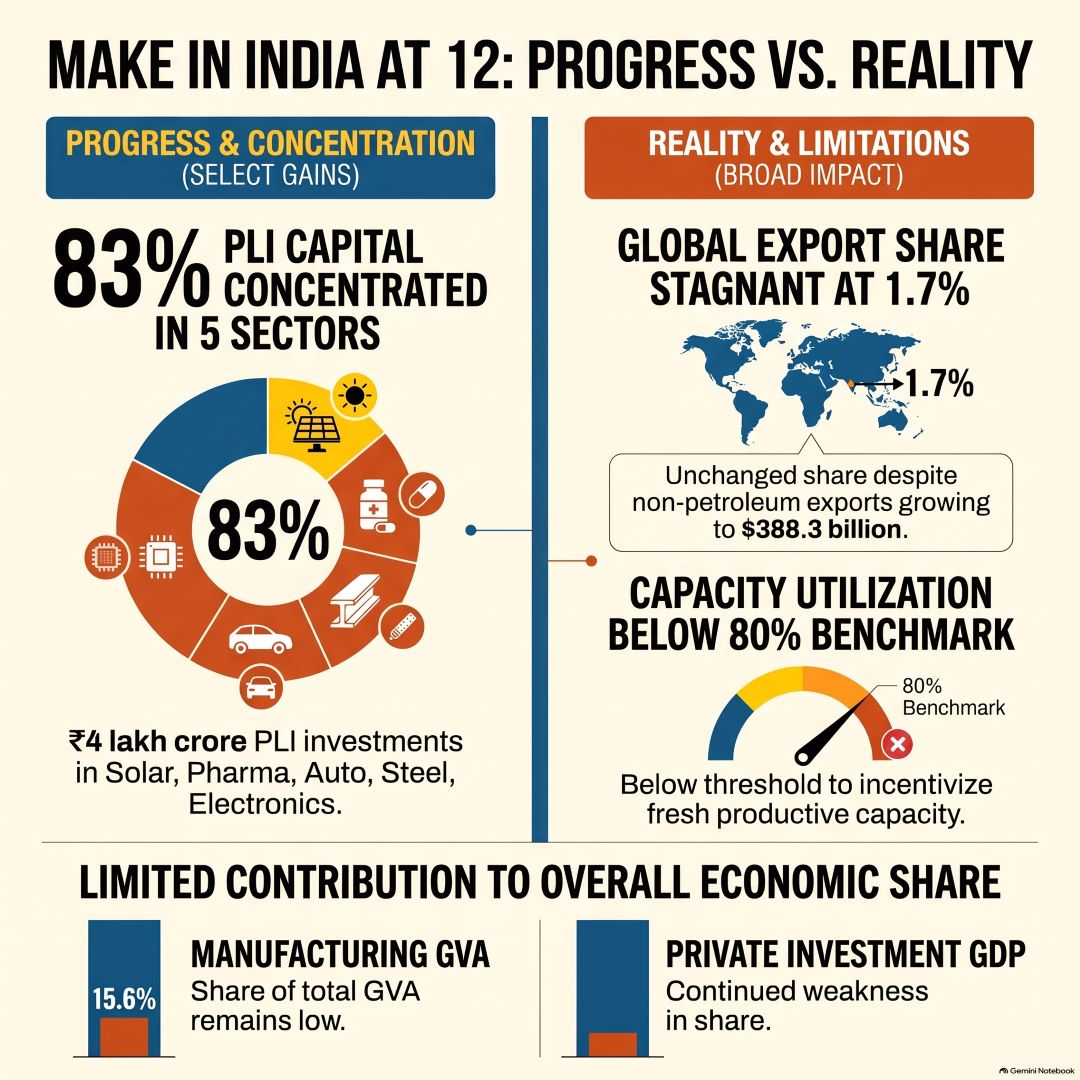
- Under the new series, manufacturing’s GVA share increased marginally from 14.6% in 2022–23 to 15.6% in 2025–26.
- Non-petroleum goods exports increased from $253.5 billion in 2014–15 to $388.3 billion in 2025–26, a rise of about 53%.
- However, non-petroleum exports had grown by more than 400% during the preceding 12 years, albeit from a much smaller base.
- India’s share in global merchandise exports remained around 1.7% in 2025–26, compared with around 1.7% in 2013, despite the expansion in absolute exports.
- Private Gross Fixed Capital Formation (GFCF):
- Its share of GDP in 2023–24 was lower than in 2014–15 under the old series.
- The new series also shows a decline in GFCF as a percentage of GDP since 2022–23.
- This points to continued weakness in private investment and capacity creation.
FDI, Capacity Utilisation and Industrial Credit
- Manufacturing FDI growth was slower than overall FDI growth in 7 of the 12 years examined.
- Manufacturing’s share of total FDI nevertheless increased from nearly 48% in 2014–15 to 55% in 2025–26.
- Capacity utilisation, as measured by RBI data, has gradually improved but remains below the 80% level generally associated with stronger incentives for companies to undertake fresh capacity expansion.
- Bank credit to industry has increased strongly in recent years, particularly credit to micro, small and medium enterprises (MSMEs).
- However, the article notes that without sustained rapid growth in industrial output, higher credit may indicate greater financing of working capital rather than fresh productive investment.
PLI Schemes: Gains but Highly Concentrated
- The Production-Linked Incentive (PLI) schemes were introduced across 2020–21 in 14 sectors to promote domestic manufacturing and attract investment.
- By March 2026, the schemes had generated cumulative investment of around ₹4 lakh crore.
- However, benefits remain highly concentrated:
- Solar modules
- Pharmaceuticals and drugs
- Automobiles and auto components
- Specialty steel
- Large-scale electronics manufacturing
- These five sectors together account for nearly 83% of total investment generated under the PLI schemes.
- Thus, PLI has demonstrated the potential of targeted industrial policy, but the gains have not yet translated into broad-based manufacturing expansion across sectors.
Overall Assessment and Policy Challenge
- The evidence presents a mixed picture: India has recorded gains in selected manufacturing sectors, FDI share and PLI-supported investment, but broader structural indicators remain less encouraging.
- Key concerns include:
- Limited increase in manufacturing’s share of GVA.
- Weak improvement in India’s share of global merchandise exports.
- Declining private investment intensity.
- Capacity utilisation remaining below the threshold associated with new capacity creation.
- Concentration of PLI investment in a few sectors.
- The central challenge for the next phase of Make in India is to move from incentive-led, sector-specific gains to broad-based manufacturing competitiveness, sustained private investment, higher productivity and deeper integration into global value chains.
