

Manipur Census Deferment and the NRC Debate

Why in News?
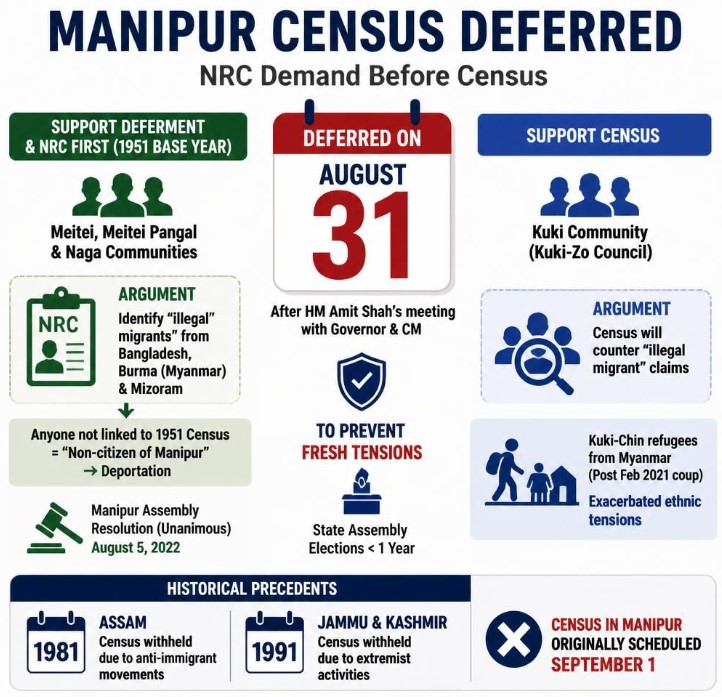
- The Centre deferred Census operations in Manipur on August 31, just before the decennial exercise was scheduled to begin on September 1.
- Several community organisations and civil society groups demanded that a National Register of Citizens (NRC) exercise be conducted before the Census, using 1951 as the base year.
- The deferment was also influenced by the continuing ethnic tensions in the State and the proximity of the Manipur Assembly elections.
- The issue has become politically sensitive because population data, migration and citizenship are closely linked to the existing Meitei–Kuki ethnic conflict.
Why is NRC Being Demanded?
- Pro-NRC groups, particularly among the Meitei, Meitei Pangal and sections of the Naga community, seek identification of alleged illegal migrants from Bangladesh, Myanmar and Mizoram.
- They argue that migration has altered the demographic balance and threatens the interests of Manipur’s indigenous communities.
- The proposed 1951 base year is intended to establish an older population/citizenship reference point and distinguish long-term residents from subsequent migrants.
- The Manipur Legislative Assembly unanimously passed a resolution in August 2022 seeking:
- Creation of a State Population Commission.
- Implementation of an NRC in Manipur.
- The influx of Kuki-Chin refugees from Myanmar after the 2021 military coup has further intensified concerns over migration and demographic change.
Ethnic Conflict and Census Sensitivity
- The Census is particularly sensitive in Manipur because population figures influence political representation, resource allocation and competing claims over land and identity.
- The Meitei community largely inhabits the Imphal Valley, while the surrounding hill areas are predominantly inhabited by Kuki-Zo and Naga communities.
- The Kuki-Zo Council supports conducting the Census and opposes the framing of its community through the lens of illegal migration.
- The prolonged ethnic conflict since May 2023 has produced deep territorial and social divisions, making the collection and acceptance of demographic data politically contentious.
- The Centre therefore faces a delicate balance between conducting a constitutional/statutory population exercise and preventing it from becoming a fresh source of ethnic mobilisation.
Census and NRC: Key Distinction
|
Census |
NRC |
|
Primarily counts and collects demographic, social and economic information about the population. |
Seeks to identify persons recognised as citizens under the applicable legal framework. |
|
A decennial national exercise. |
A citizenship-related register, not a routine population count. |
|
Does not by itself determine citizenship status. |
Involves verification of citizenship-related claims and documents. |
|
Used for planning, governance, representation and resource allocation. |
Primarily concerned with determining/recording citizenship. |
- The 2021 Census was postponed due to the COVID-19 pandemic and the Census cycle is now being undertaken in 2026–27.
- Census exercises have previously been affected by security and political conditions: Assam’s 1981 Census was not conducted amid the anti-immigrant movement, while Jammu and Kashmir’s 1991 Census was withheld due to extremist violence.
- Assam’s NRC, published in 2019, remains contested and has faced continuing legal and administrative issues.
Federal and Constitutional Significance
- The Manipur case highlights the difficulty of conducting demographic exercises in a conflict-affected and ethnically divided State.
- It raises wider questions regarding the relationship between citizenship determination, migration control, indigenous rights and constitutional equality.
- Any NRC process would require clear legal criteria, transparent procedures, effective grievance redressal and safeguards against arbitrary exclusion.
- Census data should remain neutral and evidence-based rather than becoming an instrument for ethnic or political claims.
- The larger challenge is to protect Manipur’s territorial integrity and social cohesion while addressing legitimate concerns regarding migration, citizenship and demographic change.
