

Manufacturing Growth: A Data Reality Check

Manufacturing Growth: A Data Reality Check
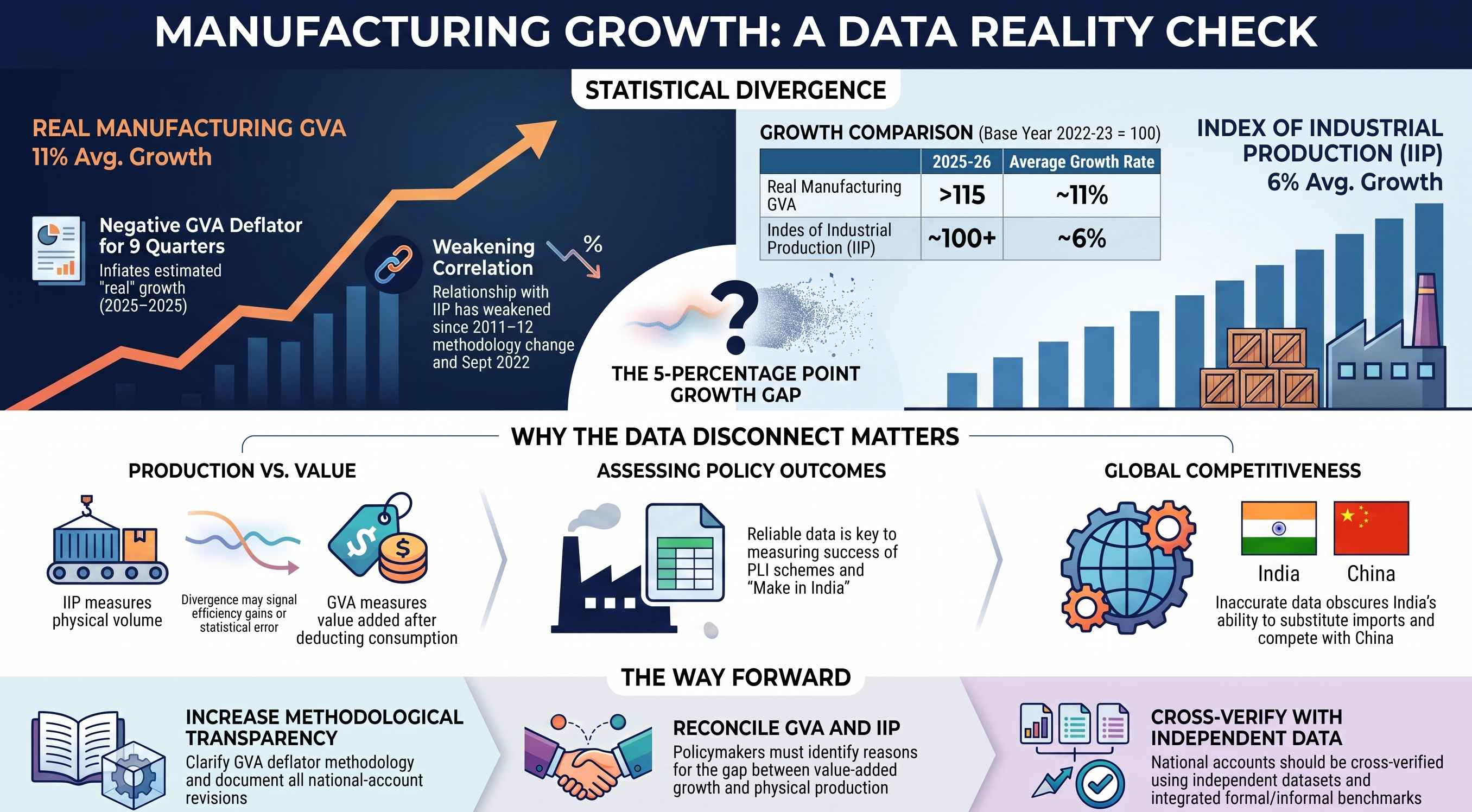
India is promoting manufacturing through Make in India and PLI schemes amid rising competition from China. However, revised national accounts show strong manufacturing growth while other indicators remain subdued, raising questions about the scale and sustainability of the revival.
Key Statistical Concerns
1. Unusual GVA Deflator
The manufacturing GVA deflator recorded negative growth for nine consecutive quarters during 2023–2025, despite positive core CPI inflation and only intermittent negative WPI inflation.
The GVA deflator differs from CPI and WPI, so divergence is not automatically an error. However, because real GVA is derived by adjusting nominal GVA for price changes, an unusually low or negative deflator can significantly raise estimated real growth.
2. Growing GVA–IIP Gap
Using 2022–23 as the base (=100), by 2025–26 real manufacturing GVA was at least 15 percentage points above IIP.
- Average manufacturing growth according to GVA: ~11%
- Average growth according to IIP: ~6%
The two indicators measure different aspects of manufacturing. GVA measures value added after deducting intermediate consumption, while IIP measures changes in industrial production volumes. Thus, productivity improvements, efficiency gains or greater value addition can cause GVA to grow faster than physical output.
3. Weakening Relationship Between GVA and IIP
Before the 2011–12 methodology change, GVA and IIP had a correlation of around 0.8. Their relationship weakened thereafter and has diverged further since September 2022, with strong real GVA growth alongside relatively stable IIP.
The informal sector alone may not explain the gap because revised GVA estimates increasingly use formal-sector benchmarks.
Why It Matters?
Reliable manufacturing data is essential for assessing:
- Make in India and PLI outcomes
- Employment and productivity
- Export competitiveness and import substitution
- Domestic value-chain development
- India's ability to compete with China
- Effectiveness of industrial policy
If production, value addition and productivity indicators send different signals, policymakers need to identify the reasons before claiming a structural manufacturing transformation.
Way Forward
India should improve:
- Transparency in GVA deflator methodology
- Documentation of national-account revisions
- Reconciliation between GVA and IIP
- Integration of formal and informal sector data
- Cross-verification using independent datasets
Conclusion
India's manufacturing revival may be genuine, but its magnitude requires careful scrutiny. The divergence among the GVA deflator, real GVA and IIP does not prove that the GDP estimates are incorrect, but it highlights the need for greater statistical transparency and reconciliation.
Credible manufacturing data is essential for sound policy decisions on employment, exports, investment, import substitution and India's long-term economic resilience.
