

Mapping oceans gave humans knowledge – and the arrogance to claim seas as territory
Times Of India
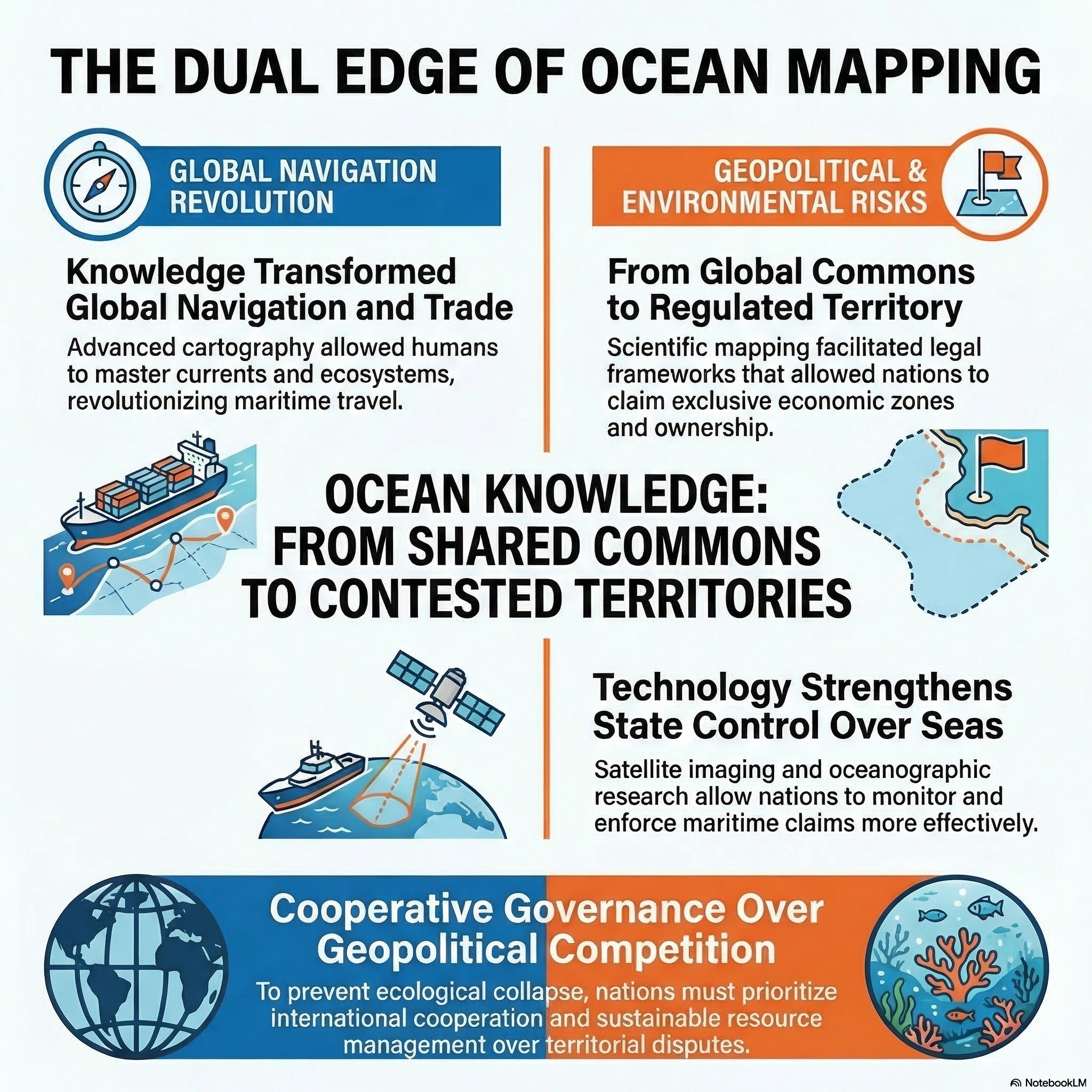
Key Arguments of the Article
Ocean Mapping Expanded Human Knowledge
The article argues that mapping oceans allowed humans to understand marine geography, currents, ecosystems, and navigation routes. Advances in cartography and marine exploration significantly improved maritime travel and global trade.
Scientific knowledge of oceans thus transformed the way humans interacted with the marine environment.
Knowledge Led to Territorial Claims
The article suggests that increased knowledge of ocean spaces encouraged states to assert ownership and control over maritime areas. Maritime mapping facilitated the development of legal frameworks that allowed countries to claim territorial waters and exclusive economic zones.
This shift marked the transformation of oceans from open commons to regulated geopolitical spaces.
Technological Advances Enabled Marine Control
Technological innovations in navigation, satellite imaging, and oceanographic research enabled states to monitor and control marine territories more effectively.
Modern technologies have strengthened the capacity of nations to enforce maritime claims and manage ocean resources.
The Ocean as a Global Commons
Despite increasing territorial claims, the article emphasises that oceans remain part of the global commons and are vital for biodiversity, climate regulation, and international trade.
The author warns against excessive geopolitical competition over marine resources.
Environmental Challenges in Oceans
The article also highlights rising environmental concerns such as ocean warming, biodiversity loss, and pollution. The exploitation of marine resources combined with geopolitical competition has intensified environmental stress on ocean ecosystems.
Sustainable management of marine resources has therefore become an urgent global priority.
Author’s Stance
The author adopts a reflective and critical perspective on humanity’s relationship with the oceans. While acknowledging the scientific benefits of ocean exploration, the article warns that the same knowledge has encouraged territorial ambitions and exploitation.
The stance emphasises the need for responsible and cooperative governance of marine spaces.
Possible Biases
Environmental Perspective
The article emphasises ecological sustainability and may highlight environmental concerns more strongly than economic benefits.
Critical View of Territorial Expansion
The narrative questions the legitimacy of excessive maritime territorial claims.
Historical Interpretation
The analysis focuses on the historical relationship between knowledge and power in shaping ocean governance.
Advantages of Ocean Mapping
Improved Maritime Navigation
Accurate mapping enhances global trade routes and maritime safety.
Scientific Advancement
Oceanographic research contributes to understanding climate systems, biodiversity, and marine ecosystems.
Resource Management
Mapping helps identify marine resources such as fisheries, minerals, and energy reserves.
Disaster Preparedness
Better knowledge of ocean systems improves forecasting of storms, tsunamis, and climate patterns.
Challenges and Concerns
Territorial Conflicts
Expanding maritime claims have increased geopolitical tensions among coastal states.
Environmental Degradation
Overexploitation of marine resources threatens biodiversity and ecological balance.
Governance Complexity
Managing ocean resources requires coordination among multiple international actors.
Climate Change Impact
Rising ocean temperatures and acidification pose serious threats to marine ecosystems.
Policy Implications
Strengthening Ocean Governance
International frameworks must ensure sustainable and cooperative management of marine resources.
Promoting Marine Conservation
Governments should expand marine protected areas and strengthen biodiversity protection measures.
Enhancing Scientific Research
Continued investment in oceanographic research can improve understanding of marine ecosystems.
Encouraging International Cooperation
Shared ocean resources require collaborative governance mechanisms among nations.
Real-World Impact
If ocean governance improves:
• Better conservation of marine biodiversity
• Reduced maritime conflicts
• Sustainable exploitation of marine resources
If geopolitical competition intensifies:
• Increased maritime disputes
• Overexploitation of ocean resources
• Greater environmental degradation
Alignment with UPSC GS Papers
GS Paper I
Geography of oceans, marine ecosystems, environmental changes.
GS Paper II
International relations, maritime disputes, global governance frameworks.
GS Paper III
Environmental conservation, climate change, resource management.
Balanced Assessment
The article highlights the dual nature of scientific knowledge. While ocean mapping has expanded human understanding of marine systems and enabled global connectivity, it has also encouraged geopolitical competition over maritime territories.
Balancing exploration with responsible governance remains essential.
Future Perspective
As the global economy increasingly depends on marine resources and maritime trade routes, the importance of sustainable ocean governance will continue to grow. Advances in technology will provide deeper insights into ocean ecosystems, but these must be accompanied by strong international cooperation and environmental stewardship.
For policymakers and civil services aspirants, the issue illustrates the intersection of science, geopolitics, and environmental sustainability in managing the world’s oceans.
