

MARCO RUBIO’S JAMNAGAR VISIT: ENERGY GEOPOLITICS

MARCO RUBIO’S JAMNAGAR VISIT: ENERGY GEOPOLITICS
Context
- US Secretary of State Marco Rubio’s reported visit to Reliance Industries Limited’s (RIL) Jamnagar refinery highlights the role of energy trade in India–US relations amid trade negotiations and disagreements over India's imports of Russian crude oil.
Jamnagar Refinery: Strategic Importance
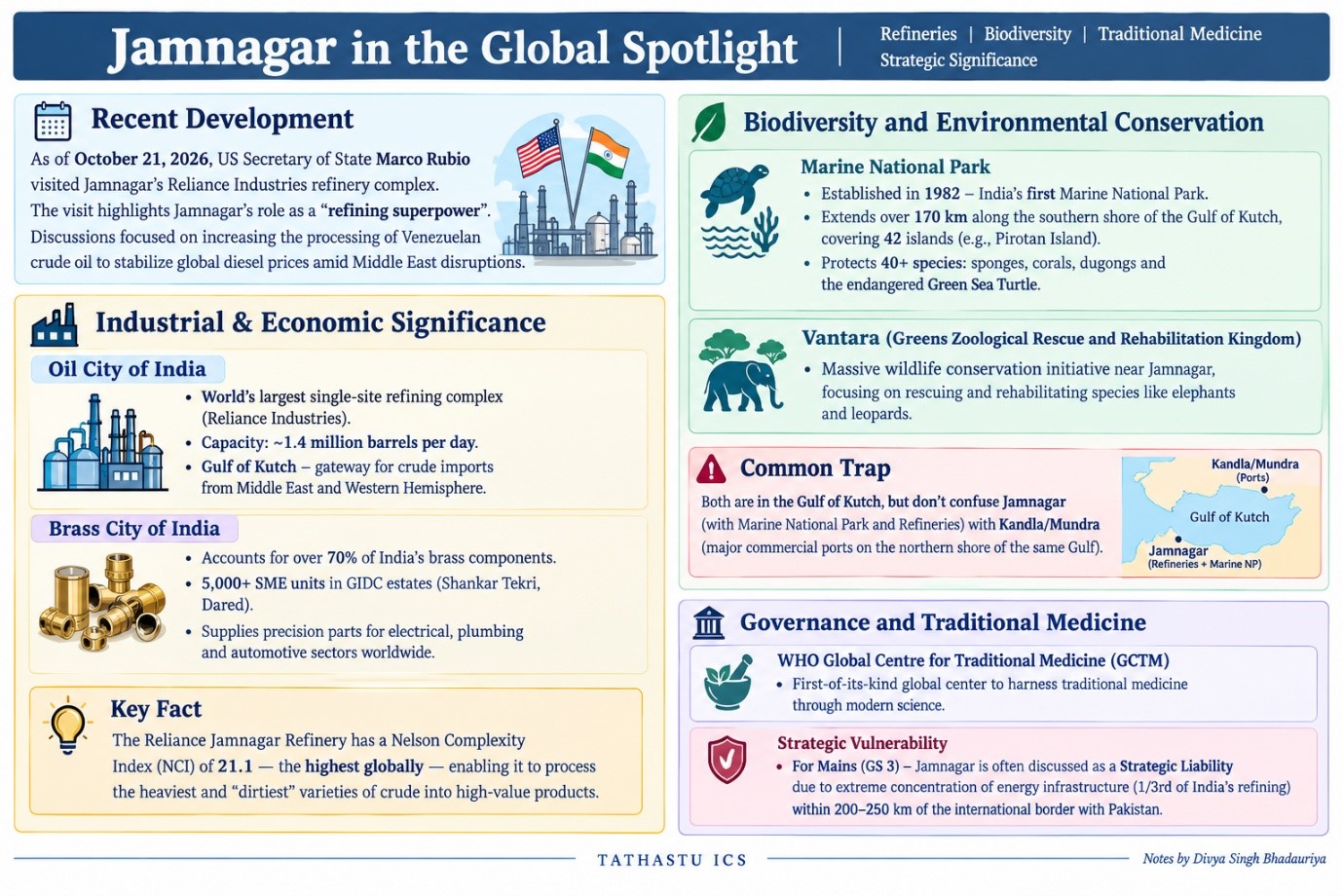
- The Jamnagar refinery complex in Gujarat is the world's largest single-location refining complex, with a reported combined capacity of 1.4 million barrels per day.
- Its advanced refining technology enables the processing of diverse crude grades, including heavy and sulphur-rich oil, into high-value products such as diesel and aviation fuel.
- Its export capacity makes India an important supplier in global refined petroleum markets.
Key Dimensions of India–US Energy Relations
- Russian Oil: India increased imports of discounted Russian crude after the Russia–Ukraine war began in 2022. The US has raised concerns that these purchases generate revenue for Russia, while India prioritises energy security and affordable supplies.
- American Oil: Washington is encouraging India to purchase more US energy products to diversify supplies and address the bilateral trade imbalance.
- Texas Refinery Project: RIL's reported participation in a proposed refinery project in Brownsville, Texas, could strengthen bilateral investment ties. The project remains distinct from an operational refinery.
- Venezuelan Crude: Jamnagar's complex refining technology may enable it to process heavy Venezuelan crude, subject to commercial feasibility and applicable sanctions.
Challenges for India
- Import Dependence: India imports over 88% of its crude oil requirements, exposing the economy to global price volatility and geopolitical disruptions.
- Geopolitical Pressure: US sanctions and tariff threats may complicate India's energy procurement and trade negotiations.
- Strategic Autonomy: India must balance its relationship with the US against its energy requirements and independent foreign policy.
- Economic Impact: Higher crude prices can increase inflation, widen the current account deficit and put pressure on the rupee.
Way Forward
- Diversify crude oil suppliers based on affordability, quality and reliability.
- Strengthen strategic petroleum reserves to manage external supply disruptions.
- Expand energy cooperation with the US while safeguarding India's energy security and strategic autonomy.
- Reduce long-term import dependence through renewable energy, electric mobility and energy efficiency.
|
Jamnagar, often called the "Oil City of India" or the "Jewel of Kathiawar," has evolved from a historical princely seat into a global energy and manufacturing powerhouse. For a UPSC aspirant, it represents a unique intersection of industrial geography, environmental conservation, and strategic diplomacy. 🏭 Industrial & Economic Significance Jamnagar is the backbone of India's petroleum and manufacturing sectors, hosting critical infrastructure that influences global energy markets.
Biodiversity & Environment The region is home to some of India’s most sensitive and unique ecological zones.
History & Culture Historically known as Nawanagar, the city was founded in 1540 by Jam Rawal.
|
Conclusion
Jamnagar illustrates how refining capacity connects India's energy security with international trade and diplomacy. Diversified supplies, resilient infrastructure and balanced partnerships can help India manage geopolitical risks while advancing its long-term energy transition.