

Median Age: Africa Youngest, Europe Oldest

Median Age: Africa Youngest, Europe Oldest
GS Paper: GS-I (Population & Associated Issues) | GS-II (Demographic Dividend) |
Source: IE
Why in News?
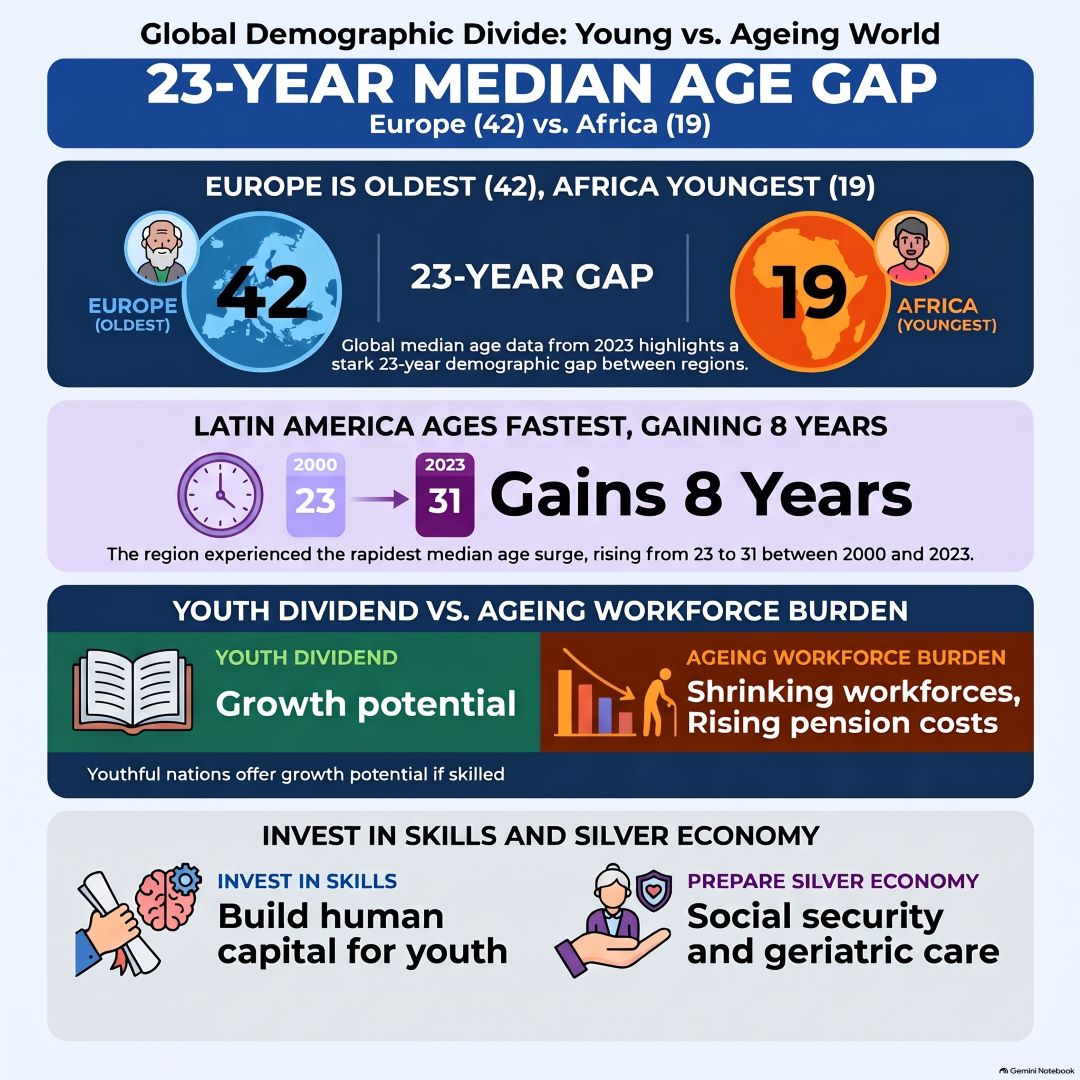
Data on median age across world regions (2000 vs 2023) shows Europe has the oldest population (median age 42) and Africa the youngest (19), a 23-year gap. India's median age stands at about 28.4 years.
Key Data
• Europe: 37 → 42 | Northern America: 34 → 38 | Oceania: 30 → 33
• Asia: 25 → 32 | Latin America: 23 → 31 (fastest increase, 8 years) | Africa: 17 → 19
• Median age is the age that divides a population into two equal halves, one younger and one older.
Causes of the Divergence
• Fertility rates: Africa's Total Fertility Rate (TFR) is high (about 4+); Europe's is far below the replacement level of 2.1.
• Life expectancy: Higher in Europe because of better healthcare and living standards, which pushes the median age up.
• Demographic transition stage: Africa is in an early-to-mid stage (high birth rate, falling death rate); Europe is in a late stage (low birth and death rates).
Implications
• Youthful societies (Africa, India): a potential demographic dividend, but only if backed by education, skilling and jobs. Otherwise it becomes a demographic burden or unrest.
• Ageing societies (Europe, East Asia): a shrinking workforce, rising pension and health costs, and a dependence on immigration.
• For India: the dividend window is open until roughly 2040s. States differ widely (Kerala is ageing, while Bihar and UP are young).
Way Forward
• Invest in health, education and skills (human capital); raise female labour force participation.
• Prepare for ageing through social security, geriatric care and a silver economy.
|
Demographic Dividend and Demographic Transition • Demographic dividend (UNFPA): economic growth potential when the share of the working-age population (15–64) exceeds the dependent population. • Four stages of transition: (1) high birth and death rates, (2) falling death rate with high birth rate, (3) falling birth rate, (4) low birth and death rates (ageing). • Dependency ratio = (population under 15 + above 64) / working-age population. • India: TFR has fallen to about 2.0 (NFHS-5), which is below replacement. Related terms: replacement-level fertility, population momentum.
|