

Memorandum of Procedure (MoP) for Judicial Appointments

Memorandum of Procedure (MoP) for Judicial Appointments
Source: IE
Why in News?
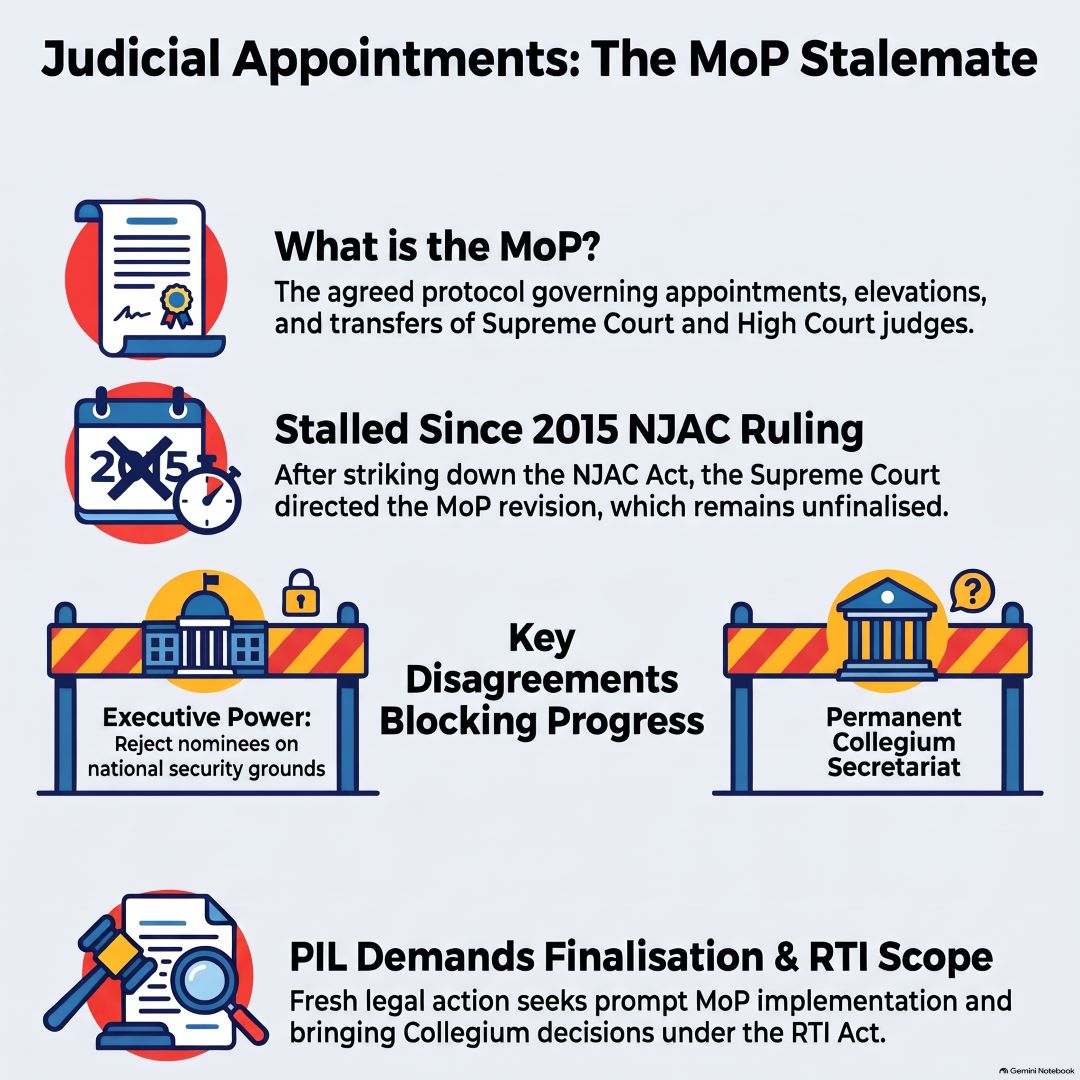
The Supreme Court has issued notice to the Union Government and the Chief Justice of India (CJI) in a PIL filed by NGO Lok Prahari, seeking finalisation of the revised Memorandum of Procedure (MoP) for appointing judges to the Supreme Court and High Courts.
- The revision has remained pending since December 2015, following the Supreme Court's decision to strike down the National Judicial Appointments Commission (NJAC).
- The petition also seeks to bring Collegium decisions under the Right to Information (RTI) Act.
What is the Memorandum of Procedure (MoP)?
- MoP is a document containing mutually agreed procedures for the appointment, elevation and transfer of judges to the Supreme Court and High Courts.
- It was first formulated on 30 June 1999 following the Second Judges Case (1993) and Third Judges Case (1998).
- The original 1999 MoP continues to govern judicial appointments because its revised version has not been finalised.
Judicial Appointment Process
- Supreme Court: The CJI initiates proposals for appointments in consultation with the Collegium.
- High Courts: The Chief Justice of the concerned High Court initiates proposals in consultation with the two senior-most puisne judges.
Background: NJAC Judgment (2015)
- The 99th Constitutional Amendment, 2014 introduced the National Judicial Appointments Commission (NJAC) to replace the Collegium system.
- In October 2015, a five-judge Constitution Bench declared the 99th Constitutional Amendment and NJAC Act unconstitutional, restoring the Collegium system.
- Proposed NJAC composition included the CJI, two senior-most Supreme Court judges, Union Law Minister and two eminent persons.
- The Court subsequently sought suggestions to improve the Collegium system, focusing on transparency, a Collegium secretariat, eligibility criteria and complaints.
- In December 2015, the Court directed the government to revise the MoP in consultation with the CJI.
Why Has the Revision Been Delayed?
- National Security Clause: The Centre sought the power to reject judicial nominees on national security grounds.
- Collegium Secretariat: Disagreement over establishing a permanent secretariat to support judicial appointments.
- Executive–Judiciary Differences: Lack of consensus over the extent of government involvement in judicial appointments.
- Transparency: Concerns regarding the disclosure and accountability of Collegium decisions.
Developments Since 2015
- 2016–17: Consultations continued, but disagreements over national security and the Collegium secretariat remained.
- December 2016: Parliamentary Standing Committee highlighted delays in judicial appointments due to the lack of consensus.
- March 2017: The Collegium's finalised MoP was reportedly sent to the government but remained under consideration.
- 2023: The Law Minister proposed including Centre and State nominees in search-cum-evaluation committees, while the government clarified that the Collegium would retain final authority.
- February 2026: The Law Minister informed the Rajya Sabha that the MoP revision was under consideration.
Conclusion
The prolonged delay in finalising the Memorandum of Procedure reflects continuing differences between the executive and judiciary over control and transparency in judicial appointments. A mutually agreed MoP is essential to protect judicial independence, improve accountability and ensure timely appointments while maintaining the constitutional balance of power.
Quick Learning – Important Constitutional Background
|
Term |
Key Information |
|
Article 124 |
Appointment of Supreme Court judges. |
|
Article 217 |
Appointment of High Court judges. |
|
Article 222 |
Transfer of High Court judges. |
|
Article 50 |
Separation of judiciary from executive. |
|
Second Judges Case, 1993 |
Established the Collegium system. |
|
Third Judges Case, 1998 |
Clarified the composition and functioning of the Collegium. |
|
99th Constitutional Amendment, 2014 |
Provided for the establishment of NJAC. |
|
NJAC Judgment, 2015 |
Struck down NJAC and restored the Collegium system. |
|
RTI Act, 2005 |
Provides citizens access to information held by public authorities, subject to statutory exemptions. |