

MGNREGA was the ground beneath our feet. It’s slipping away
Indian Express
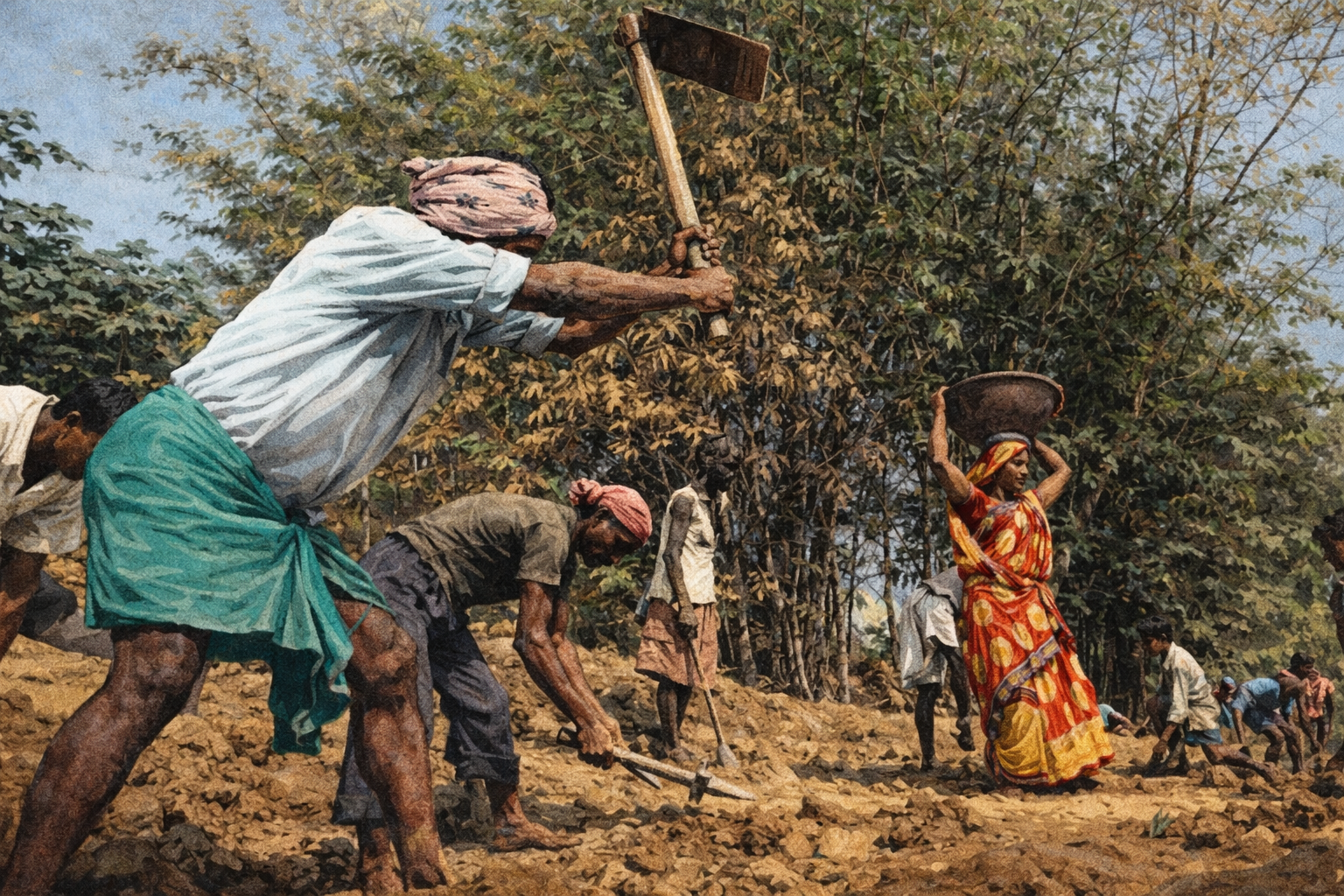
I. Core Theme and Central Argument
The article argues that MGNREGA—once a cornerstone of India’s rural social protection framework—is gradually losing its substantive economic and rights-based character, not through formal repeal but through policy drift, administrative dilution, and political neglect. The metaphor “slipping away beneath our feet” signals a slow erosion rather than abrupt dismantling.
The author contends that while MGNREGA still exists on paper, its capacity to guarantee employment, income security, and rural resilience has been steadily undermined.
II. Key Arguments Presented
1. From Rights-Based Guarantee to Administrative Programme
MGNREGA was conceived as a legal entitlement, not a discretionary welfare scheme. The article argues that frequent delays in wage payments, rationed workdays, and funding uncertainty have hollowed out its rights-based core.
2. Wage Stagnation and Erosion of Real Incomes
Although nominal wages under MGNREGA have increased marginally, they have failed to keep pace with inflation, reducing real income gains. This weakens the scheme’s role as a floor for rural wages.
3. Administrative Frictions as Structural Dilution
The author highlights procedural burdens—digital attendance systems, Aadhaar-linked payments, delayed muster roll approvals—as instruments that effectively ration access to work without formally changing the law.
4. Declining Political Ownership
MGNREGA’s earlier political consensus has frayed. The article notes reduced enthusiasm among policymakers, with the scheme increasingly treated as a fiscal liability rather than a developmental investment.
5. Shift from Livelihood Support to Crisis-Only Use
Instead of being a continuous stabiliser of rural livelihoods, MGNREGA is now activated mainly during crises (droughts, pandemics), weakening its long-term developmental role.
III. Author’s Stance
The author adopts a critical but not ideological stance. There is no rejection of fiscal discipline or governance reform per se; rather, the criticism is directed at policy inconsistency and quiet withdrawal of commitment.
The stance is best described as institutional realist: MGNREGA worked when backed by political will and adequate funding, and is failing where that support has weakened.
IV. Implicit Biases and Framing
1. Pro–Rights-Based Welfare Bias
The article clearly privileges the original rights-based philosophy of MGNREGA over efficiency-driven or fiscally conservative reinterpretations.
2. Skepticism of Technocratic Governance
Digitalisation and administrative reforms are framed largely as exclusionary tools, with limited acknowledgement of their potential benefits in reducing leakages.
3. Rural-Centric Development Lens
The analysis foregrounds rural distress and employment security, offering less space to competing policy priorities such as urban employment or capital-intensive growth.
V. Strengths of the Argument
1. Historical Contextualisation
The article situates MGNREGA within its original legislative intent, enabling readers to assess present performance against founding principles.
2. Structural, Not Anecdotal, Critique
Instead of isolated implementation failures, the focus is on systemic erosion.
3. Clear Link to Rural Economy
The author effectively connects MGNREGA’s decline to broader issues of rural demand, migration, and informal sector precarity.
4. UPSC Relevance
Strong alignment with GS-II (Welfare Schemes, Governance) and GS-III (Inclusive Growth, Employment).
VI. Limitations and Gaps
1. Limited Fiscal Perspective
The article does not fully engage with concerns about fiscal sustainability or competing budgetary pressures.
2. Underplays State-Level Variations
MGNREGA performance varies widely across states, but the analysis remains largely national in tone.
3. Lack of Reform Roadmap
While the diagnosis is strong, concrete reform pathways—beyond restoring funding and political will—are not elaborated in depth.
VII. Policy Implications
For Governance (GS Paper II)
• Reasserting legal entitlements over discretionary administration
• Improving accountability in wage payments
• Centre–State coordination in welfare delivery
For Economy (GS Paper III)
• Role of public works in sustaining rural demand
• Employment guarantees as automatic stabilisers
• Link between wage security and poverty reduction
For Ethics and Social Justice (GS Paper IV)
• State responsibility toward vulnerable populations
• Ethical implications of procedural exclusion
VIII. Real-World Impact
If Current Trends Continue
• Increased rural distress and seasonal migration
• Weakening of wage floors in informal labour markets
• Reduced resilience to climate and economic shocks
If Course Correction Occurs
• Restoration of MGNREGA as a demand-driven safety net
• Stronger rural purchasing power
• Improved trust in state capacity and welfare delivery
IX. Balanced Conclusion
The article convincingly argues that MGNREGA is not collapsing but being quietly hollowed out. Its decline is not legislative but administrative and political. While efficiency, transparency, and fiscal prudence are legitimate concerns, they cannot substitute for political commitment to the scheme’s foundational purpose.
MGNREGA’s value lies not merely in employment numbers but in its role as a guarantee against rural economic insecurity. Diluting it risks undermining one of India’s most important social protection innovations.
X. Future Perspective
• Re-index MGNREGA wages to inflation
• Ensure time-bound wage payments as a non-negotiable right
• Treat MGNREGA as a developmental investment, not a residual welfare cost
• Strengthen state capacity rather than relying solely on digital controls
• Re-anchor the scheme within India’s broader employment and climate adaptation strategy
For UPSC aspirants, the key takeaway is clear: the fate of MGNREGA reflects the broader tension between rights-based welfare and technocratic governance in contemporary India.
