

MGNREGS to VB-G RAM G: A shift in focus for rural jobs
Hindustan Times
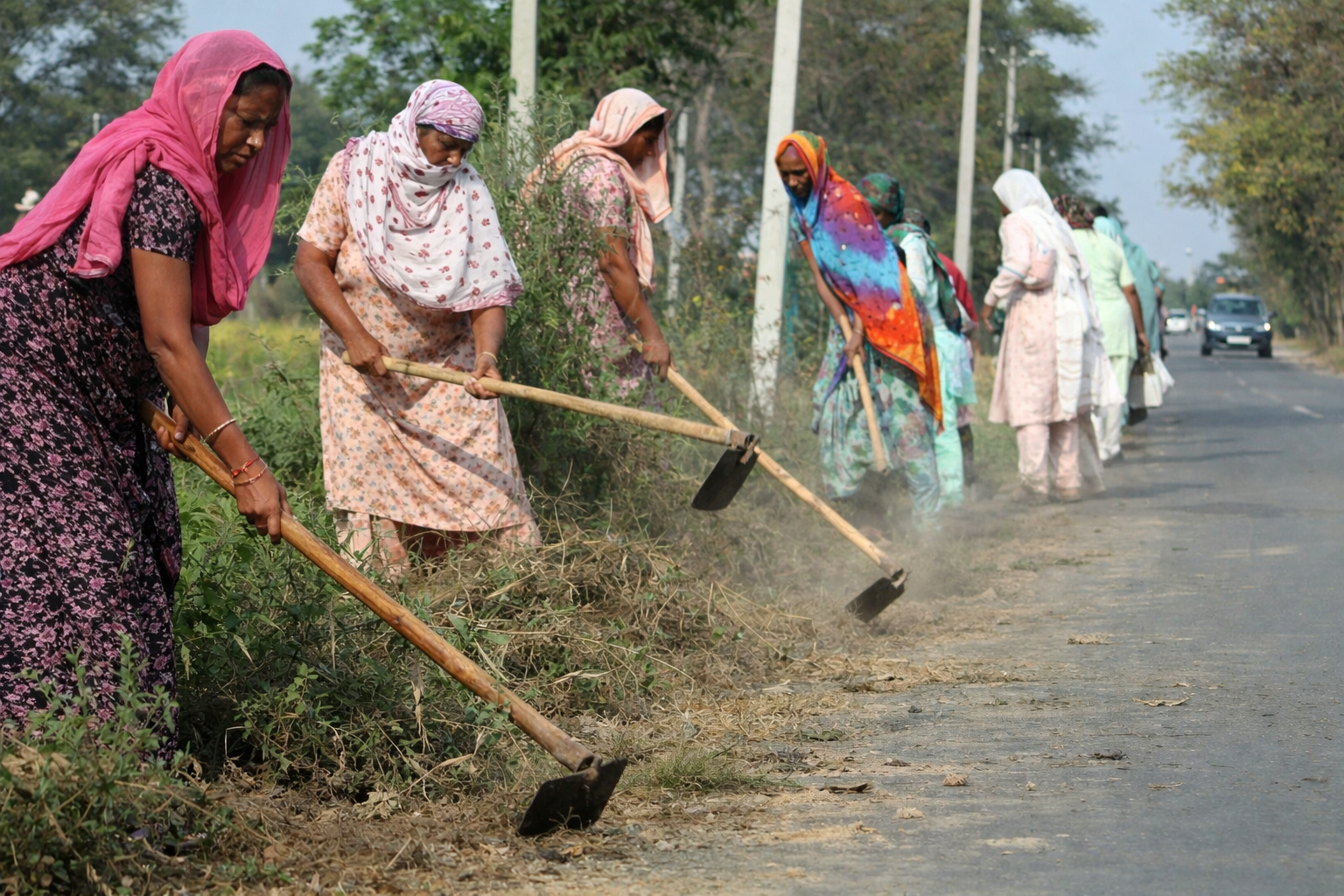
Core Context and Premise
The article examines the transition from MGNREGS, a wage-employment safety net, to Viksit Bharat–Gramin Rozgar Abhiyan (VB-G RAM G), positioned as a more growth-oriented rural employment framework. The author evaluates whether this shift meaningfully addresses rural underemployment, agrarian distress, and structural vulnerabilities, especially for marginal farmers and landless workers.
The central concern is whether policy reorientation from demand-driven wage support to productivity-linked rural employment is premature and exclusionary.
Key Arguments Presented
1. MGNREGS as a Critical Safety Net
The article argues that:
- MGNREGS remains indispensable for the poorest and most vulnerable rural households
- Its demand-driven, legal entitlement structure provides income security during agrarian distress
- Abrupt dilution risks excluding landless labourers, women, and Scheduled Castes and Tribes
MGNREGS is framed less as a development tool and more as a livelihood stabiliser in an unequal rural economy.
2. VB-G RAM G as a Productivity-Oriented Alternative
The author acknowledges that:
- VB-G RAM G seeks to align rural employment with asset creation, skilling, and agricultural productivity
- It aims to move rural policy away from short-term wage relief toward long-term growth
However, the article questions whether such a transition can succeed without first addressing structural deficits such as land access, market linkages, and credit constraints.
3. Risk of Exclusion and Uneven Impact
A central critique is that:
- Productivity-linked schemes disproportionately benefit farmers with land, irrigation, and market access
- Marginal farmers and agricultural labourers may be crowded out
- Women’s participation could decline if wage certainty is replaced with output-linked work
The article stresses that universal vulnerability is being replaced by selective eligibility.
4. Weak Evidence for Rural Income Transformation
The author points out:
- Limited empirical evidence that rural productivity schemes have consistently raised incomes at scale
- MSP-linked or agriculture-centric employment cannot substitute for off-season wage work
- Past rural development programmes show uneven outcomes across states
This challenges the assumption that growth automatically trickles down to the poorest.
Author’s Stance
The author adopts a cautiously sceptical stance:
- Not ideologically opposed to reform
- Strongly critical of replacing entitlement-based welfare with aspirational frameworks
- Emphasises sequencing: protection before productivity
The tone is reform-aware but equity-conscious, reflecting a welfare-economics lens.
Biases and Editorial Leanings
1. Pro-Welfare Orientation
The article:
- Strongly foregrounds the interests of the poorest rural households
- Prioritises income security over efficiency or fiscal rationalisation
This may underplay the long-term distortions of perpetual wage-based programmes.
2. Limited Fiscal Perspective
There is:
- Little engagement with fiscal sustainability or administrative leakages
- Minimal discussion of the opportunity cost of large welfare outlays
The analysis is social-impact heavy but fiscally light.
3. Skepticism of Growth Narratives
The author implicitly questions:
- Market-led rural transformation
- Skill and productivity narratives without structural reform
This may discount genuine innovation potential in rural employment models.
Pros and Cons of the Argument
Pros
- Highlights continued agrarian distress and rural inequality
- Brings attention to landless labourers and women, often missed in productivity debates
- Emphasises evidence-based caution rather than ideological enthusiasm
Cons
- Underestimates the need for rural economic diversification
- Does not sufficiently explore hybrid models combining wage support with skilling
- Risks presenting MGNREGS as irreplaceable rather than reformable
Policy Implications
1. Rural Employment Strategy
The article suggests:
- Any transition must be gradual and layered
- MGNREGS should coexist with productivity schemes rather than be replaced
- Entitlement-based work remains essential during agricultural slack seasons
2. Agricultural and Labour Policy
It implies:
- MSP- or agriculture-linked employment cannot absorb all rural labour
- Non-farm rural employment must be expanded before scaling down wage guarantees
3. Governance and Targeting
The shift raises questions about:
- Who defines vulnerability
- Whether targeting mechanisms can match the universality of MGNREGS
- Administrative capacity at the Panchayat and block level
Real-World Impact
- Signals potential contraction of income support for the poorest
- Could increase seasonal distress migration if wage guarantees weaken
- Risks widening intra-rural inequality between asset-owning and landless households
For aspirants, the article illustrates tensions between welfare economics and growth-led development.
UPSC GS Paper Alignment
GS Paper II – Governance and Social Justice
- Welfare schemes
- Poverty and livelihood security
- Federal and administrative capacity
GS Paper III – Economy
- Rural development
- Agricultural employment
- Inclusive growth and labour markets
GS Paper I – Society
- Rural inequality
- Gender and caste dimensions of employment
Balanced Conclusion and Future Perspective
The article makes a persuasive case that MGNREGS remains structurally relevant in an economy where rural vulnerability is still widespread. While VB-G RAM G represents a legitimate aspiration toward productivity and asset creation, the transition risks excluding those least equipped to participate in growth-led frameworks. A sustainable rural employment strategy must therefore blend entitlement-based wage security with phased productivity enhancement, rather than treating welfare and development as mutually exclusive. The real test lies not in policy intent, but in sequencing, inclusion, and institutional capacity.
