

Middle India Bigger, But Not Richer Individually

Middle India Bigger, But Not Richer Individually
Relevance: GS Paper III (Indian Economy, Employment, Formalisation, Taxation)
Why in the News?
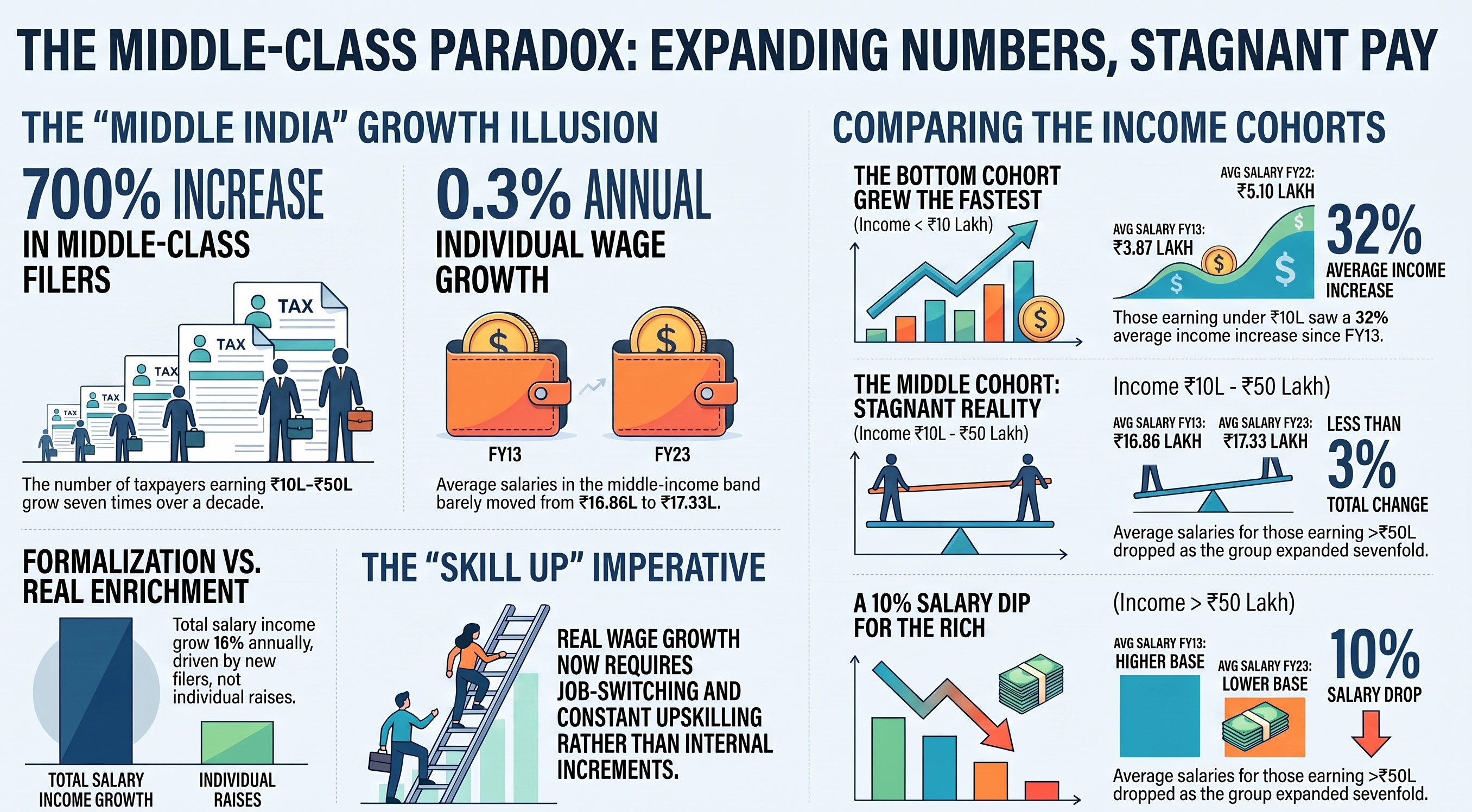
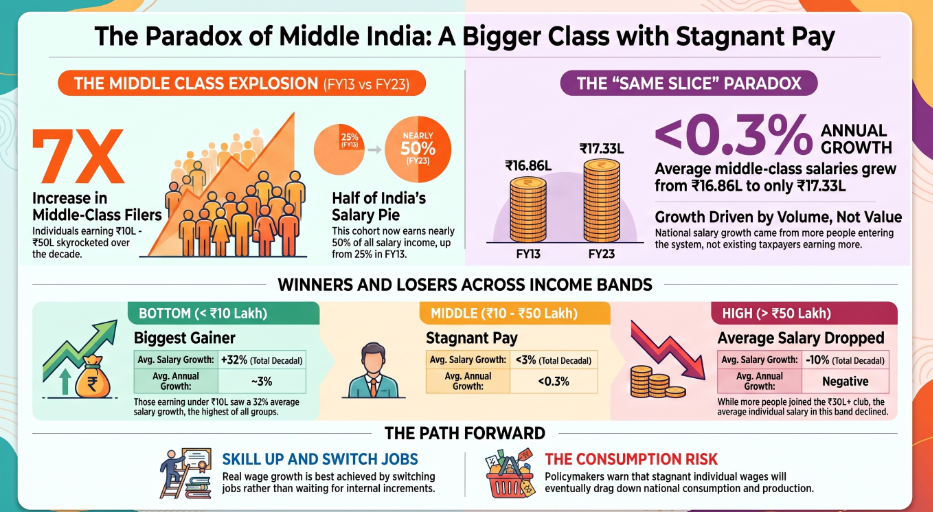
- Ten years of income tax return data (FY13 to FY23) shows India's "middle class" tax-filer base has expanded over seven times, but the average salary within this band has barely moved.
- This data-based finding "turns the feeling into a fact" for many salaried Indians who felt their salaries were stagnating.
The Broader Formalisation Story
- Nominal GDP grew at around 10.5% a year over the decade.
- Total salary income across all individual filers grew at an impressive ~16% a year.
- However, the average salary of all individual income-tax filers grew by only about 6.5% a year over the same period.
- This gap indicates the growth is coming primarily from more people entering the formal, tax-paying system — rather than existing taxpayers earning substantially more.
Methodology Note
- Taxable income is divided into five heads: salary, income from house property, income from business, capital gains, and other income; the analysis focuses on salary income for individuals only (excluding firms, HUFs, etc.).
- Three income cohorts examined: those earning less than Rs 10 lakh/year, between Rs 10 lakh and Rs 50 lakh/year (the "middle class"), and above Rs 50 lakh/year.
- Zero-tax payers in the below-Rs-10-lakh slab were excluded, as they were artificially reducing the average salary figure.
Middle India: Expanding but Not Individually Richer
- The "middle class" — those earning between Rs 10 lakh and Rs 50 lakh/year — has seen its share of total salary income rise from just over a quarter in FY13 to almost half in FY23.
- The number of tax returns filed in this cohort rose seven times over the decade — the fastest growth among the three cohorts.
- However, average salaries within this cohort barely moved — from Rs 16.86 lakh in FY13 to Rs 17.33 lakh in FY23 — under 3% total growth over ten years, or less than 0.3% annually.
- The growth is in the size of the pie, not the size of each individual's slice; inflation and taxes further erode real purchasing power.
- Likely causes: upward mobility of lower-income earners into this band, and rising formalisation of previously informal jobs — both pointing to a labour-surplus economy where wage growth pressure remains muted even amid rapid formalisation.
Have the Rich Gotten Richer?
- Contrary to popular narrative, the answer is no — the average salary for the above-Rs-50-lakh cohort actually dropped by about 10% over the decade, even as total salary income for this group grew by 20% a year.
- This apparent paradox is explained by the number of tax filers in this band rising almost sevenfold, while total salary income rose just over sixfold — meaning per-person averages fell even as the overall group expanded.
- The rich also did not see notably higher gains from house property income or asset-linked profits.
The Real Surprise: The Bottom Cohort's Gains
- Those earning up to Rs 10 lakh/year saw the highest average income growth of all three cohorts — average salaries rose from Rs 3.87 lakh to Rs 5.10 lakh, a 32% increase over the decade (nearly 3% annually).
- This challenges some recent inequality narratives that paint a starker picture of stagnation at the bottom.
Reconciling the Overall Average
- The overall average salary appears higher than any individual cohort's growth because millions of taxpayers moved into higher salary bands over the decade.
- But when comparing taxpayers within the same band over time, average salaries remained largely flat across all three cohorts.
The Core Takeaway
- India's economy is formalising rapidly — more people are entering the tax net and moving into higher salary bands — but almost none of this reflects individual taxpayers earning substantially more within their existing income band.
- This is framed as good news (a growing middle class is the backbone of long-term economic growth) but also concerning news (labour's bargaining power remains weak despite rapid formalisation).
Policy and Individual Implications
- For policymakers: continued efforts to formalise the economy and widen the tax net are working and should continue — but unless average individual wages rise, consumption growth could stall, risking a downward spiral of lower production, layoffs, and further reduced consumption. Current growth is being sustained by sheer volume (more taxpayers), but sustained high growth will eventually require genuine wage upgrades.
- For individuals ("Middle India"): the author's practical advice is to actively "skill up," since India has significant untapped potential for productivity gains compared to more mature economies like the US. She notes that individual real wage growth is often achieved through switching jobs rather than waiting for increments at one's current employer, advising regular resume updates and treating a lack of new additions to one's resume as a "red flag."
