

Mines and Minerals (Development and Regulation) Amendment Bill, 2026

Mines and Minerals (Development and Regulation) Amendment Bill, 2026
Wh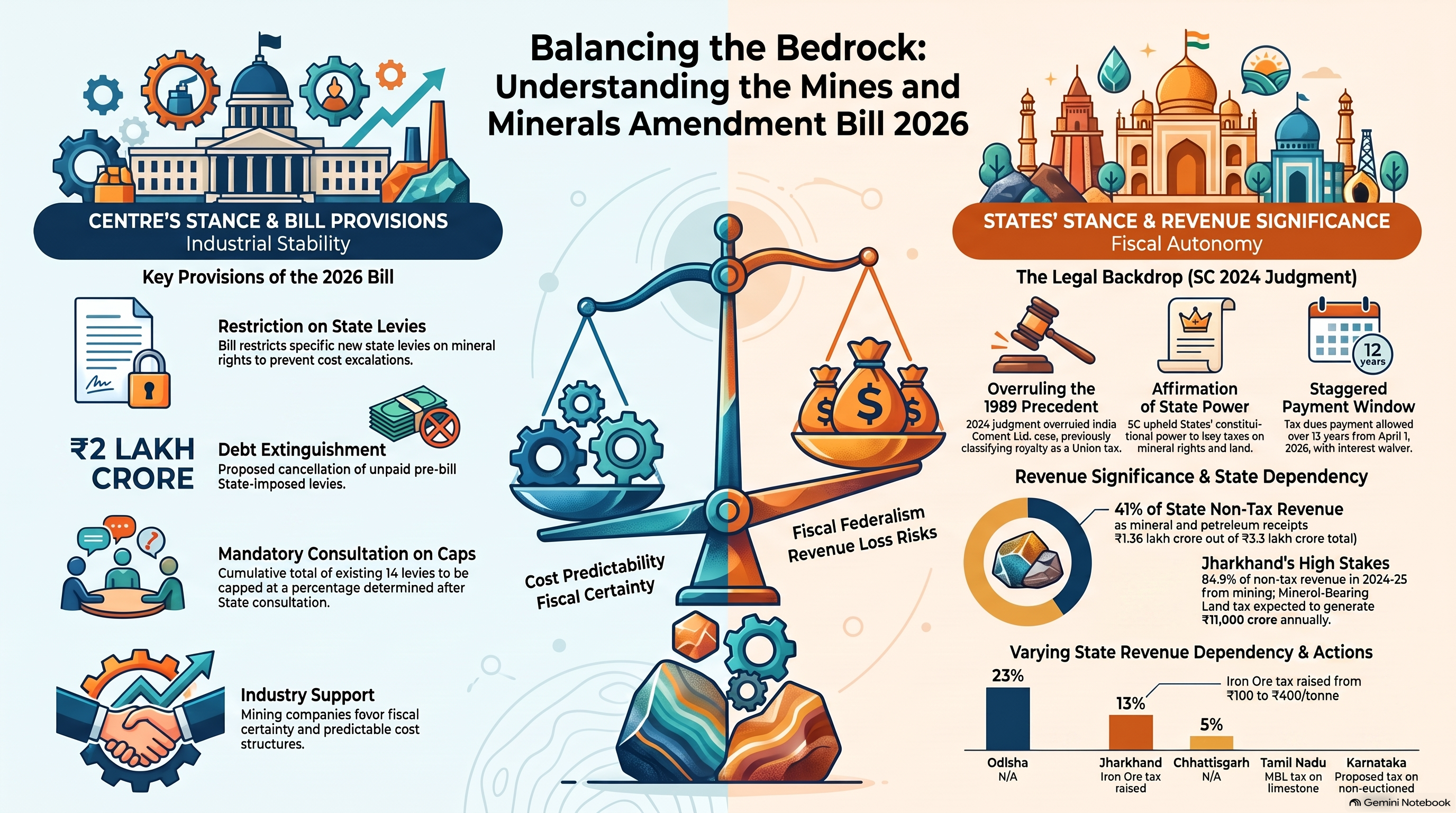 y in News?
- Parliament has passed the Mines and Minerals (Development and Regulation) Amendment Bill, 2026, triggering renewed debate over the distribution of mineral revenues between the Centre and States.
- The Bill restricts States from imposing specified levies on mineral rights and mineral-bearing land.
- It also proposes to extinguish unpaid or unrecovered dues arising from such levies imposed before the Bill comes into force, estimated at around ₹2 lakh crore.
Key Provisions and Background
- Around 14 different levies currently exist in the mineral sector. These will continue, but their cumulative burden will be capped at a percentage to be decided after consultation with States.
- The move follows the Supreme Court's July 2024 judgment, which upheld the power of States to levy taxes on mineral rights and mineral-bearing land.
- The 2024 judgment overruled the 1989 India Cement Ltd. v. State of Tamil Nadu ruling, which had treated royalty as a tax under the Union List.
- The Court also waived interest and penalties on pre-judgment tax demands and permitted staggered payment of dues over 12 years from April 1, 2026.
- Following the judgment, mineral-rich States began introducing or proposing additional levies:
- Jharkhand: Mineral-Bearing Land (MBL) tax on iron ore, increased from ₹100 to ₹400 per tonne.
- Tamil Nadu: MBL tax of ₹160 per tonne on limestone.
- Karnataka: Proposed tax on non-auctioned iron ore mines.
Centre–State Debate
- The Centre argues that excessive State-level levies increase the cost of minerals and can raise infrastructure and overall production costs.
- Mining companies already contribute through royalty, District Mineral Foundation (DMF), National Mineral Exploration Trust (NMET) and environmental and pollution-related levies.
- Industry supports the amendment on the grounds of greater fiscal certainty and predictability.
- Mineral-rich States, however, fear substantial revenue losses.
- Jharkhand has highlighted that mining revenue constituted about 84.9% of its own non-tax revenue in 2024-25, while its MBL Cess was expected to generate around ₹11,000 crore annually.
- Kerala has raised concerns regarding the implications for fiscal federalism.
Revenue Significance and Way Forward
- States' own non-tax revenue was about ₹3.3 lakh crore in 2024-25, of which around 41% or ₹1.36 lakh crore came from mineral and petroleum receipts.
- Mineral and petroleum receipts constitute about 3.4% of States' total revenue receipts nationally, but dependence is considerably higher in mineral-rich States:
- Odisha: 23%
- Jharkhand: 13%
- Chhattisgarh: 5%
- The issue therefore represents a wider Centre–State fiscal federalism debate.
- A balanced approach requires transparent limits on cumulative levies while ensuring that mineral-producing States are not deprived of legitimate revenue.
- Genuine consultation with States can provide cost predictability to industry while protecting States' fiscal interests.
