

Mining revenue must be the means,not end

Mining revenue must be the means,not end
Context:
The philosophy that mining revenue should be a "means, not an end" shifts the focus from simple fiscal extraction to the long-term socio-economic transformation of mining regions. As of September 2026, this debate has taken center stage following the passage of the Mines and Minerals (Development and Regulation) Amendment Act, 2026, which has redefined how mineral wealth is taxed and utilized in India.
The 2026 Legal & Fiscal Landscape
The recent legislative changes represent a major pivot in India’s "Resource Federalism."
- MMDR Amendment Act, 2026: Passed in August 2026, this law restricts the power of States to impose additional levies on mineral-bearing lands, a move designed to provide "fiscal certainty" for investors.
- Supreme Court Precedent: The Act effectively overrides parts of the July 2024 MADA vs. SAIL judgment, where a 9-judge bench had originally upheld the States' right to tax mineral rights.
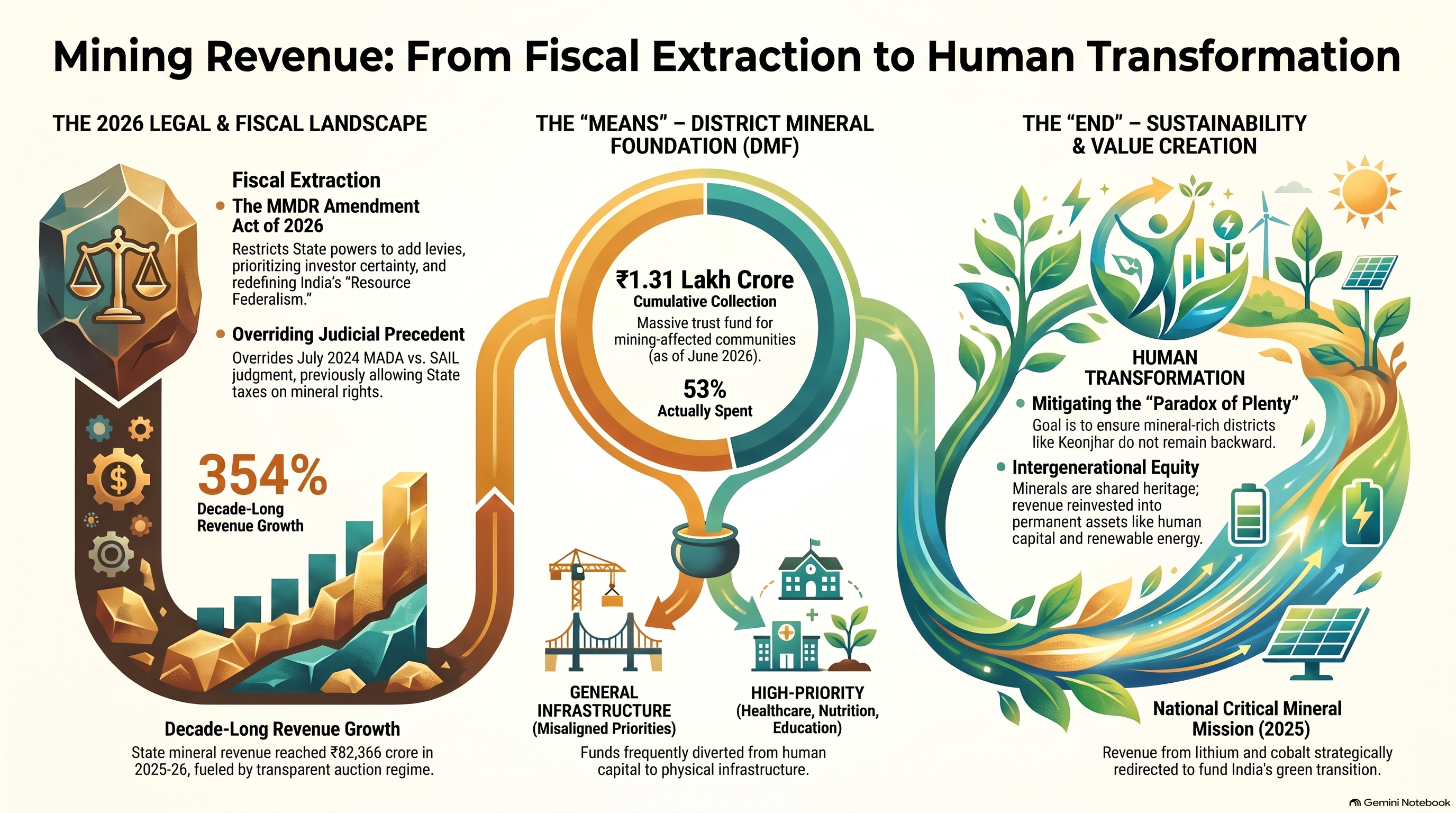
- Revenue Growth: Despite the new restrictions, State mineral revenue reached ₹82,366 crore in 2025-26, a 354% increase over the last decade, primarily driven by the transparent auction regime introduced in 2015.

The "Means": Revenue as a Tool for Development
If revenue is the "means," its success is measured by the District Mineral Foundation (DMF), a trust designed to benefit mining-affected communities.
- DMF Accrual: As of June 2026, cumulative DMF collections across India reached ₹1.31 lakh crore.
- The "End" Reality: Currently, only about 53% of collected DMF funds have been spent, and a significant portion has been diverted to general physical infrastructure rather than "high-priority" areas like healthcare and nutrition.
- Resource Curse Mitigation: The objective is to prevent the "Paradox of Plenty," where mineral-rich districts (like Keonjhar or West Singhbhum) remain among India's most backward despite generating billions in revenue.
Challenges: Revenue vs. Sustainability
Treating revenue as an "end" leads to aggressive extraction at the cost of the environment and local rights.
- Intergenerational Equity: The Supreme Court (Goa Foundation case) emphasized that minerals are a shared heritage. Revenue must be reinvested into permanent assets (human capital, renewable energy) to ensure future generations are not left with only hollowed-out mines.
- Critical Mineral Mission: With the launch of the National Critical Mineral Mission in 2025, the focus is shifting toward minerals like Lithium and Cobalt. The revenue from these should fund India's green transition, not just bridge fiscal deficits.
Ultimately, the shift from "revenue-seeking" to "value-creation" requires ensuring that every rupee extracted from the ground is visible in the improved health, education, and environment of the people living above it.
