

Moon Base Programme

Moon Base Programme
Why in News?
- India has reportedly received an invitation to join NASA's Moon Base programme.
- The initiative could significantly accelerate India's space technology development by giving ISRO access to experience and capabilities developed through large-scale international lunar missions.
- While there is no official confirmation yet, ISRO is widely expected to consider participation.
About the Moon Base Programme
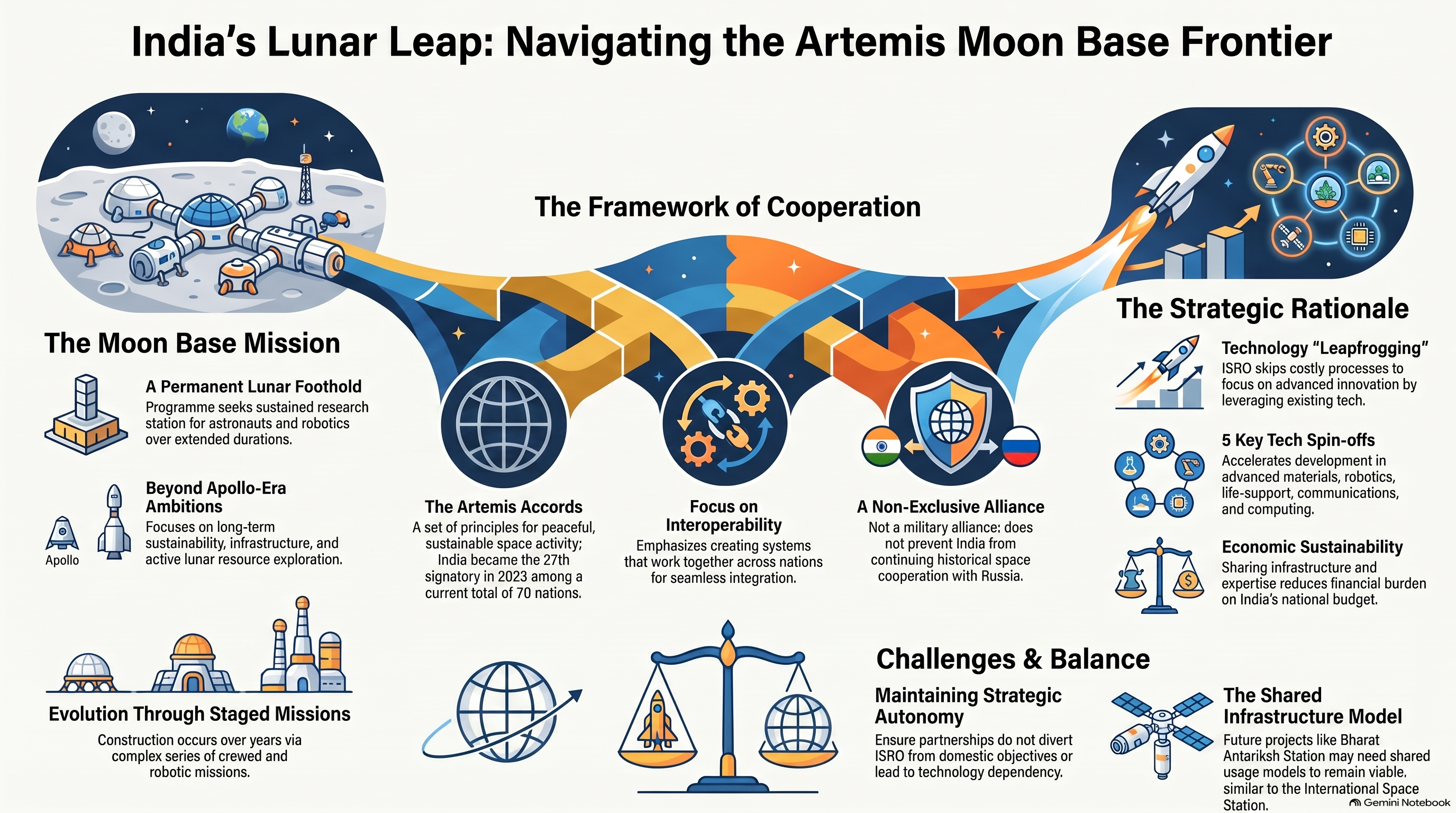
- The programme aims to establish a permanent research station on the Moon that can support astronauts and robots for prolonged periods.
- The base would be constructed in stages over several years through multiple crewed and robotic missions.
- It would facilitate:
- Long-duration lunar research
- Human presence on the Moon
- Exploration of lunar resources
- Potential utilisation of lunar resources
- It is expected to be one of the most challenging engineering projects undertaken, requiring repeated missions and extensive infrastructure.
- In scale and ambition, it can be compared with the Apollo programme, while potentially having much greater long-term implications for human space exploration.
International Cooperation and Artemis Accords
- NASA is seeking international and private-sector partners because the programme is too technologically and financially demanding to be executed entirely by NASA.
- The Artemis Accords provide a framework of principles and good practices for countries conducting peaceful and sustainable space activities.
- The Accords currently have 70 signatories, including major space-faring countries such as Japan, India, South Korea and Israel.
- India became the 27th signatory in 2023.
- Russia and China are not members, leading to a perception that the Accords represent a US-led approach to lunar exploration and the use of extraterrestrial resources.
- However, the Accords are not a military or geopolitical alliance.
- Participation in the Accords or the Moon Base programme does not prevent India from maintaining its longstanding space cooperation with Russia.
What India Stands to Gain?
- India already has plans for:
- Human spaceflight
- Human lunar missions
- Bharat Antariksh Station
- Independent space exploration capabilities
- Participation in the Moon Base programme could allow ISRO to gain practical experience in planning and executing highly complex, long-duration missions.
- It could help India leapfrog certain stages of technological development instead of independently recreating capabilities that already exist.
- This is particularly important because a significant technology gap can put countries substantially behind in the rapidly evolving space sector.
- Cooperation could also accelerate the development of:
- Advanced materials
- Robotics
- Life-support systems
- Communications
- Computing
- Human-spaceflight technologies
Economic Rationale and Concerns
- India's simultaneous pursuit of an independent human spaceflight programme, Moon landing programme and space station raises questions about the financial sustainability of developing every capability independently.
- The Bharat Antariksh Station may eventually need to function as shared infrastructure, similar to the International Space Station, rather than being used exclusively by India throughout the year.
- Similarly, developing independent capabilities for human lunar missions is important for strategic autonomy, but maintaining an entirely separate full-fledged lunar exploration programme could impose very high costs.
- International cooperation can therefore help India share infrastructure, expertise and costs while retaining critical independent capabilities.
- The costs of lunar exploration are enormous even for the world's largest economies, making partnerships economically attractive.
Concerns for ISRO
- India must ensure that international collaboration does not divert ISRO from its own long-term objectives.
- It should avoid becoming excessively dependent on the US technology ecosystem.
- The Artemis Accords emphasise interoperable systems, which could facilitate cooperation between different space agencies.
- Since India is still developing many of these systems, interoperability can be incorporated from the beginning without necessarily compromising technological autonomy.
- India must maintain a balance between international cooperation and strategic technological self-reliance.
Significance for India
- Could fast-track ISRO's human and lunar exploration capabilities.
- Provides access to experience in complex missions that would otherwise take considerable time and financial resources to develop independently.
- Strengthens India-US space cooperation while allowing India to continue cooperation with other countries.
- Can generate technological spin-offs in materials, robotics, life-support systems, communications and computing.
- These secondary technological gains can benefit India's wider scientific and industrial ecosystem, making international space cooperation valuable beyond the immediate lunar mission.
