

MSMEs: From survival to scale
Business Standard
1. Key Arguments
A. MSMEs as Backbone of Economy
MSMEs are central to employment, exports, and inclusive growth.
They contribute significantly to GDP, manufacturing, and livelihoods.
B. Structural Constraint: Access to Finance
Mismatch between MSME cash flows and formal credit systems is the core issue.
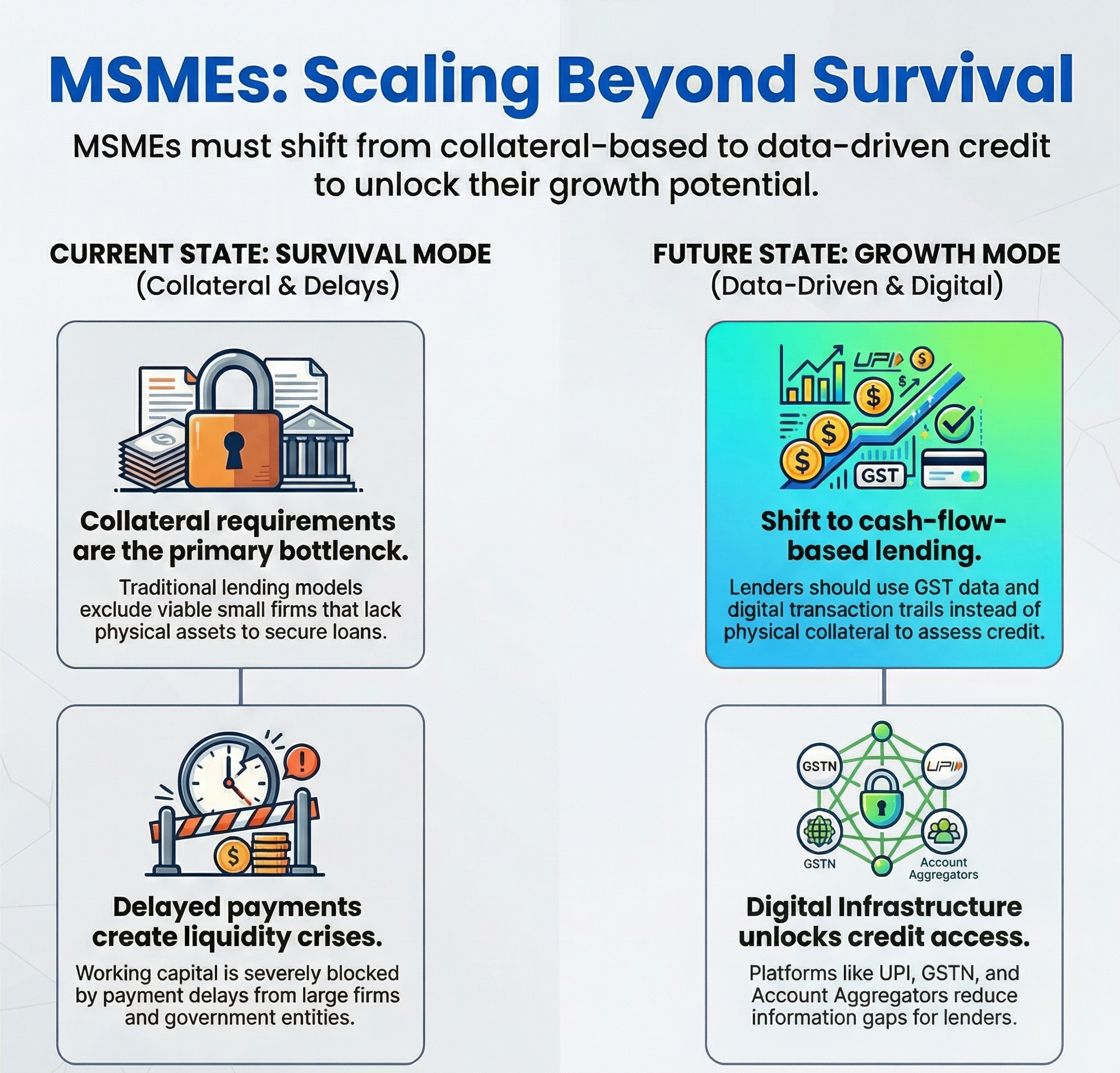
Traditional collateral-based lending excludes many viable small firms.
C. Formalisation as a Double-Edged Sword
Formalisation improves access to credit and markets but increases compliance burden.
Smaller firms struggle with GST, digital records, and regulatory costs.
D. Delayed Payments Crisis
Working capital blockage due to delayed payments from large firms and government.
This severely affects liquidity and survival.
E. Need for Cash Flow-Based Lending
Shift from collateral-based to data-driven, cash flow-based credit models.
Use of GST data, digital transactions, and fintech tools.
F. Role of Digital Public Infrastructure
Platforms like UPI, GSTN, Account Aggregator can unlock credit access.
Data trails can reduce information asymmetry.
G. Cluster-Based and Ecosystem Approach
MSMEs need support beyond credit—technology, skilling, market linkages.
2. Author’s Stance
Reform-oriented and pragmatic
Supports systemic reforms in MSME financing
Advocates for innovation in credit delivery.
Recognises MSMEs as growth engines
Emphasis on scaling rather than survival.
3. Biases and Limitations
Pro-formalisation bias
Assumes formalisation is universally beneficial
Underestimates informal sector resilience and constraints.
Credit-centric approach
Overemphasis on finance as solution
Other structural issues (demand, infrastructure) less explored.
Limited labour perspective
Worker conditions and informality not deeply addressed
4. Strengths (Pros)
Sharp diagnosis of financing problem
Identifies cash flow mismatch as key bottleneck.
Forward-looking solutions
Highlights fintech, digital infrastructure, data-based lending.
Policy relevance
Directly linked to ongoing reforms (Account Aggregator, TReDS).
5. Weaknesses (Cons)
Underplays demand-side constraints
Market access and consumption slowdown not fully discussed.
Limited focus on regional disparities
MSME challenges vary across states and sectors.
Implementation challenges ignored
Digital divide and financial literacy issues not addressed.
6. Policy Implications
A. Reforming Credit Architecture
Adopt cash flow-based lending models
Expand fintech and alternative credit scoring.
B. Strengthening Payment Ecosystem
Strict enforcement of timely payments (MSME Samadhaan, TReDS)
C. Reducing Compliance Burden
Simplify GST, labour laws for small enterprises
D. Promoting Digital Inclusion
Capacity building for MSMEs to use digital platforms
E. Cluster Development
Integrated support: credit + technology + skilling + market access
7. Real-World Impact
Economic Impact
Higher productivity and job creation if MSMEs scale
Financial Inclusion
Broader access to formal credit
Industrial Growth
Strengthening manufacturing and exports
Risk
Exclusion of smallest firms if reforms are not inclusive
8. UPSC GS Paper Linkages
GS Paper III (Economy)
- MSME sector
- Financial inclusion
- Inclusive growth
- Digital economy
GS Paper II (Governance)
- Ease of doing business
- Regulatory reforms
Essay / Interview
- “MSMEs as engines of growth”
- “Formalisation vs informality debate”
9. Balanced Conclusion
The editorial correctly identifies that MSMEs cannot remain survival-oriented if India aims for sustained high growth. However, scaling requires a holistic approach—finance, demand, infrastructure, and regulatory ease—not just credit innovation.
10. Future Perspective
Data-driven lending ecosystem
Expansion of Account Aggregator framework.
Integration with global value chains
Boost exports and competitiveness.
Green MSMEs
Sustainable production and ESG compliance.
Inclusive formalisation
Balancing ease of compliance with growth incentives.
Final Insight
MSMEs will not scale merely through credit access; they will scale when finance, policy, and markets align with the realities of small enterprise economics.
