

Nailing Pakistan's Lies on Indus Water Sharing

Nailing Pakistan's Lies on Indus Water Sharing
Context
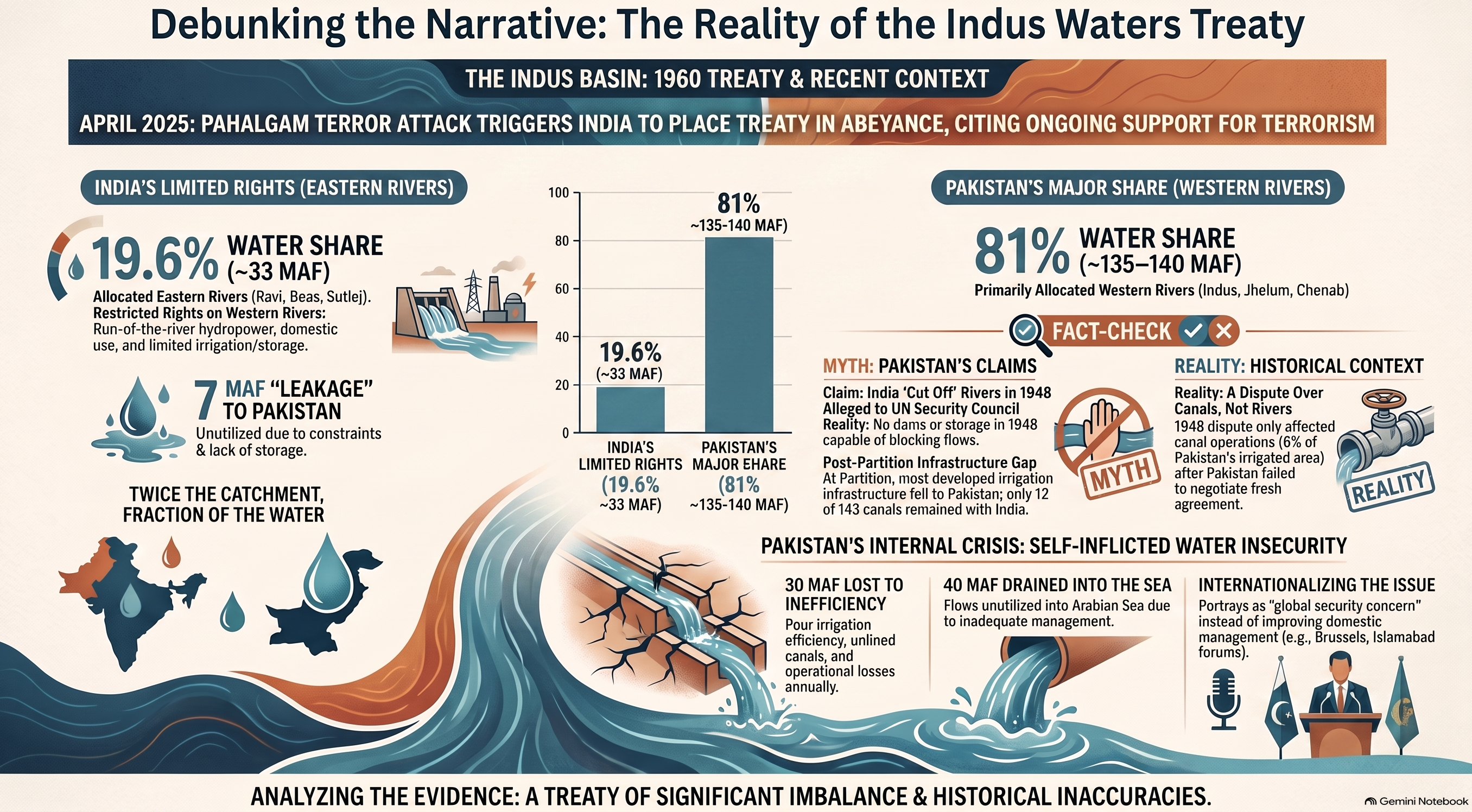
Following the April 2025 Pahalgam terror attack, India placed the Indus Waters Treaty (IWT), 1960 in abeyance, citing Pakistan's continued support for cross-border terrorism. The decision has renewed discussions on the historical background of the treaty, its unequal water-sharing arrangement and Pakistan's allegations regarding India's compliance.
Indus Waters Treaty (IWT), 1960
- Signed on 19 September 1960 between India and Pakistan with the World Bank as the broker.
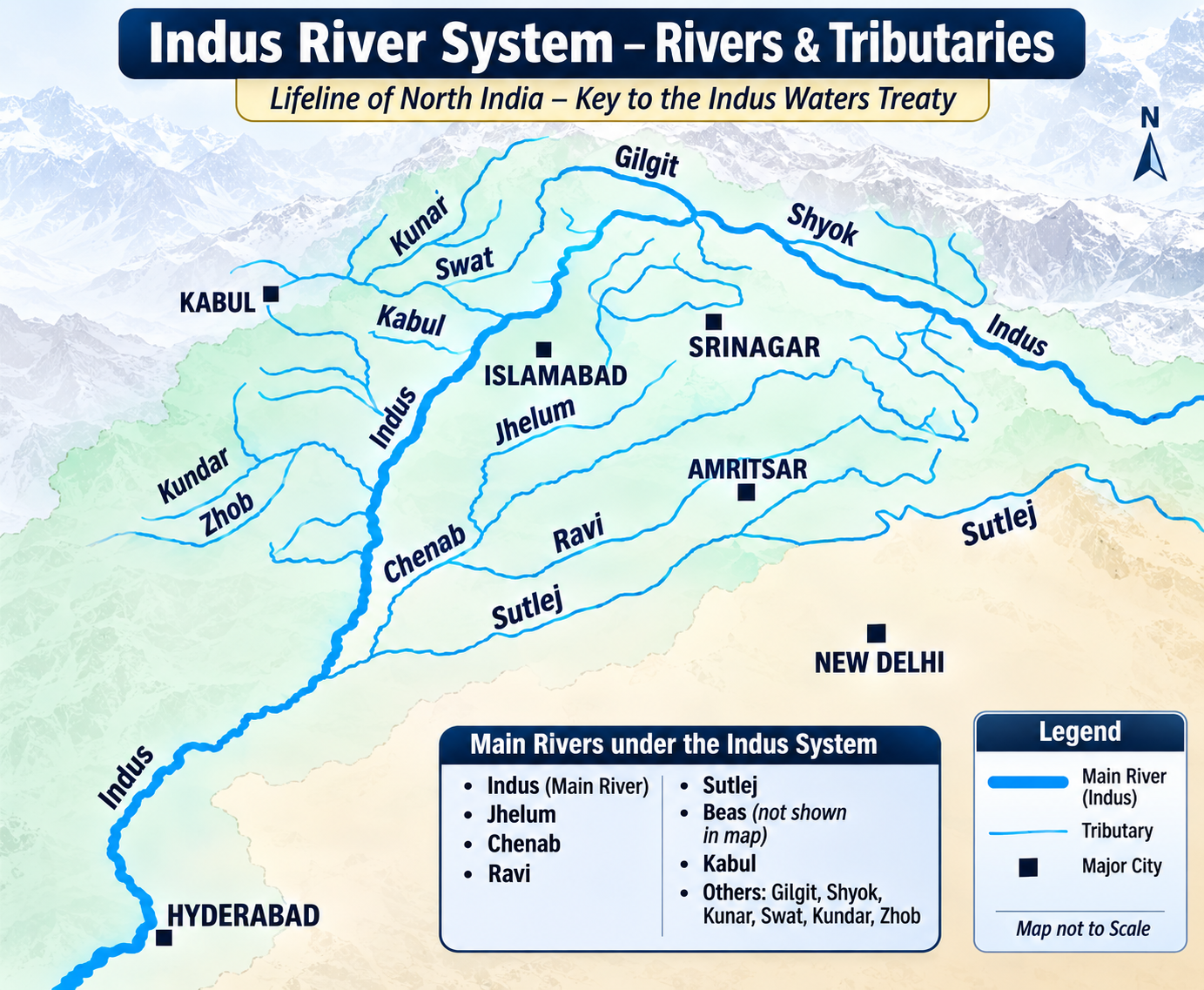
- Allocated the Eastern Rivers (Ravi, Beas and Sutlej) for India's exclusive use and the Western Rivers (Indus, Jhelum and Chenab) primarily to Pakistan.
- India retains limited rights over the western rivers for domestic use, irrigation, run-of-the-river hydropower projects and specified storage.
Historical Background
- After Partition, only 12 of 143 canals of undivided Punjab remained with India, while most developed irrigation infrastructure fell in Pakistan.
- An interim agreement signed on 20 December 1947 maintained the status quo on canal operations until 31 March 1948.
- After Pakistan failed to negotiate a fresh agreement, India discontinued water supply through its canal installations on 1 April 1948, affecting only canals irrigating about 6% of Pakistan's irrigated area.
Pakistan's Claims and India's Response
- Pakistan alleged that India had stopped the flow of all six rivers to Pakistan and raised the issue before the UN Security Council.
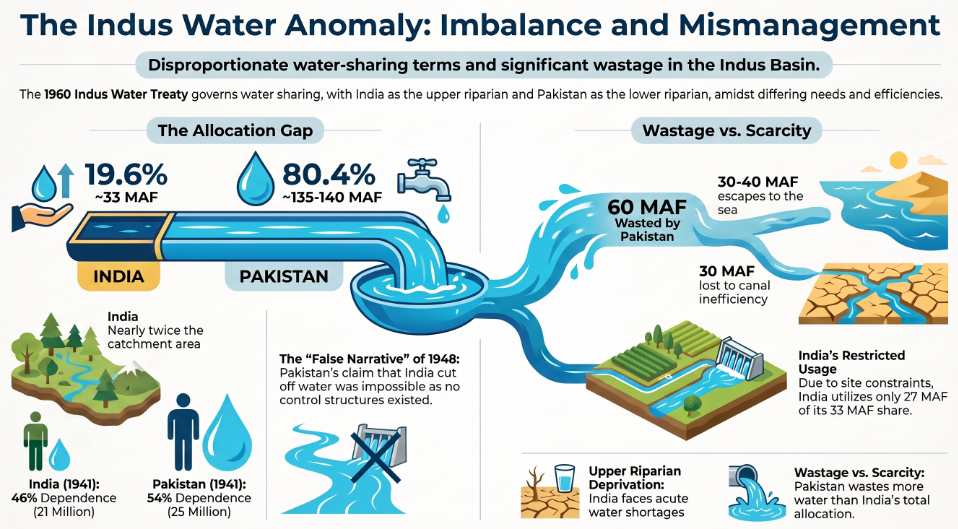
- India maintains that no dams or storage infrastructure existed in 1948 to block the flow of the six rivers and that the dispute related only to canal operations, not river waters.
- According to India, this narrative created an international perception that later influenced negotiations leading to the IWT.
Unequal Water Sharing
- India receives only about 33 Million Acre Feet (MAF) or nearly 19.6% of the Indus waters, while Pakistan receives around 135–140 MAF or nearly 81%.
- India possesses almost twice the catchment area of Pakistan in the Indus basin, yet received a significantly smaller share of water.
- Despite similar dependent populations at the time of Partition, the treaty heavily favoured Pakistan in terms of water allocation.
India's Concerns
- Punjab, Haryana, Rajasthan and Delhi continue to face water scarcity and increasing dependence on groundwater.
- Nearly 7 MAF of water allocated to India still flows into Pakistan because of geographical constraints and inadequate storage infrastructure.
- India argues that the treaty restricts the optimal utilisation of waters flowing through its own territory despite being the upper riparian state.
Pakistan's Water Management Issues
- According to the article, 30–40 MAF of water flows unutilised into the Arabian Sea.
- Around 30 MAF is lost annually due to unlined canals, poor irrigation efficiency and operational losses.
- The article argues that Pakistan should prioritise improving water management rather than internationalising the issue.
Recent Developments
- Pakistan has raised the issue at international forums, including policy discussions in Brussels and Islamabad, portraying the Indus waters as a global security concern.
- Pakistani leaders have also issued statements warning against India's future water infrastructure projects on the western rivers, escalating tensions over the treaty.
