

Nation-making and women
The Statesman
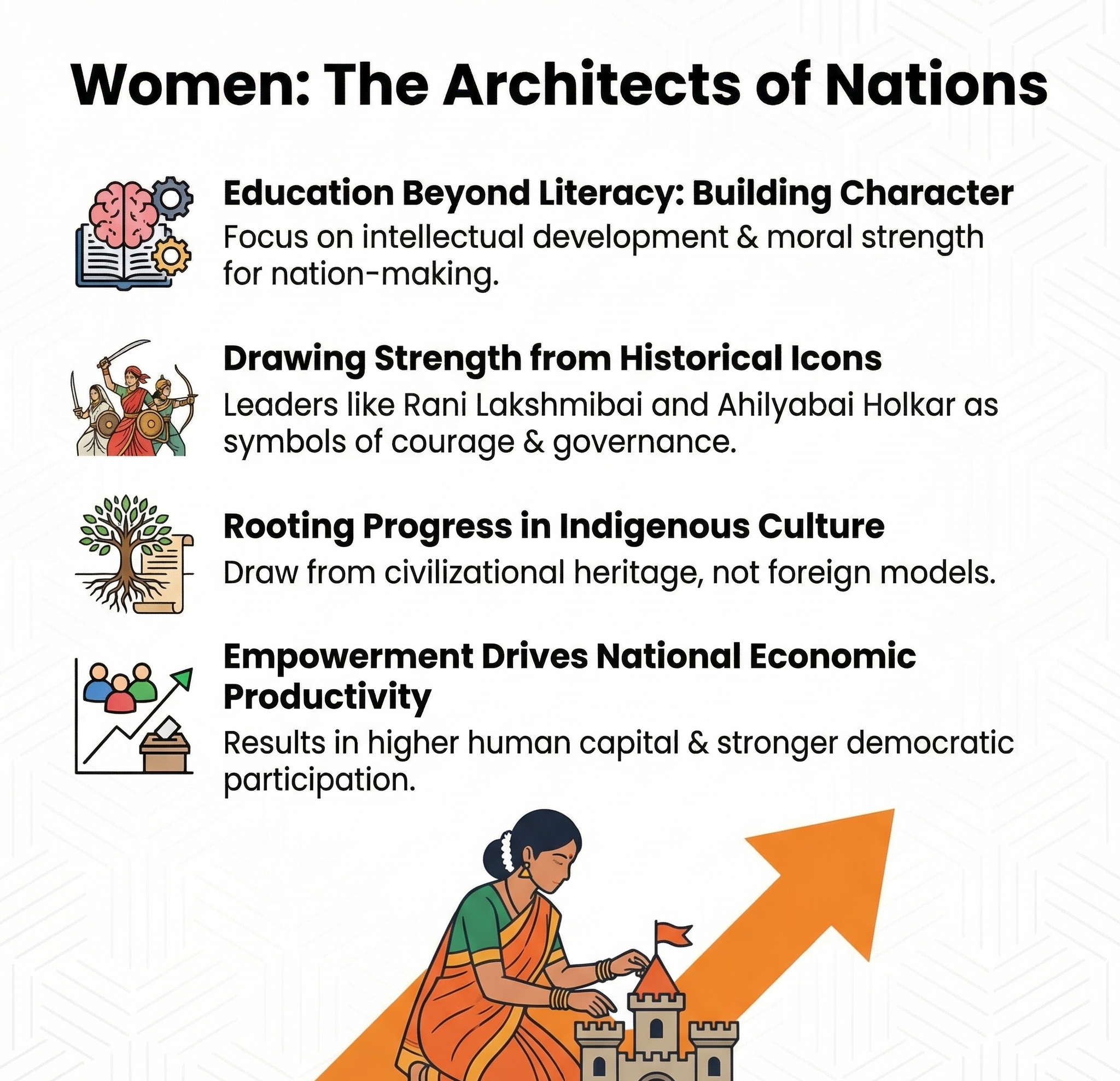
Key Arguments of the Article
Women as Central Actors in Nation-Building
The article argues that women play a foundational role in shaping national identity, social values, and cultural continuity. Women influence future generations through family structures, socialisation, and education.
Therefore, empowering women through education becomes essential for sustainable national development.
Education as the Core Instrument of Empowerment
The author emphasises that education is the most powerful tool for enabling women to participate in nation-making. Education should not merely focus on literacy but on character-building, intellectual development, and social responsibility.
The article draws from Sister Nivedita’s vision of national education that nurtures cultural roots while promoting modern knowledge.
Historical Role Models of Women
The article invokes historical figures such as Rani Lakshmibai, Chand Bibi, Ahilyabai Holkar, and Meerabai as symbols of courage, leadership, spirituality, and cultural strength.
These examples demonstrate that women have historically contributed to governance, social reform, and resistance against oppression.
Cultural Roots and National Identity
The article stresses that education should remain connected to indigenous culture and historical experiences. National education must draw inspiration from India’s civilisational heritage rather than simply imitating foreign educational models.
This cultural grounding strengthens national identity and social cohesion.
Moral and Character Formation
The author argues that women’s education should cultivate values such as simplicity, sincerity, discipline, and moral strength. Character formation is viewed as a critical element of national development.
The article suggests that strong moral foundations in society depend significantly on the empowerment of women.
Author’s Stance
The author strongly advocates the central role of women in nation-building through education and cultural leadership. The tone reflects admiration for historical women leaders and emphasises the need to integrate women’s empowerment into national educational philosophy.
The stance combines cultural nationalism with a progressive emphasis on women’s education and social participation.
Possible Biases
Cultural Idealisation
The article places strong emphasis on cultural and historical ideals of womanhood, which may sometimes romanticise traditional roles.
Historical Selectivity
By focusing on exemplary figures from history, the article may overlook structural barriers that have historically limited women’s participation.
Normative Perspective
The article adopts a normative tone emphasising moral values, which may appear less analytical in addressing contemporary gender challenges.
Advantages of the Perspective
Emphasis on Women’s Education
The article correctly highlights education as a transformative force in empowering women.
Recognition of Historical Contributions
It draws attention to the often overlooked role of women in India’s social and political history.
Cultural Contextualisation
The discussion integrates women’s empowerment with India’s civilisational heritage, promoting culturally rooted development.
Moral Foundations of Development
The focus on character-building highlights the ethical dimension of nation-building.
Challenges and Limitations
Structural Gender Inequalities
Women continue to face barriers in education, employment, and political representation.
Socio-economic Disparities
Access to education for women varies widely across rural-urban and socio-economic contexts.
Policy Implementation Gaps
Despite progressive policies, outcomes in gender equality remain uneven.
Balancing Tradition and Modernity
Reconciling cultural ideals with contemporary gender rights remains a complex challenge.
Policy Implications
Strengthening Women’s Education
Investment in female literacy, higher education, and vocational training is essential.
Promoting Leadership Opportunities
Encouraging women’s participation in governance, entrepreneurship, and academia strengthens national development.
Integrating Gender Perspectives in Education
Curricula should promote gender equality and challenge stereotypes.
Supporting Social Reform
Government policies and civil society initiatives must address systemic barriers faced by women.
Real-World Impact
If women’s empowerment through education is strengthened:
• Higher economic participation of women
• Improved health and social outcomes
• Stronger democratic participation
• Enhanced human capital development
If gender disparities persist:
• Reduced economic productivity
• Social inequality
• Underutilisation of national talent
• Slower progress toward inclusive development
Alignment with UPSC GS Papers
GS Paper I
Role of women in society, social empowerment, historical contributions of women.
GS Paper II
Government policies for women, education reforms, social justice.
GS Paper IV
Ethics in public life, moral values in society, character-building through education.
Balanced Assessment
The article presents a culturally grounded vision of women’s role in nation-building, emphasising education, moral leadership, and historical inspiration. It highlights the transformative potential of women’s empowerment for national progress.
However, contemporary policy debates must also address structural inequalities and ensure equal opportunities in education, employment, and governance.
Future Perspective
The future of nation-building in India will increasingly depend on how effectively women are integrated into economic, social, and political institutions. Expanding access to quality education, leadership opportunities, and social freedoms will be critical.
For policymakers and civil services aspirants, the discussion reinforces that gender equality is not merely a social objective but a strategic requirement for sustainable national development.
