

NCDs accounted for 60% of all deaths in 2022-2024
The Hindu
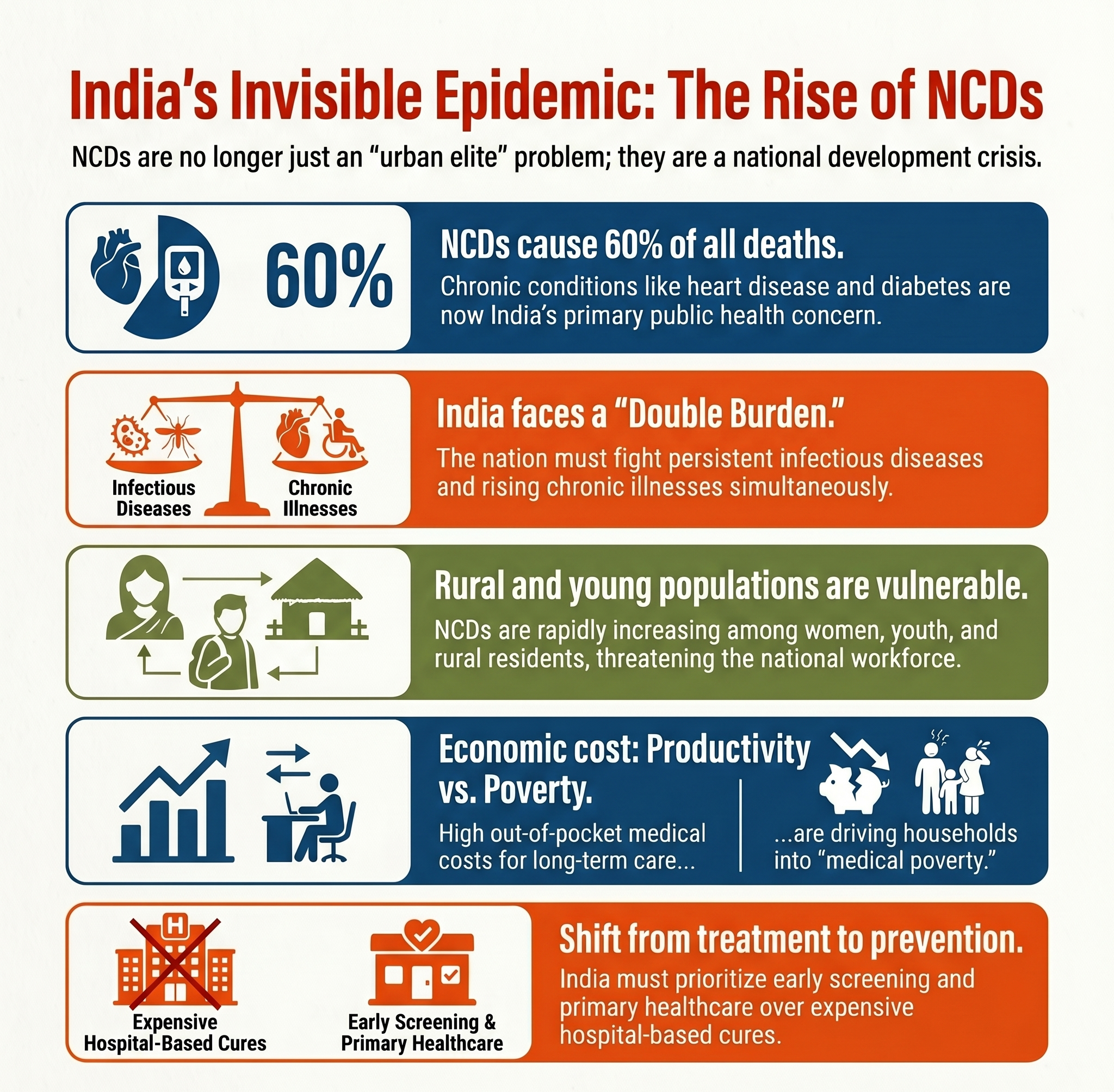
1. Core Arguments of the Article
NCDs have become India’s biggest health challenge
The article’s central argument is that:
- India’s disease profile has fundamentally shifted.
NCDs now account for:
- Around 60% of all deaths,
making them the primary public health concern.
The NCD burden is spreading beyond urban India
The article challenges the earlier assumption that:
- Lifestyle diseases are largely urban phenomena.
The data shows:
- Rural populations are increasingly vulnerable.

Women and younger populations are increasingly affected
The article stresses that:
- NCDs are rising among women and younger adults.
This is especially concerning because:
- Premature mortality affects workforce participation and family stability.
India is witnessing a “double burden of disease”
The article argues that India simultaneously faces:
- Persistent communicable diseases,
and: - Rapidly rising NCDs.
This creates immense pressure on:
- Healthcare infrastructure,
- Public finances,
- Human capital.
2. Author’s Stance
Strong public health concern
The tone of the article is:
- Alarmed,
- Data-driven,
- Reform-oriented.
The author clearly views the rise of NCDs as:
- A major national developmental challenge.
Supportive of preventive healthcare
The article implicitly supports:
- Preventive health systems,
- Early screening,
- Public awareness,
- Lifestyle interventions.

3. Biases and Framing
Health-system centric framing
The article mainly interprets NCDs through:
- Healthcare and mortality statistics.
Less attention is given to:
- Structural socio-economic causes,
- Urban planning,
- Food systems,
- Corporate influence.
Medicalisation bias
The article primarily frames the issue medically rather than politically or economically.
However, NCDs are deeply connected with:
- Poverty,
- Work culture,
- Pollution,
- Processed food industries,
- Inequality.
Limited behavioural nuance
Lifestyle diseases are often discussed in terms of:
- Individual choices.
But structural determinants like:
- Lack of public spaces,
- Unsafe cities,
- Poor food access,
- Work stress,
also shape health outcomes.
4. Epidemiological Transition in India
A. From infectious diseases to chronic diseases
Historically, India’s health challenges centred around:
- Tuberculosis,
- Malaria,
- Diarrhoeal diseases,
- Maternal mortality.
Now India faces:
- Cardiovascular diseases,
- Obesity,
- Diabetes,
- Cancer,
- Hypertension.
This transition reflects:
- Urbanisation,
- Economic growth,
- Dietary changes,
- Sedentary lifestyles.
B. The “double burden” problem
India still struggles with:
- Malnutrition,
- Tuberculosis,
- Maternal health challenges.
At the same time:
- NCDs are rapidly increasing.
This creates:
- Competing health priorities,
- Fiscal stress,
- Healthcare overload.
5. Major Causes Behind Rising NCDs
Lifestyle changes
Key drivers include:
- Sedentary lifestyles,
- Processed food consumption,
- Tobacco and alcohol use,
- Reduced physical activity.
Urbanisation and stress
Rapid urbanisation has contributed to:
- Pollution exposure,
- Psychological stress,
- Poor sleep patterns,
- Reduced physical movement.
Environmental factors
Air pollution is increasingly linked to:
- Respiratory diseases,
- Cardiovascular disorders,
- Premature mortality.
India’s environmental crisis is therefore also:
- A public health crisis.
Ageing population
Improved life expectancy naturally increases:
- Chronic disease prevalence.
6. Economic and Social Consequences
A. Loss of productivity
NCDs heavily affect:
- Working-age populations.
This reduces:
- Labour productivity,
- Household income,
- Economic growth potential.
B. Catastrophic healthcare expenditure
India’s healthcare system still relies heavily on:
- Out-of-pocket expenditure.
Chronic diseases lead to:
- Long-term treatment costs,
- Financial distress,
- Medical poverty.
C. Gendered impact
Women often face:
- Delayed diagnosis,
- Unequal healthcare access,
- Higher unpaid caregiving burdens.
D. Rural healthcare stress
Rural India lacks:
- Specialists,
- Diagnostic facilities,
- Preventive screening systems.
The rural spread of NCDs therefore becomes especially dangerous.
7. Public Health System Challenges
Curative over preventive healthcare
India’s healthcare system remains:
- Treatment-oriented rather than prevention-oriented.
Preventive public health remains underdeveloped.
Weak primary healthcare
Primary Health Centres (PHCs) are often:
- Understaffed,
- Underfunded,
- Poorly equipped.
NCD management requires:
- Continuous monitoring,
- Early detection,
- Long-term care.
Shortage of healthcare personnel
India continues to face:
- Doctor shortages,
- Uneven health infrastructure,
- Urban-rural disparities.
8. Policy Implications
A. Shift toward preventive healthcare
India must prioritize:
- Health education,
- Nutrition awareness,
- Fitness promotion,
- Tobacco control,
- Mental health.
B. Strengthening primary healthcare
The solution lies in:
- Community-level healthcare systems,
- Routine screening,
- Local disease surveillance.
C. Integration with nutrition policy
Public health policy must connect with:
- Food regulation,
- School nutrition,
- Junk food advertising controls.
D. Urban planning reforms
Health outcomes are linked to:
- Walkable cities,
- Public transport,
- Green spaces,
- Pollution reduction.
E. Digital health systems
Technology can support:
- Telemedicine,
- Chronic disease tracking,
- AI-assisted diagnostics,
- Public health monitoring.
9. Real-World Impact
Healthcare burden
NCDs increase pressure on:
- Hospitals,
- Insurance systems,
- Government expenditure.
Demographic dividend risk
India’s demographic advantage may weaken if:
- Young adults suffer chronic illnesses early.
Household vulnerability
Families often experience:
- Long-term financial instability due to chronic illness.
Mental health implications
Chronic diseases also increase:
- Anxiety,
- Depression,
- Social stress.
10. UPSC GS Paper Linkages
GS Paper II
Relevant themes:
- Public health
- Government schemes
- Healthcare governance
- Social justice
- Vulnerable populations
GS Paper III
Relevant themes:
- Human capital
- Economic productivity
- Sustainable development
- Environmental pollution
- Biotechnology and health
GS Paper I
Relevant themes:
- Urbanisation,
- Population transition,
- Social development.
Essay Relevance
Potential essay themes:
- “Health is the foundation of development”
- “India’s demographic dividend and public health”
- “Lifestyle diseases in modern society”
11. Pros of the Article
Data-driven analysis
The article effectively uses:
- Mortality statistics,
- Disease trends,
to establish urgency.
Recognition of rural spread
It correctly highlights:
- NCDs are no longer purely urban problems.
Focus on women and youth
The article broadens the discussion beyond traditional stereotypes.
Public health awareness
The article helps shift discourse toward:
- Preventive healthcare.
12. Weaknesses of the Article
Limited structural analysis
The article underplays:
- Corporate food systems,
- Environmental degradation,
- Socio-economic inequality.
Insufficient discussion on mental health
Mental health receives inadequate attention despite growing relevance.
Limited policy depth
The article identifies the crisis but does not deeply examine:
- Institutional reforms,
- Health financing,
- Regulatory mechanisms.
13. Broader Governance Perspective
The rise of NCDs reveals:
- India’s development paradox.
Economic growth has improved:
- Life expectancy,
- Consumption,
- Urbanisation.
But it has also increased:
- Stress,
- Pollution,
- Sedentary living,
- Dietary imbalance.
This reflects the challenge of:
- Sustainable development.
14. Balanced Conclusion
The article successfully highlights one of India’s most important yet under-discussed public health transformations: the dominance of Non-Communicable Diseases as the leading cause of mortality.
Its greatest strength lies in showing that:
- NCDs are no longer restricted to urban elites,
but increasingly affect: - Rural populations,
- Women,
- Young adults.
The article correctly identifies that India now faces a “double burden of disease,” where:
- Infectious diseases persist,
while: - Chronic illnesses rapidly expand.
However, the article could have more deeply explored:
- Structural causes,
- Environmental determinants,
- Food industry influence,
- Socio-economic inequality.
The NCD crisis is not merely:
- A medical issue,
but: - A developmental,
- Economic,
- Social justice challenge.
15. Future Perspective
India’s future developmental success will increasingly depend on:
- The health of its population.
The next phase of public policy must move from:
- Reactive treatment,
to: - Preventive healthcare systems.
Achieving a healthy and productive India requires:
- Strong primary healthcare,
- Public awareness,
- <span style="font-size: 14.0pt; l
